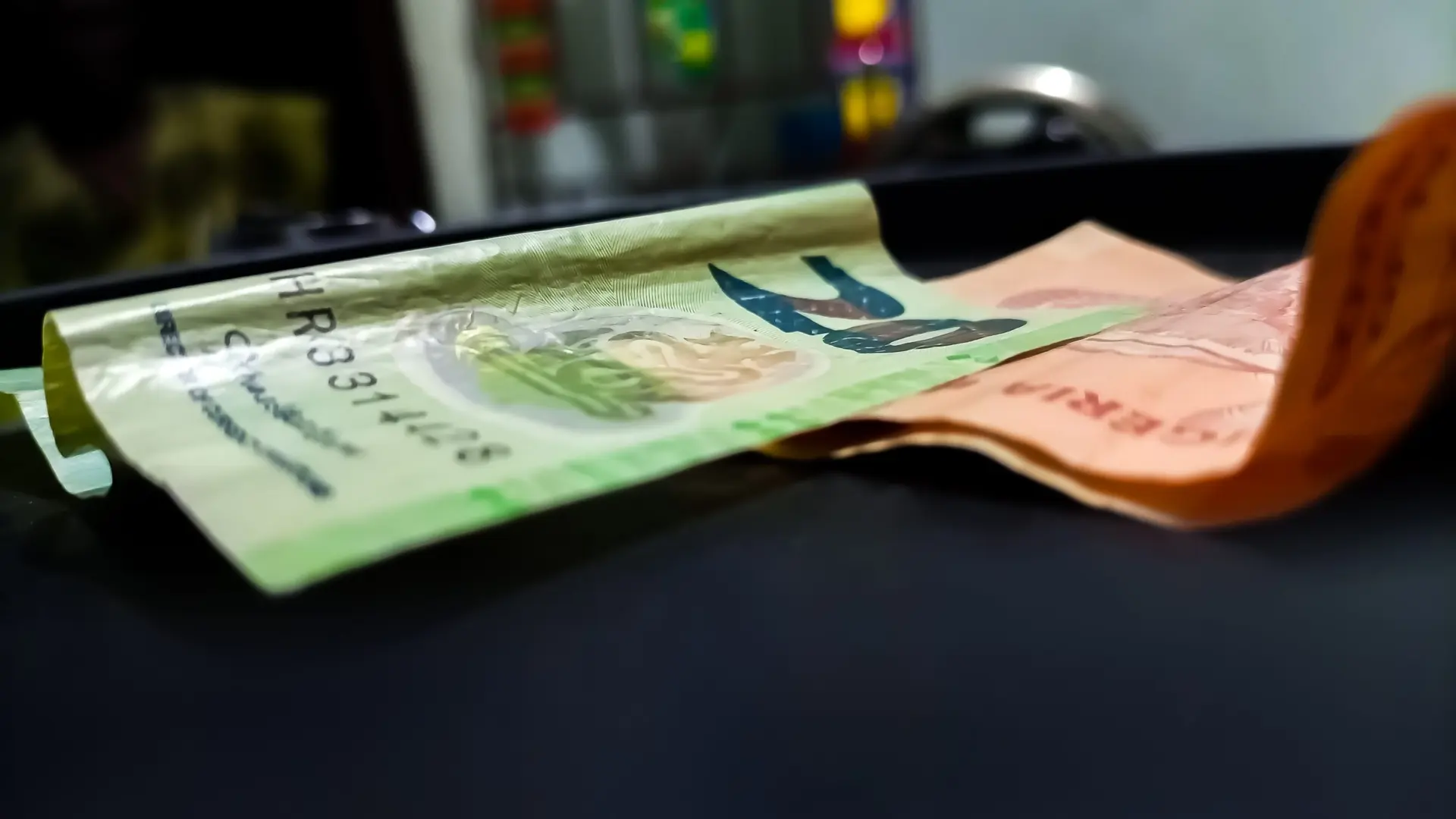
Nigeria’s minimum wage disputes are fiscal disputes before they are labour disputes. When state governors said in November 2018 that a monthly floor of N30,000 would bankrupt them, and when the same argument returned over the N70,000 floor enacted in July 2024, they were describing a federation that concentrates revenue at the centre while most of its 36 states cannot pay their own wage bills without federal transfers. The number changes with each round. The structure that produces the conflict does not.
The numbers behind the 2019 settlement
The economic setting was severe. In the World Bank’s World Development Indicators, measured in current US dollars, Nigeria’s GDP per capita fell from about $3,089 in 2014 to about $1,876 in 2017, a drop of nearly two-fifths. Much of that fall reflects the devaluation of the naira after the oil price collapse, so it is not a direct measure of real living standards. It does show how far the dollar value of the economy, and of state revenue tied to oil, contracted before any new wage law was tabled.
Poverty estimates pointed the same way. A Brookings Institution analysis published on 19 June 2018, drawing on modelled projections from World Data Lab’s World Poverty Clock, estimated that about 87 million Nigerians lived in extreme poverty by May 2018, against about 73 million in India. It was a projection rather than a survey count, but it made Nigeria the country with the largest number of people below the extreme poverty line.
Labour’s opening position dated from April 2016, when the Nigeria Labour Congress and the Trade Union Congress asked the federal government to raise the floor from N18,000 to N56,000 a month. During the 2018 negotiations the unions raised their figure to N66,500. The tripartite committee chaired by Amal Pepple recommended N30,000 in November 2018, the National Assembly passed the bill in March 2019, and President Muhammadu Buhari signed the National Minimum Wage Act into law on 18 April 2019. The settled figure was about 54 per cent of labour’s 2016 demand. Even so, it proved politically explosive.
Why governors pleaded poverty
After an emergency meeting of the Nigeria Governors’ Forum in Abuja on 14 November 2018, its chairman, Zamfara State Governor Abdulaziz Yari, told reporters that paying N30,000 without cutting staff or revising the federal revenue-sharing formula was impracticable. “We will be bankrupt,” he said, according to The News Nigeria, adding that only Lagos and Rivers states could afford it.
The warning had a recent precedent. By mid-2015, after oil revenue collapsed, 27 of the 36 states had fallen behind on civil-service salaries and pensions, some by more than a year. The arrears covered staff at every grade, not only workers on the N18,000 floor. The federal government responded with a Central Bank of Nigeria bailout facility, announced in July 2015 with an initial N338 billion and disbursed from August that year. The Independent Corrupt Practices Commission later monitored how states used the funds.
The governors’ position was structurally coherent but, labour argued, selective. In briefings and rallies between October 2018 and May 2019, NLC President Ayuba Wabba and other union leaders answered the bankruptcy claim by pointing to governors’ convoys of luxury vehicles, frequent chartered and foreign travel, large teams of political aides and unaudited security votes. Labour’s case was not that the revenue figures were false. It was that state budgets reflect political priorities, and that executive spending had been protected while wage bills were treated as unaffordable. The scale of that spending is examined in our analysis of the cost of governance in Nigeria.
Two levels of failure, fiscal and institutional
The first failure is fiscal. In most states internally generated revenue is small and the monthly federal allocation is the main source of income. That leaves state governments dependent on oil prices and on federal goodwill, and neither is reliable. When oil revenue contracts, as it did sharply in 2014, wage bills are among the first obligations to slip.
The second failure is institutional. A wage law without enforcement is a statement of intent. After 2019, states implemented the N30,000 floor and its consequential adjustments on timelines of their own choosing, with uneven compliance. South Africa offers a contrast in design. Its first national minimum wage took effect on 1 January 2019 at R20 an hour, with defined exemptions and enforcement provisions. Countries that raise wage floors without large job losses tend to rely on labour inspection, transparent business registration and courts that make non-compliance costly. Nigeria has the statute. It has not built the enforcement system that gives the statute force.
Nigeria’s minimum wage revision of 2024 repeats the pattern
On 29 July 2024 President Bola Tinubu signed the National Minimum Wage (Amendment) Act 2024. It raised the floor from N30,000 to N70,000 a month and shortened the review cycle from five years to three, which puts the next statutory review in 2027. Enactment again did not mean payment. The NLC set a 1 December 2024 strike deadline for states that had not implemented the new wage. Most states then approved it in late 2024 and early 2025, and about 20, including Lagos, Rivers, Edo and Adamawa, announced rates of N71,000 to N85,000. Unions continued to report delays in consequential adjustments, pension arrears and payment at local-government level. The cost-of-living pressure behind labour’s demand is set out in our October 2024 analysis of Nigerian workers’ wages.
What wage promises do in a federation
The 2019 campaign showed the political use of wage floors. In November 2018 the Peoples Democratic Party candidate, Atiku Abubakar, said he had raised pay across his own companies to a minimum of N33,000, above the tripartite figure. The African Action Congress candidate, Omoyele Sowore, promised at rallies and in a televised debate in October 2018 to set the national minimum wage at N100,000. Such pledges are made at the national level, while the cost falls on state treasuries, where scrutiny is weakest and attention easiest to divert.
The minimum wage conflict is a problem of architecture rather than of any single number. A federation that has not settled how states raise their own revenue, a question at the centre of the restructuring debate, and has not built institutions to enforce wage law, will repeat this dispute at every review. Labour will demand rises that track living costs. Governors will cite fiscal incapacity while, labour argues, spending at rates that contradict that claim. Workers will receive what the law guarantees on timelines set by political calculation. With the next review due in 2027, the same test is already scheduled.



