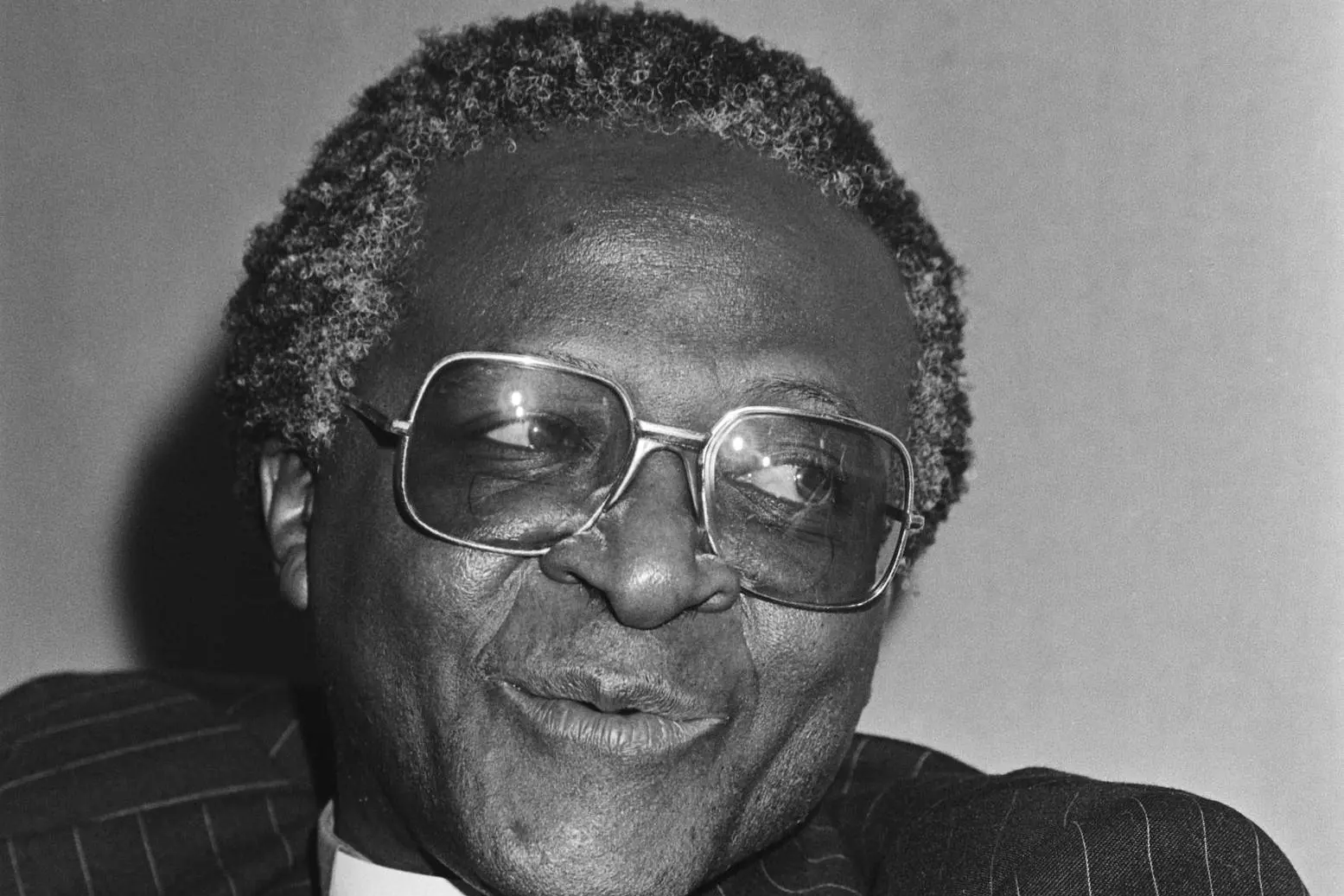
Desmond Tutu made the Anglican Church one of apartheid’s most persistent opponents by insisting that his quarrel with the system was religious before it was political. A BBC profile in 2010 recorded that he repeatedly told the government its racist approach defied the will of God and so could not succeed.
That conviction carried him from a Krugersdorp classroom to the Nobel Peace Prize in 1984, the archbishopric of Cape Town in 1986 and the chair of South Africa’s Truth and Reconciliation Commission. It also left him free to criticise the governments that followed apartheid. In February 2020, when this profile was written, he was 88 and had been formally retired from public life for nine years.
From the classroom to the priesthood
Tutu was born on 7 October 1931 in Klerksdorp, in the Transvaal, to Xhosa and Tswana parents. His father was a teacher. He was accepted to study medicine at the University of the Witwatersrand but could not obtain a bursary, South African History Online records, so he trained as a teacher and began work in 1954 at his old high school in Krugersdorp. One of those who helped him with his university studies was Robert Sobukwe, the first president of the Pan Africanist Congress.
On 2 July 1955 he married Nomalizo Leah Shenxane, and they had four children. He left teaching in 1957, after the Bantu Education Act of 1953 had enforced racial separation in every school and college. In 1958 he enrolled at St Peter’s Theological College in Johannesburg. He was ordained a deacon in December 1960 and a priest a year later.
In 1962 he moved to London to study at King’s College, where he took a master’s degree in 1966. He returned to teach at the Federal Theological Seminary at Alice in the Eastern Cape and then at the University of Botswana, Lesotho and Swaziland. In 1972 he went back to England as associate director for Africa of the Theological Education Fund, a post that sent him travelling across the continent.
A churchman against apartheid
Tutu came home in 1975 as the first black Anglican Dean of Johannesburg. On 6 May 1976, weeks before the Soweto uprising, he sent an open letter to the prime minister, John Vorster, on the pass laws, the homelands and racial discrimination, and asked for a national convention of recognised leaders. The government replied that his motive was political propaganda.
He was Bishop of Lesotho from 1976 to 1978 and general secretary of the South African Council of Churches from 1978 to 1985, the first black person to hold the post. From it he pressed for non-violent protest and for foreign economic pressure on Pretoria. The government withdrew his passport in March 1980 and returned it in January 1981. It meant he could not travel to accept the honorary doctorate of the Ruhr University in West Germany, the first that university had awarded.
The Norwegian Nobel Committee gave him the 1984 Peace Prize “for his role as a unifying leader figure in the non-violent campaign to resolve the problem of apartheid in South Africa”. It said the award was also a gesture of support for the Council of Churches. In his Nobel lecture of 11 December 1984 Tutu said: “There is no peace in Southern Africa. There is no peace because there is no justice.”
In 1985, at the height of the township uprisings, he became Johannesburg’s first black Anglican bishop. In 1986 he was elected Archbishop of Cape Town, the head of the Anglican Church in southern Africa. A year later the All Africa Conference of Churches elected him its president, with 147 of the 184 votes cast. From 1988 he was chancellor of the University of the Western Cape. He was presiding over the synod in 1992 when it voted by a 79 per cent majority to open the priesthood to women.
Truth and reconciliation
Tutu welcomed the reforms President FW de Klerk announced after taking office in 1989, which included lifting the ban on the African National Congress (ANC). Nelson Mandela left prison in 1990. As the country moved towards the 1994 election and majority rule, Tutu promoted the idea of South Africa as “the Rainbow Nation”.
In November 1995 President Mandela asked him to head the Truth and Reconciliation Commission. Its task was to gather evidence of apartheid-era crimes committed on all sides and to recommend whether those who confessed should receive amnesty. He retired as archbishop in 1996 and became archbishop emeritus. He said he had been “appalled at the evil we have uncovered”, the BBC recorded in a profile published in 2010. Africa 360° has examined what the commission left unresolved.
A critic of governments after apartheid
The claim that his motive was religious and not political outlasted apartheid. Delivering the Nelson Mandela lecture on 23 November 2004, Tutu criticised what he saw as a lack of debate inside the ANC. He said that “unthinking, uncritical, kowtowing party line-toeing is fatal to a vibrant democracy”, the Irish Times reported. President Thabo Mbeki called the criticism ill-informed. In October 2011, when the Dalai Lama cancelled a visit to Cape Town for want of a visa, Tutu attacked the ANC and President Jacob Zuma, South African History Online records.
He did not stop at South Africa. He urged George W Bush and Tony Blair to admit that the war in Iraq was a mistake and accused Israel of practising apartheid in its policies towards the Palestinians, the BBC noted in a 2010 profile. He chaired the Elders, the group of former leaders founded by Mr Mandela in 2007, until May 2013. At the launch of a United Nations gay equality campaign in Cape Town on 26 July 2013 he said, as Al Jazeera reported: “I am as passionate about this campaign as I ever was about apartheid.”
Retirement, books and honours
On 22 July 2010 Tutu announced that he would withdraw from public life on 7 October, his 79th birthday. The time had come, he said, “to slow down, to sip Rooibos tea with my beloved wife in the afternoons, to watch cricket, to travel to visit my children and grandchildren”. He said he would keep working with the Elders and step down from his positions at the University of the Western Cape.
His books include The Divine Intention (1982), a collection of lectures; Hope and Suffering (1983), a collection of sermons; No Future Without Forgiveness (1999), a memoir of the commission; God Has a Dream (2004); and Made for Goodness (2010).
The United States named him a recipient of the Presidential Medal of Freedom in July 2009. In 2012 the Mo Ibrahim Foundation gave him a one-off award, with a grant of $1 million, for his lifelong commitment to speaking truth to power. The 2013 Templeton Prize, worth £1.1 million, recognised his “life-long work in advancing spiritual principles such as love and forgiveness”. He was made an honorary Companion of Honour in 2015 and a Bailiff Grand Cross of the Order of St John in September 2017.
Two tributes were closer to home. Munsieville, the Krugersdorp township where he grew up, has a public library that bears his name. In June 2018 scientists named Tutusius umlambo, a Devonian four-legged vertebrate known from a fossil found at Waterloo Farm near Grahamstown, in his honour.



