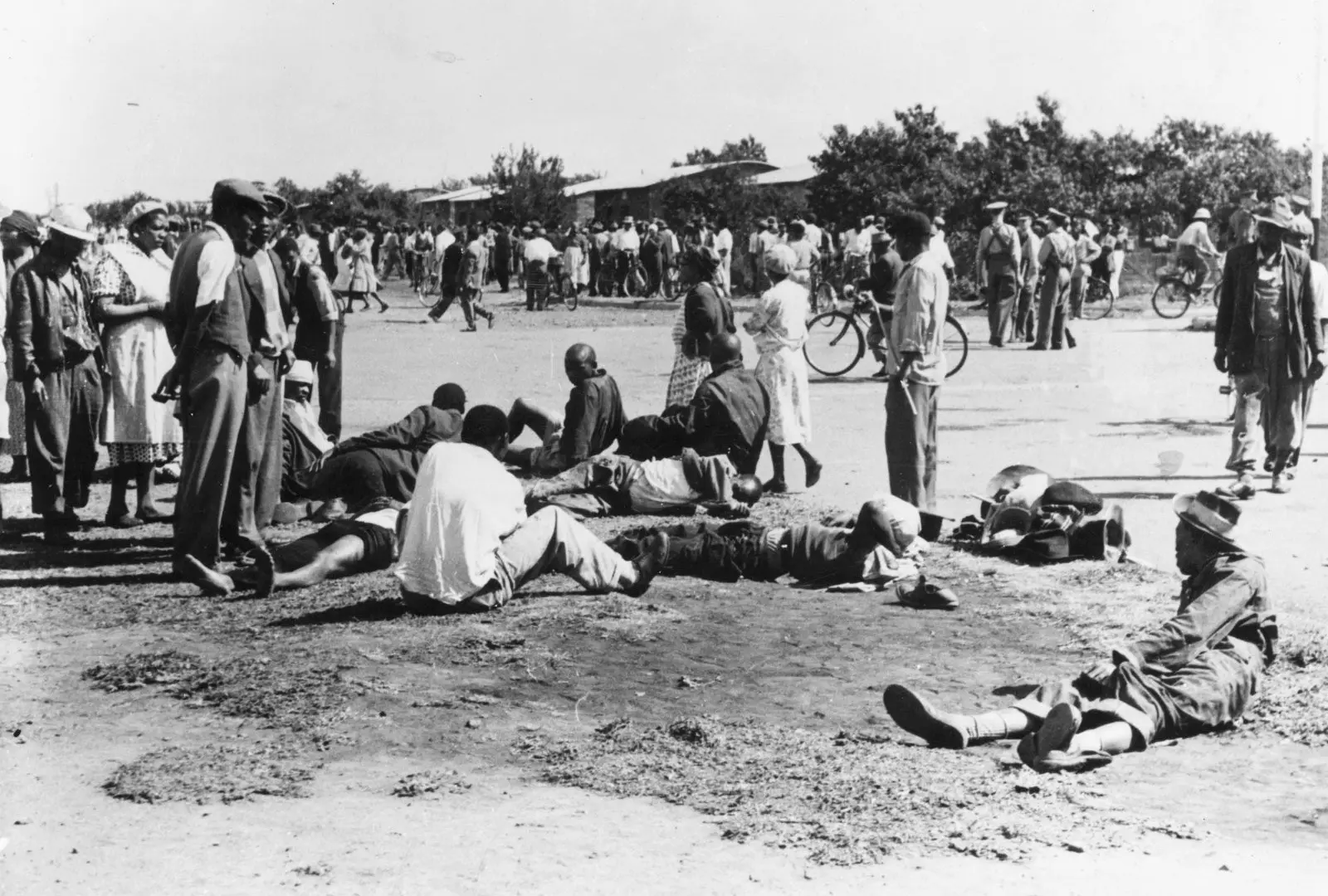
The shootings at Sharpeville were reported around the world. They marked a shift in South Africa’s liberation movement and led the United Nations to recognise apartheid as a human rights violation. The man who called the protest that ended in massacre, Robert Sobukwe, paid for it with the rest of his life.
The protest was aimed at the pass laws, the apartheid state’s main tool for controlling where black South Africans could live and work. Governments had restricted the movement of black people into the cities since the eighteenth century, and the rules were updated in the 1950s. Under the National Party, every black resident of an urban district over 16 had to carry a passbook. It held an identity card, a labour bureau’s permission to work and stay in the area, the employer’s name and address, and a personal history. In the years before Sharpeville, the government of Dr Hendrik Verwoerd used the system to push segregation further, and in 1959 to 1960 extended it to women. From the 1960s the pass laws were the state’s main instrument for detaining and harassing its political opponents.
In 1952 the Natives (Abolition of Passes and Co-ordination of Documents) Act entrenched the system. Despite its name, it did not end passes. Africans were instead told to carry a single reference book with their photograph, employment record and personal details, and not carrying it was treated as a criminal offence.
The PAC breaks away
The Pan Africanist Congress (PAC) was founded in 1959 by members of the African National Congress (ANC) who were unhappy with its internationalist approach and with the imprisonment of many of its leaders. The ANC held that South Africa belonged to all who lived in it. Sobukwe, who became the PAC’s leader, and his followers wanted Africans to come first. He had edited The Africanist, a journal that argued for protest and non-cooperation with the white authorities.
The PAC accused the ANC of betraying its principles by working with other racial groups. It opposed communism and any alliance with whites, and held that Africans should control their own destiny and answer to no one. The ANC rejected this philosophy and kept its doors open to members of all races.
The ANC was preparing a campaign of protests against the pass laws, due to begin on 31 March 1960. The PAC decided to move first and launched its own campaign ten days earlier, on 21 March.
The campaign was meant to be peaceful resistance to the passbook. Black South Africans would leave their passes at home and present themselves at police stations to be arrested. Sobukwe reasoned that if thousands of black workers were arrested, the economy would come to a standstill and the apartheid government would be forced to reconsider.
The massacre
On the morning of 21 March 1960, thousands joined the campaign in segregated townships including Sharpeville in Vereeniging, south of Johannesburg, Orlando in Soweto and Langa in Cape Town. At Sharpeville the mood was at first peaceful, even festive, as an unarmed crowd of about 5,000 gathered in front of some 300 police. A small scuffle broke out and a policeman was accidentally pushed over. Accounts differ on whether the police first tried tear gas and batons. At about 13:00 officers tried to arrest a protester, and the crowd surged forward. The shooting began soon afterwards. By the official count, the police killed 69 people, including 8 women and 10 children, and wounded 180, including 31 women and 19 children. Many were shot in the back as they turned to flee, and some were left paralysed.
Prison and the Sobukwe Clause
On 4 May 1960 Sobukwe was sentenced to three years in prison for inciting Africans to demand the repeal of the pass laws. He refused a lawyer and would not appeal, arguing that the court had no jurisdiction over him because it was neither a court of law nor a court of justice. As his sentence came to an end on 3 May 1963, Parliament passed a General Law Amendment Act. It contained what became known as the Sobukwe Clause, which allowed the Minister of Justice to extend the detention of any political prisoner indefinitely.
Sobukwe was moved to Robben Island and held there for six more years. The clause was never used against anyone else. He lived apart from the main prison, in solitary confinement and without contact with other prisoners, though he was allowed books and civilian clothes. He spent much of the time studying and earned a degree in economics from the University of London. In 1964 the US civil rights organisation NAACP and the Montgomery Fellowship for Foreign Aid in the United States offered him work. He applied to leave the country with his family to take it up, but the then Minister of Justice, John Vorster, refused.
Life after Robben Island
Sobukwe was released in May 1969 and banished to Galeshewe in Kimberley, where he was reunited with his family. He remained under twelve-hour house arrest, and his banning order barred him from any political activity.
In 1970 he won a teaching post at the University of Wisconsin in the United States. The apartheid government refused him a passport, even though the US government had assured him of a visa. When he applied in 1971 to leave South Africa permanently with his family, he was refused again.
Under house arrest he began to study law. He completed his articles in Kimberley and opened his own law firm in 1975. The Department of Justice at first barred him from the courts, then withdrew the ban.
Illness and death
Soon after he began practising, Sobukwe fell ill. In July 1977 he asked for permission to seek treatment in Johannesburg and was refused. Only after Benjamin Pogrund, a close family friend, intervened was he allowed to leave Kimberley for Johannesburg, under strict conditions, on 9 September. He was diagnosed with lung cancer, and his condition was serious. He was then moved to Groote Schuur hospital in Cape Town, where the security branch told staff to admit no visitors except his family. His wife applied to the Cape magistrate for him to stay with a family friend, Bishop Pat Matolengwe. Permission was granted, but only after delays.
Each time he left Kimberley he had to report to the police, and again whenever he arrived in or left Cape Town. By insisting that he keep to the terms of his restrictions as his health visibly failed, the government made his treatment harder.
Sobukwe died of lung complications at Kimberley General Hospital on 27 February 1978. His funeral was held on 11 March 1978, and he was buried in Graaff-Reinet.
Legacy and memorial
His family set up the Robert Mangaliso Sobukwe Trust to revive his legacy. Its main project is a museum and learning centre in his name in Graaff-Reinet.
In 2017 the University of the Witwatersrand in Johannesburg, where Sobukwe taught African Studies in the 1950s, renamed its Central Block the Robert Sobukwe Block.
In South Africa, 21 March is a public holiday, Human Rights Day. It commemorates the Sharpeville massacre of 1960, which became a catalyst in the fight against apartheid, and Sobukwe remains a celebrated figure in the struggle for a democratic South Africa.



