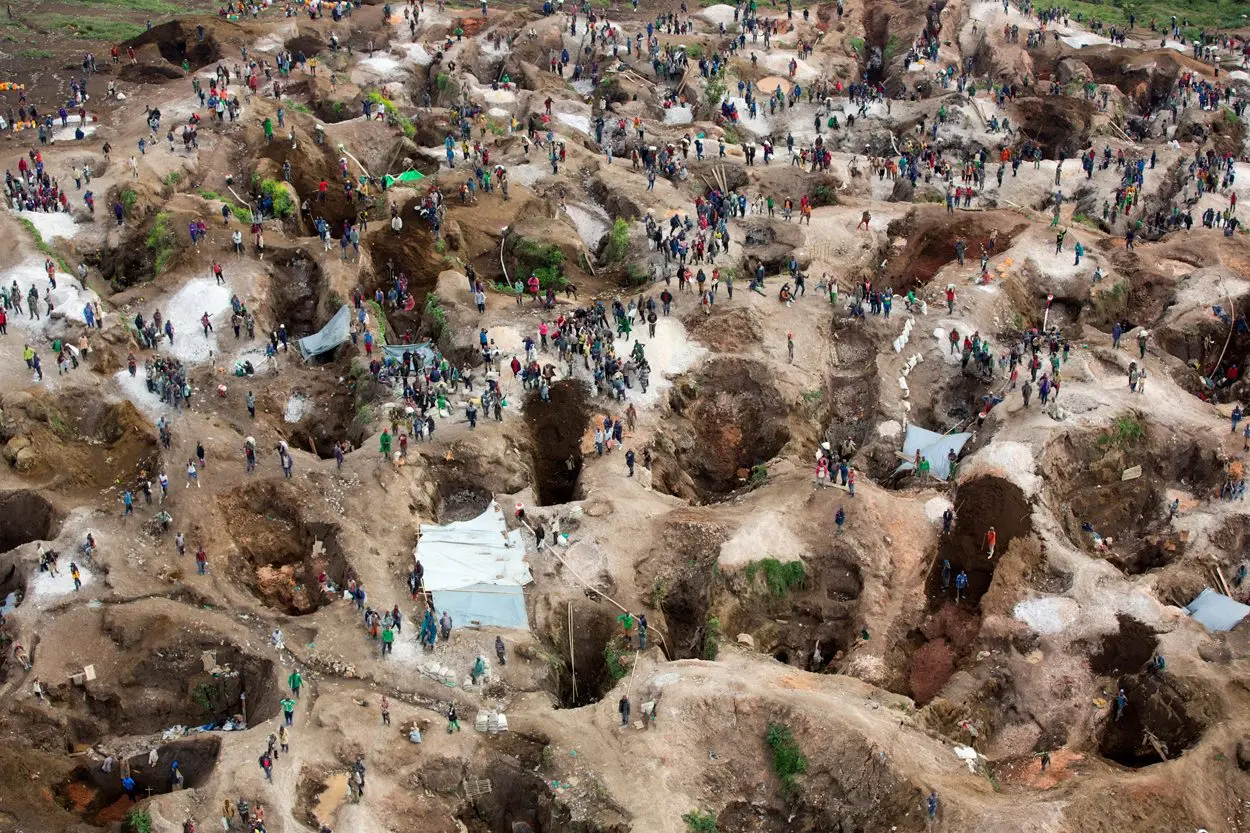
Congo’s mineral wealth has not shielded its people from conflict or poverty, and the reasons differ by region. Congo conflict minerals, chiefly gold and the tin, tantalum and tungsten ores dug by artisanal and semi-industrial miners in North Kivu, South Kivu and Ituri, finance armed groups through taxation and smuggling. The industrial copper and cobalt belt of Haut-Katanga and Lualaba, more than 1,000 kilometres south of Goma, feeds global battery supply chains and raises a different set of questions about contracts and corporate conduct. Accountability has to fit each.
Congo conflict minerals and the war economy
More than 120 armed groups operate across the eastern provinces, according to mapping by the Kivu Security Tracker, a project of the Congo Research Group and Human Rights Watch. Their violence looks chaotic from outside. Successive reports by the UN Group of Experts on the DRC describe something more organised: groups embedded in wider political, regional and commercial networks. The experts’ reporting on M23 documents a structured military command, a parallel civil administration and cross-border mineral smuggling, with backing from the Rwanda Defence Force. Rwanda denies supporting M23.
M23 took Goma on 28 January 2025 and Bukavu on 14 February. On 21 February the Security Council unanimously adopted Resolution 2773, which condemned the M23 offensive in North and South Kivu “with the support of Rwanda Defence Forces (RDF)” and called on Rwandan forces to cease support for M23 and withdraw from Congolese territory without preconditions.
The money comes from several streams. Roadblock mapping by the International Peace Information Service and UN Group of Experts investigations show armed actors, and some state security units, raising revenue through mineral trading, checkpoint tolls, market levies and direct control of mining and transport. The share from each varies by group and place. Some groups rely mainly on road tolls where there are no mines; others depend on gold or coltan. After M23 seized the Rubaya coltan area in North Kivu in April 2024, UN experts reported that it was collecting hundreds of thousands of dollars a month in production and transport taxes. Rubaya produces roughly 15 per cent of the world’s tantalum, according to the UN experts and Global Witness.
Certification, contracts and the curse of wealth without power
Ore from these areas reaches international markets with paperwork that investigators have found unreliable. In “The ITSCI Laundromat”, published in April 2022, Global Witness alleged that the International Tin Supply Chain Initiative, the industry’s main traceability scheme for tin, tantalum and tungsten, allowed smuggled and militia-taxed minerals from eastern Congo and Rwanda to enter global supply chains under its tags. ITSCI rejected the allegations in June 2022, saying the report contained inaccuracies, misstated production tonnages and ignored its incident-reporting mechanisms.
In the south, scrutiny has centred on contracts and corporate conduct. A 2017 Carter Center review of the copper sector, “A State Affair”, found that about $750 million of the $1.1 billion generated by the state miner Gécamines from its partnerships between 2011 and 2014 could not be reliably traced to the national treasury. In 2021 the Congo Hold-up investigation, coordinated by the Platform to Protect Whistleblowers in Africa and media partners using more than 3.5 million leaked files from BGFIBank DRC, reported that at least $138 million in public funds was routed to companies and associates linked to the circle of former President Joseph Kabila. Kabila called the accusations unfounded. In May 2022 Glencore pleaded guilty in a United States court to foreign bribery charges, admitting it paid about $27.5 million through intermediaries to bribe Congolese officials between 2007 and 2018. In December 2022 it agreed to pay $180 million to Congo’s government to settle corruption claims.
Artisanal miners around Kolwezi dig ore for the same battery chains. In 2016 Amnesty International documented children and adults working there without protective equipment for one to two dollars a day, and later reports by RAID in 2021 and Amnesty in 2023 found the pattern persisted.
The UN peacekeeping mission, MONUSCO, cost more than $1 billion a year for most of its existence; its approved budget fell to about $912 million for 2024 to 2025 as it began to draw down. The UN Office of Internal Oversight Services and UN investigators have documented failures to deter or stop mass killings near peacekeeping deployments, in Beni between 2014 and 2021 and at Kishishe in November 2022, where UN investigators found that M23 had killed at least 171 civilians.
What sovereignty demands
China offers a modern precedent in mineral statecraft. Rather than remain an exporter of unrefined ore, Beijing used joint-venture technology transfer, industrial subsidies and export quotas and taxes on raw rare earths to build around 90 per cent of the world’s rare-earth refining capacity, according to the International Energy Agency, and from 2023 imposed export licensing on gallium, germanium and graphite. Africa, by contrast, still sends much of its ore abroad unrefined and imports finished goods at a premium.
Kinshasa has started to test its own leverage. On 22 February 2025 the strategic minerals regulator, ARECOMS, suspended all cobalt exports for four months to curb oversupply and support prices, the International Energy Agency records. A suspension is a blunt tool. Turning it into lasting value requires local processing zones, public oversight of mining contracts and investment in Congolese expertise, along with the transparency to resist the kind of corporate bribery the Glencore case documented. The policy choices, and the risks, sit with Congolese leaders. Power transfers and mineral wealth have not ended Congo’s instability, and an export lever alone will not change that.
The army is part of the same problem. UN Group of Experts and Congo Research Group investigations have documented pay arrears among rank-and-file soldiers of the national army, FARDC, in the east, diversion of payroll by commanders, and units taxing mine sites, running illegal roadblocks and colluding with the smugglers they are deployed to police. Reform means regular wages, discipline and a chain of command loyal to the republic rather than to factions.
For external partners, statements of concern should carry consequences. Where interference is documented, as the Security Council has found in Rwanda’s case, targeted sanctions should follow. Mining companies should face independent audits with real penalties for violations. A producer alliance of the main mineral states, akin to OPEC, could strengthen African bargaining power over prices and technology transfer. The African Continental Free Trade Area can supply a tariff-free regional framework for cross-border refining and battery supply chains built on Congo’s cobalt, but production quotas or price floors would need a dedicated alliance of producing states, not a trade pact. The conflict endures because leaders, neighbours and distant powers have all found profit in it.



