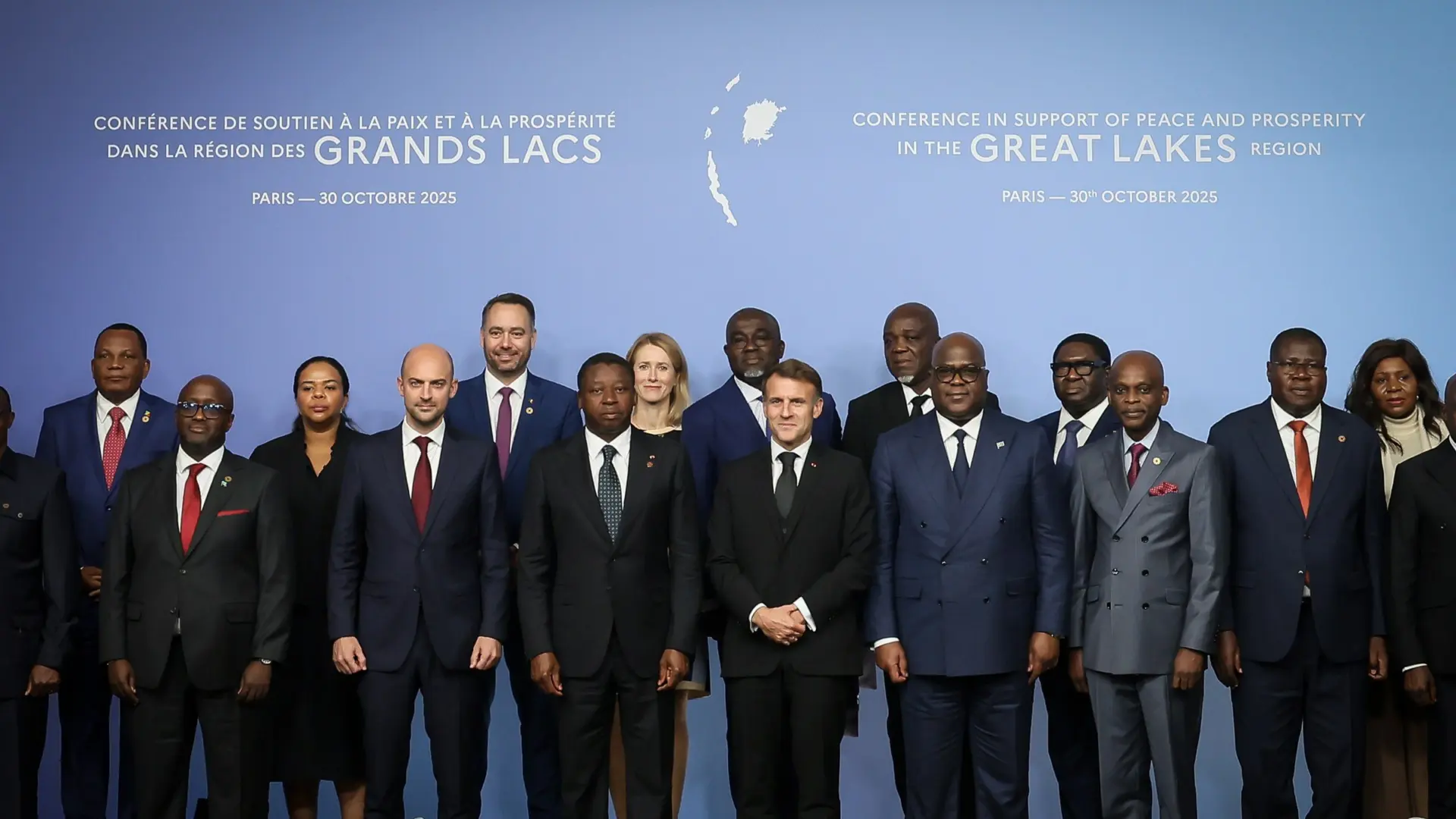
Six years after Félix Tshisekedi’s improbable rise to the presidency, the Democratic Republic of Congo remains precarious. His re-election in December 2023 reaffirmed democratic continuity on the surface. Beneath it, armed violence, institutional decay and resource exploitation run deeper than electoral processes can reach. The country that produces a large share of the world’s mined cobalt has spent thirty years in a state of structured fragility, and the reasons lie in who profits from it.
Tshisekedi’s first term began under a power-sharing arrangement with his predecessor Joseph Kabila that made coherent government nearly impossible. Kabila’s camp controlled the parliamentary majority, and Kabila loyalists occupied critical cabinet positions, the judiciary and the security services. Tshisekedi held the presidency without holding the state. The rupture of that arrangement in 2021, when Tshisekedi built a new majority coalition and moved against Kabila’s networks, turned the power transfer into an open power struggle. The institutions caught in the middle were too weak to arbitrate and too penetrated by factional interest to remain neutral.
A conflict that pays
Eastern Congo remains the central wound. The territory from North Kivu through South Kivu to Ituri has been in armed conflict for more than a quarter century, with a severe and contested human toll, and the conflict has been sustained, in part, because it is economically productive for those who manage it. The armed groups operating in the east (M23, whose support from Rwanda was condemned in Security Council Resolution 2773, the FDLR, the ADF and dozens of smaller factions) are not simply military actors. They are economic entities, taxing populations, controlling mining sites and operating logistics networks that connect the DRC’s mineral wealth to international commodity chains through routes that bypass the Congolese state and its regulators.
The DRC’s conflict is not a governance failure waiting for a governance solution. It is a resource extraction system that produces outcomes its external participants would call failure but that delivers value to the actors sustaining it.
Rwanda’s role in eastern Congo is one of the most consequential relationships in African geopolitics. Kigali denies direct support for M23. The UN Group of Experts on the DRC has documented that support in consecutive reports. The political logic of Rwandan engagement is not difficult to reconstruct. The FDLR, the Democratic Forces for the Liberation of Rwanda, composed partly of people involved in the 1994 genocide, operates from Congolese territory and represents a genuine security threat to Rwanda. Kigali’s response has been to maintain a security buffer through proxy forces rather than through diplomacy, at a cost to Congolese civilians for which the international community has not held Rwanda accountable.
A regional answer and its risks
Tshisekedi’s response to the eastern crisis has combined military posturing, regional diplomacy and appeals for international support that have produced less practical help than the scale of the crisis justifies. The deployment of Southern African Development Community (SADC) forces under a regional mandate marked a genuine shift, away from the UN mission MONUSCO, whose predecessor began in 1999, towards a regional security framework with more direct African ownership. That shift carries risks. Regional forces operate with their own national interests, and the SADC mission’s composition reflects the diplomatic alignments of southern African states rather than a neutral security calculus.
The institutional picture within Kinshasa is no less contested. The constitutional court’s validation of the December 2023 election results, despite opposition claims of irregularities and observer concerns, again places the judiciary in the position of appearing to ratify outcomes rather than adjudicate them. Running elections in a country of the DRC’s scale, infrastructure deficit and security fragmentation is genuinely difficult, and some deficiencies reflect structural constraints rather than deliberate manipulation. The distinction matters, but it does not resolve the legitimacy question that a contested result and a deferential court leave open.
Minerals and the central injustice
The mineral question sharpens the stakes of everything else. Cobalt, coltan, gold and lithium deposits in the DRC are foundational to global technology supply chains, and the shift to electric vehicles runs through Congolese mines. The smartphone, the laptop and the battery storage system are, in substantial measure, Congolese in origin. That origin is not reflected in Congolese living standards, infrastructure or institutional capacity. Whether the gap is chiefly the product of state capture, of unfavourable contract terms or of the conflict economy that controls artisanal mining, it is the central injustice of Congolese political economy, and Tshisekedi’s government has not yet shown the political will and institutional capacity to alter it.



