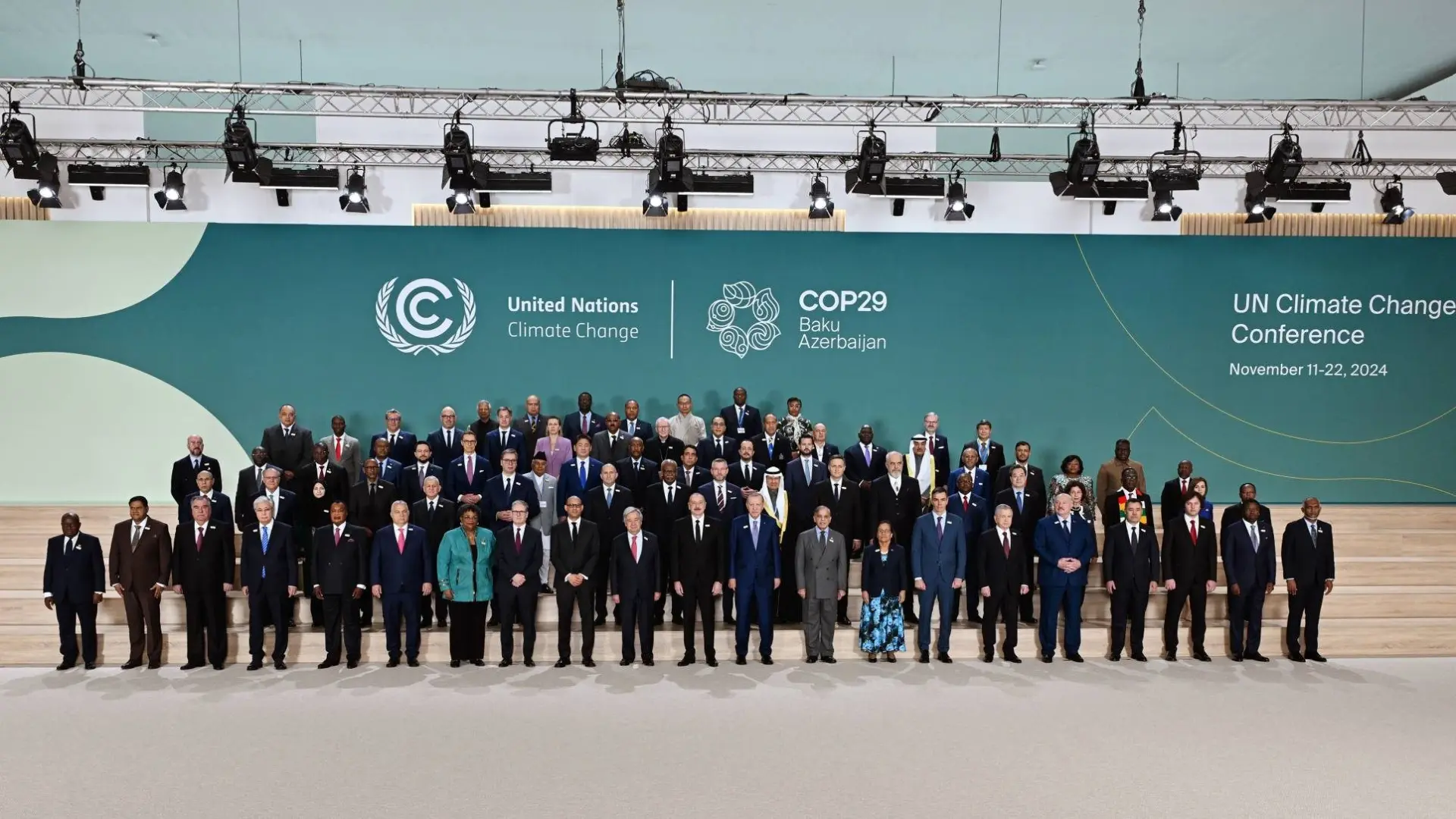
African climate diplomacy enters 2026 with less support from the largest historical emitter and a finance goal whose value depends on its terms. The United States notified the UN of its second withdrawal from the Paris Agreement on 27 January 2025, and the withdrawal took legal effect on 27 January 2026. For Africa’s most climate-exposed states, the question is no longer how much was promised at COP29 in Baku but how much will arrive as grants rather than debt, and what leverage African negotiators can bring to that argument.
What Washington withdrew
The treaty exit was only part of the change. Separately from the one-year withdrawal clock, Executive Order 14162 of 20 January 2025 directed officials to “immediately cease or revoke any purported financial commitment made by the United States under the United Nations Framework Convention on Climate Change”. It also revoked the US International Climate Finance Plan, which housed American bilateral and multilateral adaptation pledges, including the PREPARE initiative. On 27 January 2025 Secretary of State Marco Rubio told UN Secretary-General António Guterres that the United States was rescinding its outstanding pledges to the Green Climate Fund. That cancelled $4 billion of the $6 billion pledged under the Obama and Biden administrations, of which $2 billion had been paid. In January 2026 Washington also moved to withdraw from the UN climate convention itself and gave up its seat on the fund’s board.
The finance goal and its mix
COP29, held in Baku from 11 to 22 November 2024, adopted a new collective quantified goal on climate finance. Developed countries are to take the lead in mobilising at least $300 billion a year for developing countries by 2035, and all actors are called on to scale finance from public and private sources to at least $1.3 trillion a year by the same date. The $300 billion figure sounds large in isolation. The Independent High-Level Expert Group on Climate Finance, co-chaired by the economists Vera Songwe, Nicholas Stern and Amar Bhattacharya, estimated in November 2024 that emerging and developing economies other than China need $2.4 trillion a year in climate and nature investment by 2030 and $3.2 trillion by 2035. Of that, $1.3 trillion a year by 2035 would have to come from external sources.
African negotiators arrived with a clear position. The African Group of Negotiators, meeting in Nairobi in August 2024, and environment ministers at the 10th Special Session of the African Ministerial Conference on the Environment in September 2024 called for a goal anchored in grants and highly concessional public finance rather than debt-creating loans. They also sought predictable adaptation funding against an estimated adaptation need of $360 billion a year. They left with a larger headline number, but the share of grants, loans and mobilised private finance will decide how much support reaches vulnerable countries without adding to their debt.
Loss and damage showed the same gap between creation and funding. The Fund for responding to Loss and Damage, set up at COP27 in 2022 and made operational at COP28, entered Baku with roughly $700 million to $730 million in pledges. Only a small fraction had been paid in, because contributor agreements with the World Bank as trustee were still being signed during the summit.
Who is in the room
Representation at the talks is uneven. The Kick Big Polluters Out coalition counted at least 1,773 fossil fuel lobbyists granted access to COP29. That was more than the 1,033 delegates of the ten most climate-vulnerable countries combined, and more than any national delegation except those of Azerbaijan, Brazil and Türkiye. Industries whose business models depend on slower transition timelines have an obvious interest in being present. Final texts have repeatedly referred to transitioning away from fossil fuels without the phase-out dates that would give investors certainty.
A year after Baku, COP30 in Belém, held from 10 to 22 November 2025 without an official US delegation, adopted the Belém Political Package. It launched the Baku to Belém Roadmap to $1.3 trillion and called for adaptation finance to be tripled, but ended without an agreed roadmap for phasing out fossil fuels.
Africa’s climate diplomacy faces a structural asymmetry. The nations most responsible for warming have the most institutional capacity to delay accountability for it, while those least responsible carry much of the cost of inadequate ambition. African negotiators can contest that only with leverage.
African instruments and mineral leverage
African states are building their own instruments. The African Development Fund’s Climate Action Window, set up in December 2022 under the ADF-16 replenishment, directs 75 per cent of its resources to adaptation, largely as grants, for 37 low-income African countries. African Risk Capacity, an African Union specialised agency established in 2012 whose insurance affiliate has operated since 2014, pools sovereign drought and weather risk so that payouts are triggered on pre-arranged terms. Together with South-South partnerships, these reduce dependence on multilateral processes exposed to great-power defection. That is not a retreat from multilateralism. It is a hedge against its weaknesses, and it sits alongside the harder question of how debt constrains Africa’s climate response.
Critical minerals are the leverage that climate negotiations have not yet fully drawn on. Lithium, cobalt, manganese and rare earths are inputs to every major economy’s net-zero supply chain. The objection is that a buyers’ market blunts that leverage. The Democratic Republic of the Congo tested it. With cobalt prices at multi-year lows in an oversupplied market, its regulator ARECOMS suspended cobalt exports on 22 February 2025, extended the suspension to 15 October 2025 and replaced it on 16 October with an export quota system. Benchmark cobalt hydroxide prices quadrupled from their pre-ban lows, and the measure was designed to push processing investment into the country.
Linking mineral policy to climate demands, by making market access conditional on credible climate finance and fair technology terms, would carry its own risks. Coordination among African producers is untested, and one country’s export controls are not a continental negotiating strategy, as the debate over export restrictions and processing shows. But the Congolese case demonstrates that a dominant producer can move a market. The consensus on climate finance is fractured. Rebuilding it on terms that serve African interests requires a clearer view of what African climate diplomacy is for, and of the leverage behind it.



