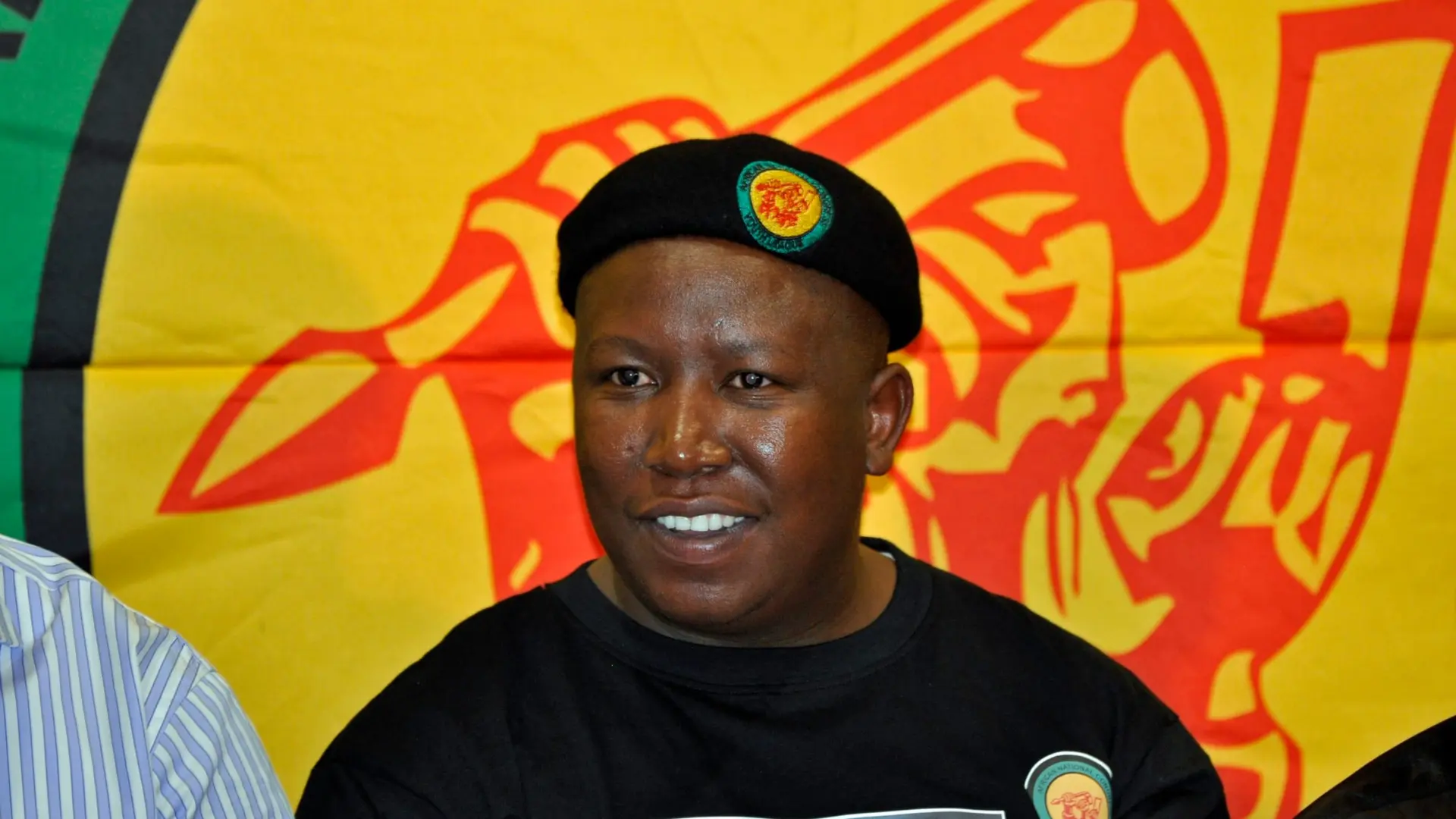
When Donald Trump dimmed the Oval Office lights on 21 May 2025 and played footage of Julius Malema leading the Kill the Boer chant, he turned a South African political song into a foreign policy weapon. The question the episode raises is not whether the chant is dangerous. It is who decides what it means, and from where. South Africa’s own courts had already given their answer, and Washington set it aside.
At the meeting with President Cyril Ramaphosa, Trump repeated claims of anti-white persecution, “white genocide” and uncompensated land seizures. Ramaphosa and his delegation, which included Agriculture Minister John Steenhuisen, disputed them. They said the constitution protects property rights, that no farms had been confiscated and that violent crime affects all South Africans.
What South Africa’s courts decided about the chant
Malema, leader of the Economic Freedom Fighters, did not invent “Dubul’ ibhunu”, “Shoot the Boer”. It is an anti-apartheid chant from the 1980s, cited in testimony at the 1985 Delmas Treason Trial and popularised in the early 1990s by ANC Youth League leader Peter Mokaba. Its revival at EFF rallies is deliberate and confrontational. It keeps the EFF, and the unfinished business of transformation, at the centre of South African politics.
The legal record is not one-sided. In September 2011 the Equality Court in Johannesburg found that Malema’s singing of the song was hate speech and interdicted him. That order was abandoned in a settlement before the Supreme Court of Appeal in November 2012. In August 2022 the Equality Court dismissed AfriForum’s complaint over six EFF performances between 2016 and 2019, finding that it had not proved they incited harm. On 28 May 2024 the Supreme Court of Appeal dismissed AfriForum’s appeal, holding that a reasonably informed observer would understand the chant, in its historical and political context, as metaphorical struggle expression. On 27 March 2025 the Constitutional Court refused leave to appeal, leaving that ruling final. The judgments turn on context. They do not approve every use of the chant.
How Musk and Trump recast the Kill the Boer chant
None of this stopped Elon Musk. After the EFF’s tenth-anniversary rally at FNB Stadium on 29 July 2023, he posted a clip of the chant and wrote: “They are openly pushing for genocide of white people in South Africa.” In March 2025 he accused the party of “actively promoting white genocide”. Trump’s path ran separately. In August 2018 he asked his Secretary of State to “closely study” land and farm seizures in South Africa. On 7 February 2025 he signed Executive Order 14204, which halted US assistance to South Africa and directed officials to prioritise refugee resettlement for Afrikaners.
Pretoria did not stay silent. Ramaphosa spoke to Musk directly in early February 2025 and rejected the claim that land was being seized arbitrarily, pointing to the constitutional and court-supervised process under the Expropriation Act of 2024. The foreign ministry responded to the executive order as “lacking factual accuracy” and the product of a “campaign of misinformation”. The episode does not reveal a country in the grip of racial terror. It reveals how post-colonial protest can be extracted from its context, amplified by figures with their own political audiences, and returned to Africa as a diplomatic problem.
Land, inequality and the EFF’s case
The structural stakes are real, even if the genocide narrative is not. South Africa’s consumption Gini coefficient of 0.63, recorded by the World Bank, is the highest in the world. Land ownership remains highly unequal. The government’s 2017 Land Audit Report found that white South Africans held 72 per cent of the 37 million hectares of farms and agricultural holdings owned by private individuals, a category covering about a third of registered land; land held by trusts and companies was not classified by race. The EFF’s base is built on that gap, among young South Africans born into formal freedom but shut out of economic participation.
Malema’s stated position is that the chant demands the return of land, not violence against white people. That distinction is the core of the EFF’s case, and the Supreme Court of Appeal accepted that reading in context. His own words have not always helped him. Outside the Newcastle Magistrate’s Court in November 2016, he told supporters the party was “not calling for the slaughter of white people, at least for now”, a remark the South African Human Rights Commission examined in a ruling of March 2019. The rhetoric is built for provocation. That is its function, and it is also why critics distrust it.
What the crime data shows
Trump’s claims about farm killings do not survive the official figures. In 2023 to 2024 the South African Police Service recorded 49 murders on farms out of 27,621 murders nationally, about 0.2 per cent, according to Africa Check’s analysis of police data. The farm count includes black and white workers and residents as well as owners. Police record where a killing happens, not its motive, and criminological research, including work by the Institute for Security Studies, identifies robbery as the main driver of farm attacks. Farm murders occur within severe rural insecurity, but aggregate totals neither establish a racial motive nor approach the legal threshold for genocide under the 1948 Genocide Convention.
The white crosses in footage shown at the White House were genuine symbols of grief. The aerial clip showed a temporary roadside memorial erected by a farming community near Newcastle, KwaZulu-Natal, in September 2020, after the murder of a farming couple. The crosses were not graves. Presented abroad without that context, they became evidence of an atrocity the data does not show.
Who interprets South African political language
The internationalisation of the controversy has concrete costs. It added friction to a relationship Ramaphosa was already trying to repair, and it displaced the argument South Africans are actually having about land redistribution, redress and the limits of reconciliation. Researchers at the Southern Poverty Law Center and the Anti-Defamation League have documented how white nationalist networks in North America and Europe use the South African “white genocide” narrative as a template for claims about their own countries.
The deeper issue is interpretive authority. Musk was born in South Africa and now has influence over American political communication. When he strips a liberation chant of its history and broadcasts it, that is an exercise of power over how African political life is understood. South Africa’s courts, at three levels of the judiciary, have produced a reading grounded in evidence and context. That reading deserves more weight than one produced in the Oval Office.
The Rainbow Nation project was always more aspirational than complete, as debates over the economic questions left by the 1994 transition and the unfinished redress of the Truth and Reconciliation Commission show. The row over the chant exposes its unfinished architecture, a political settlement that was not matched by economic redistribution, a democracy that freed the vote but not the land. The EFF presents the song as a demand for redress, and its language remains contested. That argument over land and redress, not the noise generated thousands of miles away, is the one South Africa has to settle.



