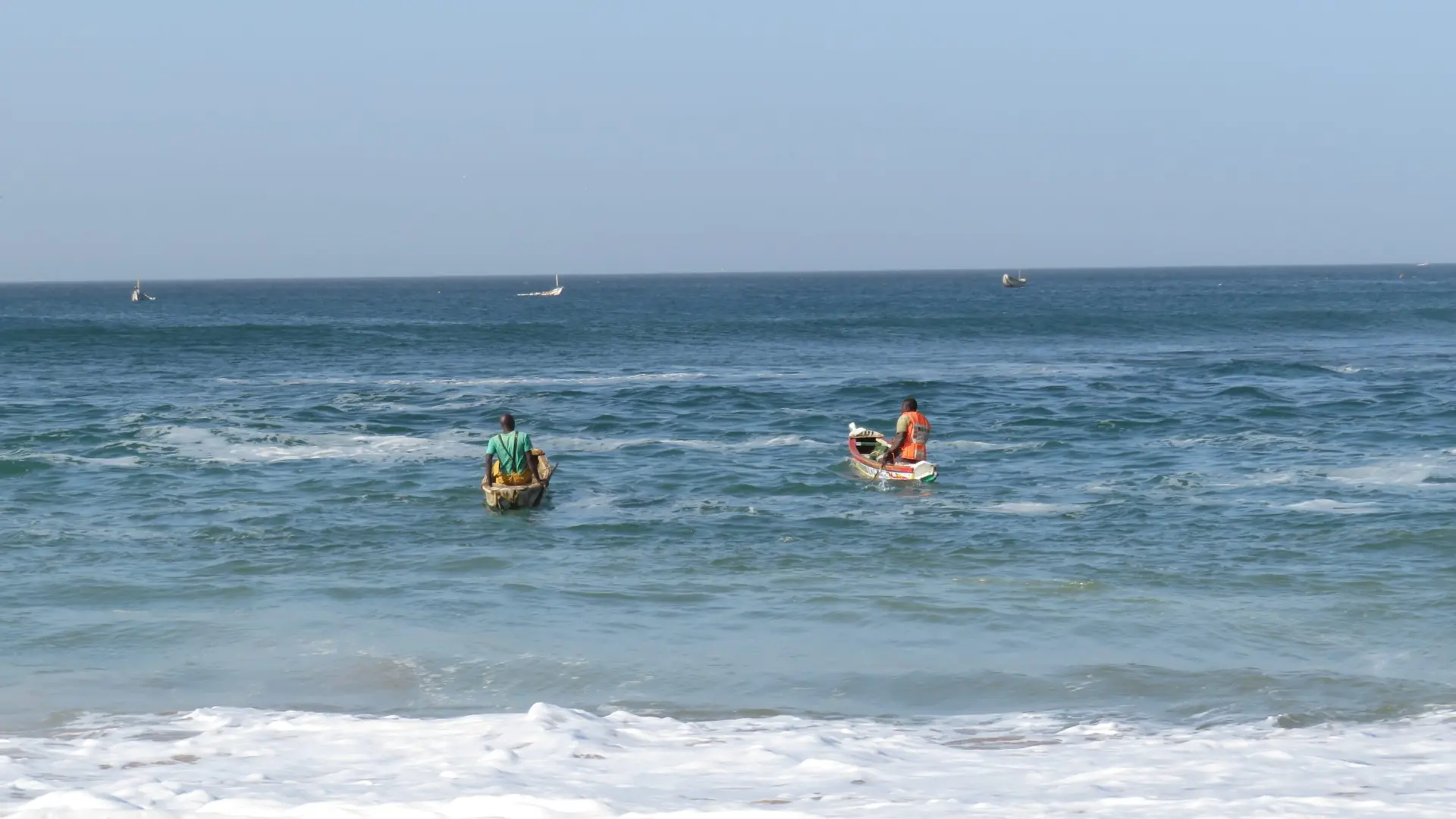
Water supports food production, transport, tourism and employment across Africa. Africa’s blue economy brings those activities into one discussion about how to earn income from oceans, lakes and rivers while protecting the ecosystems on which that income depends. Its long-term value turns on governance choices that African states are making now: who gets access to fishing grounds, how licences are issued and monitored, and how disputes across borders are settled.
The opportunity is substantial, but the resources are not unlimited. Fish stocks can be depleted, habitats damaged and coastal communities displaced by poorly planned development. Economic growth that destroys its own productive base cannot provide a sustainable future.
The term is most often associated with oceans and coasts, although inland waters also matter to African economies. Rivers and lakes support fisheries, transport and livelihoods that need their own management arrangements. Treating all water-based activity as one sector can obscure differences in ecology, ownership and regulation.
The industries behind Africa’s blue economy
Fisheries and aquaculture supply food and income, while ports and shipping connect producers with distant markets. Tourism depends partly on healthy coastal environments, and on the transport links and local demand that Africa’s tourism ambitions still lack in many places. Research into marine organisms and new technologies may create further opportunities, though their commercial promise has to be weighed against costs and environmental effects.
Transport is particularly important. A port’s value extends beyond the vessels it serves to the businesses, workers and inland routes connected to it. Security failures, delays and unreliable services can reduce those benefits.
Renewable energy, including offshore wind and tidal technologies, offers another area of interest. These are not interchangeable investments. Their viability depends on location, technology, financing and the ability to connect generation to users.
Offshore oil and gas can bring revenue, but they also create environmental and fiscal risks, as the long and contested clean-up of oil pollution in Ogoniland shows. Counting all activity around water as evidence of a sustainable blue economy would confuse extraction with conservation.
Conservation is an economic responsibility
Pollution, climate change and damage to habitats threaten fisheries, tourism and coastal settlements. Protection therefore belongs within economic planning, rather than being treated as a separate task to address after investment decisions are made.
The United Nations’ Sustainable Development Goal 14 commits states to “conserve and sustainably use the oceans, seas and marine resources for sustainable development”. One of its targets, 14.b, calls on governments to provide access for small-scale artisanal fishers to marine resources and markets. Turning that ambition into practice requires monitoring, enforcement and cooperation between the authorities responsible for different activities.
Fishing communities need a place in those decisions. Policies that protect a resource while removing people’s livelihoods without workable alternatives can undermine both conservation and public trust. Access rights, local knowledge and the distribution of benefits deserve attention alongside national revenue.
The pressure on those communities is documented. The African Union’s Africa Blue Economy Strategy, developed in 2019, warns that weak maritime governance, opaque licensing of distant-water industrial fleets and illegal, unreported and unregulated fishing in West African waters, including the Canary Current and Guinea Current ecosystems, deplete fish stocks and undermine the food security and incomes of artisanal fishers. Licensing is where that damage is decided. A government that sells access without the capacity to monitor catches transfers value away from its own coastal population.
Cooperation must reach beyond conferences
Kenya hosted the first global Sustainable Blue Economy Conference in Nairobi from 26 to 28 November 2018, co-hosted with Canada and Japan. It drew more than 18,000 participants from 184 countries, according to the Earth Negotiations Bulletin summary, and closed with the Nairobi Statement of Intent on Advancing the Global Sustainable Blue Economy. Such meetings help governments exchange knowledge and coordinate priorities. Their lasting value depends on the policies and investments that follow.
Cooperation is also necessary where resources and risks cross borders. Fishing grounds, pollution and maritime routes do not stop at national boundaries. Disputes over access can damage livelihoods and raise the cost of trade. Kenya’s own waters show the stakes. In August 2014 Somalia brought a maritime boundary case against Kenya at the International Court of Justice over a triangle of the Indian Ocean of roughly 100,000 square kilometres, rich in tuna and potential offshore hydrocarbons. The court rejected Kenya’s preliminary objections in February 2017, and the case remains unresolved. Fishing communities around Lamu and Kiunga depend on those waters while two governments contest them.
That case also shows the value of peaceful settlement. Taking a boundary to an international court is slow, but it replaces confrontation at sea with a process both states can be held to. Clear rules are economic tools as much as legal ones.
Investment in patrols and security may be necessary, but force alone cannot manage a shared ecosystem. Scientific information, accountable licensing and reliable dispute-resolution arrangements are equally important.
Africa’s blue economy can support development where investment improves livelihoods without exhausting the resources that sustain them. The practical task is to decide which activities meet that test, who receives the benefits and how the costs are managed.



