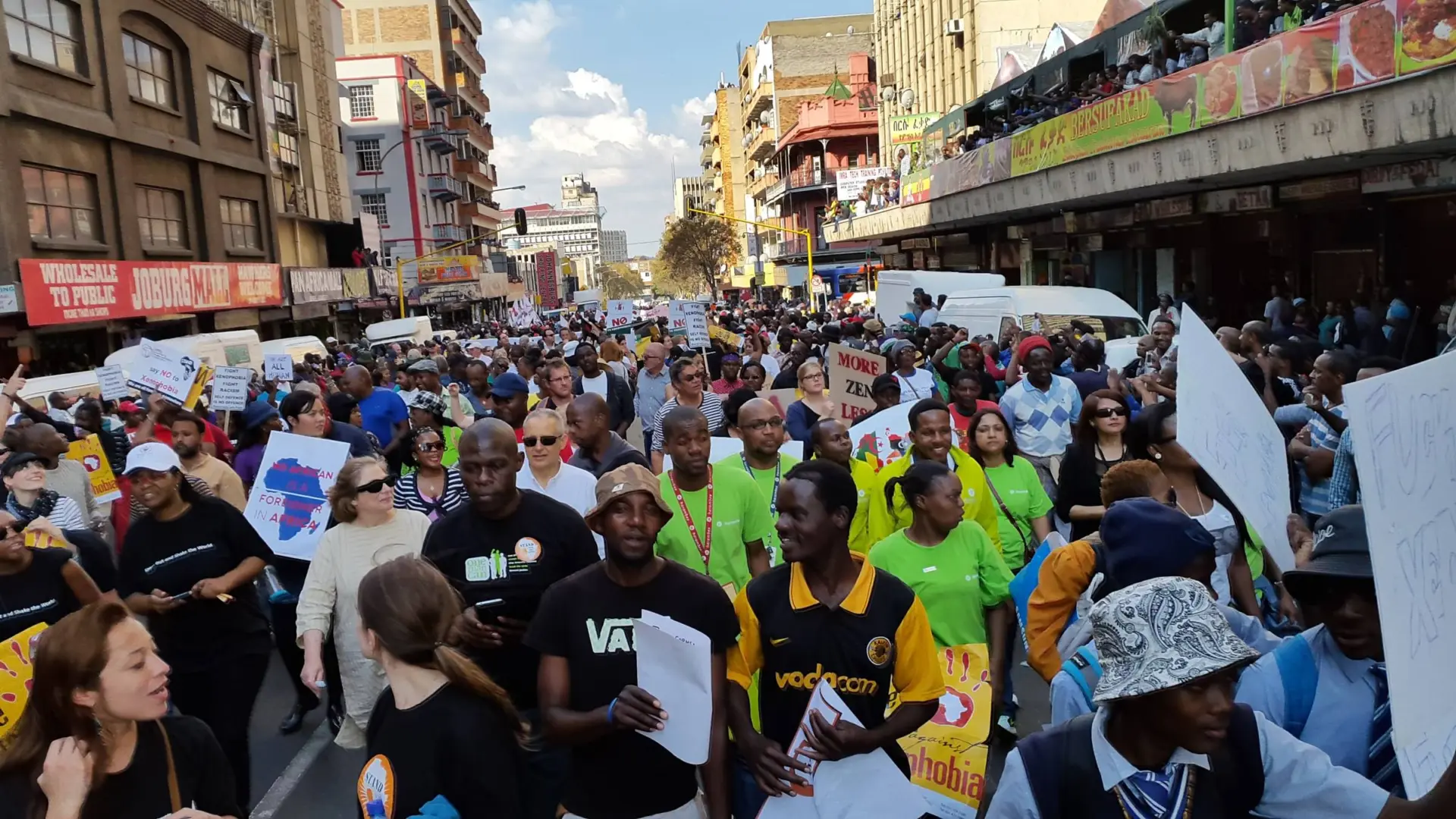
Violence targeting foreign nationals in South Africa moved beyond a domestic security story this week and became a continental diplomatic issue. Ghana, Nigeria, Kenya, Malawi, Lesotho and Zimbabwe each responded publicly, through travel warnings, diplomatic representations or direct pressure on Pretoria to contain the tensions before they deepened into a wider crisis.
This analysis argues that the violence follows a recognisable mechanism, economic hardship exploited to scapegoat migrants, and that because South Africa is a regional power built on regional labour, the contradiction it exposes is a continental problem the continent has not yet built the institutions to manage.
Why the story crossed borders
South Africa occupies a position in the region that other countries do not. It is economically dominant in several sectors, deeply embedded in regional labour flows, and home to large migrant communities drawn by opportunities unavailable elsewhere in southern Africa. Instability inside South Africa rarely remains domestic once foreign nationals become direct targets. The responses from other African governments were more than diplomatic reflex. They recognised that what happens in Johannesburg and Durban has economic and social consequences in Lagos, Accra and Harare.
Pretoria rejected broad characterisations of the country as inherently xenophobic, while acknowledging the severity of the unrest and pledging stronger protective action. The underlying tensions resist official framing because they sit at the intersection of unemployment, structural inequality, political frustration and migration pressure, none of which respond quickly to statements or policing alone.
The mechanism of scapegoating
For many migrants, South Africa remains an essential destination for work, trade and remittances, an economy that functions, however imperfectly, at a scale unavailable in most neighbouring states. For many struggling South Africans, migration has become politically entangled with competition over jobs, housing, informal trade and public services. Where politicians look for external explanations of domestic failure, that hardship can be exploited to scapegoat migrants. It does not make violence inevitable or excuse those responsible.
Named precisely, the mechanism is not spontaneous prejudice. An economy that cannot create enough formal jobs creates something else instead: a target. The migrant trader becomes the visible explanation for an invisible structural failure, and the politician who points at him is spared the harder accounting for why the failure exists. In this reading, scapegoating is not a breakdown of the system under strain but one of its release valves, cheaper than industrial policy and faster than reform, which is why it recurs.
A regional power built on regional labour
The contradiction cuts deeper because South Africa is not an incidental host. Its mines, farms and cities were built on regional labour, and its retailers, banks and brands earn across the very borders whose nationals are now being attacked. South African business draws value from continental integration at the wholesale level while migrants face attack on the street. The attacks undermine the regional cooperation from which South African businesses and workers also benefit.
From policing to legitimacy
Once embassies, foreign ministries and the African Union enter the frame, the issue shifts from policing to questions of legitimacy, regional stability and whether pan-African solidarity can be sustained in practice rather than proclaimed in principle. The shift comes at a difficult moment for South Africa, with sluggish growth, infrastructure failure, persistently high unemployment and declining public trust in institutions that promised a different trajectory after 1994. In a country of South Africa’s regional significance, migration tension used as a political pressure valve carries continental consequences.
Governments across the continent speak routinely of free movement, regional cooperation and pan-African solidarity. Those ideals meet economic insecurity and institutional fragility on the ground, and the gap shows most clearly in moments of social strain. In a region tied together by labour, remittances and economic dependency, instability within the continent’s largest industrial economy spills outward. The reckoning is not only South Africa’s to manage. It belongs to the continent, and the continent has not yet built the governance structures capable of managing it together.



