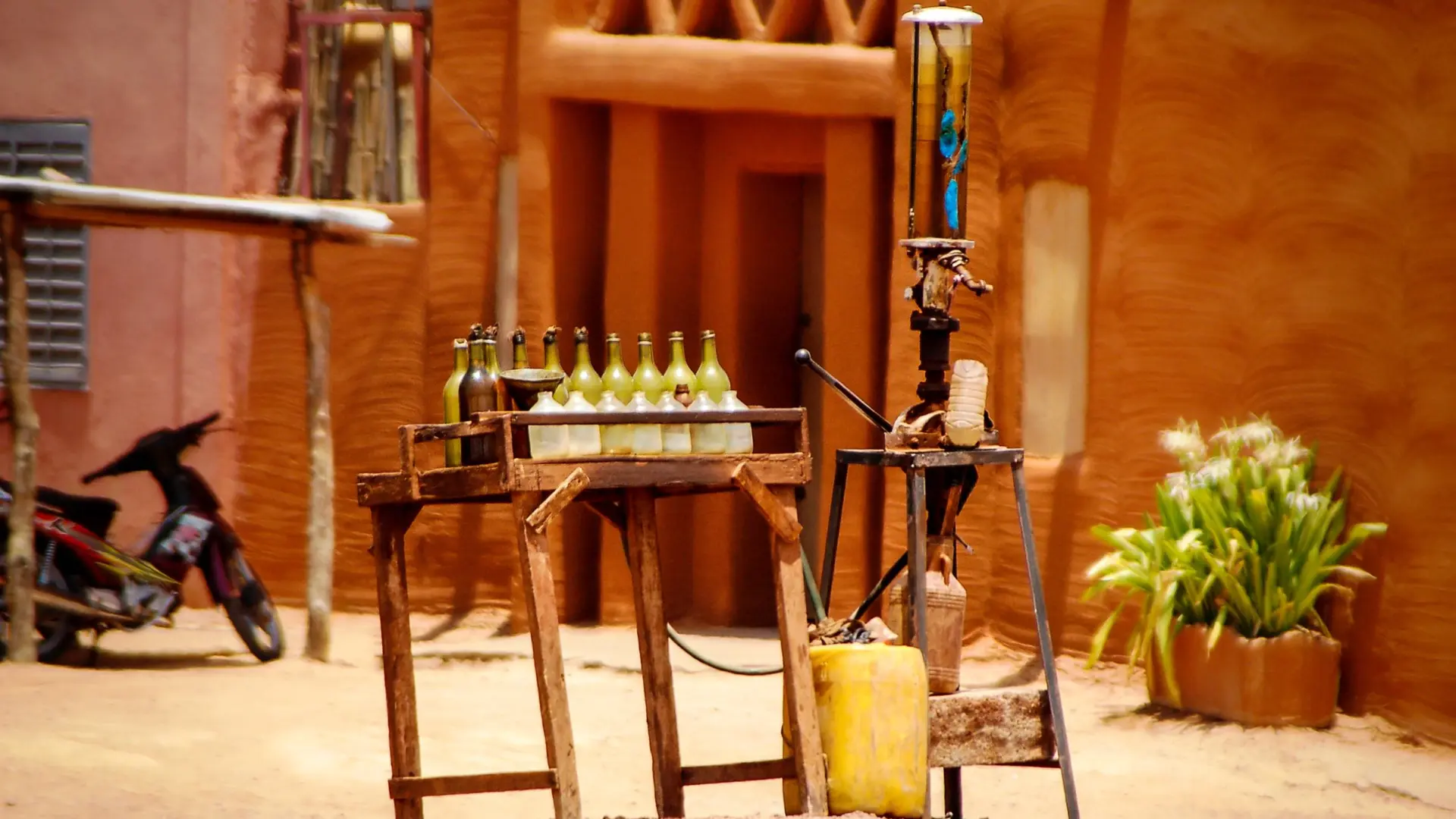
On 3 September 2025, Jama’at Nusrat al-Islam wal-Muslimin did not move on Bamako. It moved on the fuel that reaches Bamako. Over the months that followed, tanker convoys were struck along the trunk roads running in from Côte d’Ivoire and Senegal, and the capital did what no direct assault had ever made it do. Filling stations rationed. Schools closed. A city of more than three million was governed, for a period, by the arrival schedule of a fuel truck.
The significant fact is not that an armed group attacked a road. Armed groups have attacked roads in the Sahel for a decade. The significant fact is the substitution of target. Bamako was never besieged. It was supplied on someone else’s terms, and the difference between those two conditions is the difference between an insurgency that wants a city and one that has worked out it does not need to own a place to set the terms of life inside it.
That is a governing relationship, arrived at without a flag, an administration, or a single day of occupation. It is also cheap. A landlocked, import-dependent economy carries its most valuable asset in motion, on a small number of predictable routes, and the cost of interrupting motion is a fraction of the cost of holding ground. The fuel campaign tested not the state’s control of territory but its ability to keep essential supplies moving.
The cheapest weapon in a landlocked economy
Mali produces no refined fuel. Almost all of it comes in by road from two directions. FEWS NET traces roughly 60 per cent of national supply to the Côte d’Ivoire corridor and roughly 35 per cent to the Senegal corridor, which means that two highways carry approximately 95 per cent of the energy on which a country of some 24 million people runs its generators, its mills, its clinics, and its army. That concentration predates the 2025 campaign, and it leaves a landlocked state exposed to sustained attacks on its supply routes.
The campaign that began on 3 September 2025 exploited it. FEWS NET recorded more than 200 tankers destroyed by November. The UN Secretary-General’s reporting to the Security Council confirmed sustained disruption of fuel supply into Bamako, including attacks on convoys under military escort, and the shortages that followed. ACLED’s event record shows the pressure applied first around Kayes and Nioro, on the Senegalese approach, then extended to further corridors as the campaign matured. Each of those is a small tactical event. Together they are a national fuel policy written by people with no seat in any ministry.
The arithmetic nobody in Bamako can win
Consider what each side spends. Destroying a tanker requires a small team, a stretch of road chosen at leisure, and an hour. Protecting a tanker requires the state to convert its army into a haulage escort service, indefinitely, across hundreds of kilometres it does not control at night. Escort is not a solution to interdiction; it is a permanent tax that interdiction levies on the defender. And because the army must now spend itself on movement, it is not spending itself on anything else.
This is the reversal that makes the campaign interesting rather than merely destructive. Conventional counter-insurgency assumes the insurgent is the party that cannot afford attrition. On the corridor, the arithmetic inverts. The defender bears the recurring cost and must succeed on every convoy; the attacker bears a one-off cost and needs to succeed occasionally. A state can win every engagement on the Bamako road and still lose the argument at the pump, because the public does not measure security in engagements. It measures it in whether the tanker came.
The public does not measure security in engagements won. It measures security in whether the tanker came.
The pressure point crosses borders
Here the story stops being about Mali. The corridors that were attacked do not begin in Mali. They begin at the port of Abidjan and the port of Dakar, and they run for hundreds of kilometres through Ivorian and Senegalese territory before they reach a Malian customs post. The attacks have fallen on Malian roads, but the supply chain crosses several jurisdictions, and keeping it open requires cooperation across borders.
That geography has already moved cost across borders. A study by Senegal’s Direction de la Prévision et des Études Économiques, reported by the Institute for Security Studies and in Senegalese media, put the disruption at roughly 120 Mali-bound containers blocked daily at Dakar and monthly losses in the order of 15 billion FCFA. The figure belongs to the Senegalese government and should be read as its own estimate rather than an audited customs total, but the direction of transmission is not in doubt. Hauliers, freight forwarders, port labour, and insurers in a country that is not at war are absorbing the cost of a campaign waged against a neighbour.
The political geometry of this is severe. Mali, Burkina Faso and Niger withdrew from ECOWAS and built the Alliance of Sahel States on the proposition that regional bodies were instruments of external control and that sovereignty meant exit. The exit was real. The dependency was not renegotiated. The fuel still enters through the ports and roads of the states they left, which means the Alliance’s most acute physical vulnerability now runs through the jurisdiction of the organisation it repudiated. Sovereignty was measured in treaties and troop deployments. It is being tested in litres.
Nor is this a Sahelian peculiarity. Sixteen African states are landlocked, and a far larger group is functionally dependent on a single port or a single trunk route for refined fuel, fertiliser, or grain. What happened on the Bamako corridors is a demonstration, and demonstrations travel. The lesson is not that JNIM is unusually capable. It is that corridors like these are exposed, and that the exposure has now been priced.
What the corridor actually buys
It is worth being precise about the limits of this leverage, because overstating it produces bad analysis in the other direction. Corridor interdiction is not conquest and it does not substitute for it. It cannot administer, tax at scale, deliver services, or hold a population in a settled relationship of authority. It has not ended the group’s interest in ground, and the record does not support a claim that territorial ambition has been abandoned. What has changed is emphasis and, more importantly, the discovery of a second instrument that produces political effect at a fraction of the price.
What that instrument buys is conditionality. A group that can throttle supply can also release it, and the ability to release is where coercion turns into negotiation. Every period of restored flow becomes a fact about who permitted it. A group that works this way does not defeat the state. It becomes a party whose acquiescence the state’s own functioning quietly requires.
The counter is structural, not tactical, and it is unglamorous. It runs through storage, not soldiers. Strategic reserves can cushion a short interruption, although a sustained blockade can exhaust them. The time bought depends on consumption and the volume of usable stocks. It runs through route redundancy, which means investment in the Guinean and Mauritanian approaches that no one has had reason to fund. It runs through regional arrangements on corridor security among states that have just spent two years dismantling the forum in which such arrangements were negotiated. Storage and alternative routes take time and capital, and whether governments are building them can be judged only from published investment plans and reserve data.
The market on the Bamako road has been trading in something other than fuel since September. It has been trading in the question of who guarantees arrival, and the state’s bid has not been high enough. Governments across the continent describe sovereignty in the language of bases, treaties, and foreign troop withdrawals, and that language is not wrong, only incomplete. The harder measure is whether a government can promise that a thing will get where it is going. On that measure the Sahel’s military authorities have been found wanting by an adversary that never had to enter the capital to prove it, and the states that host the roads have discovered they hold an asset they never intended to own. The corridor is where the argument about African sovereignty is now being conducted, and it will be settled by whoever can afford to keep it open.



