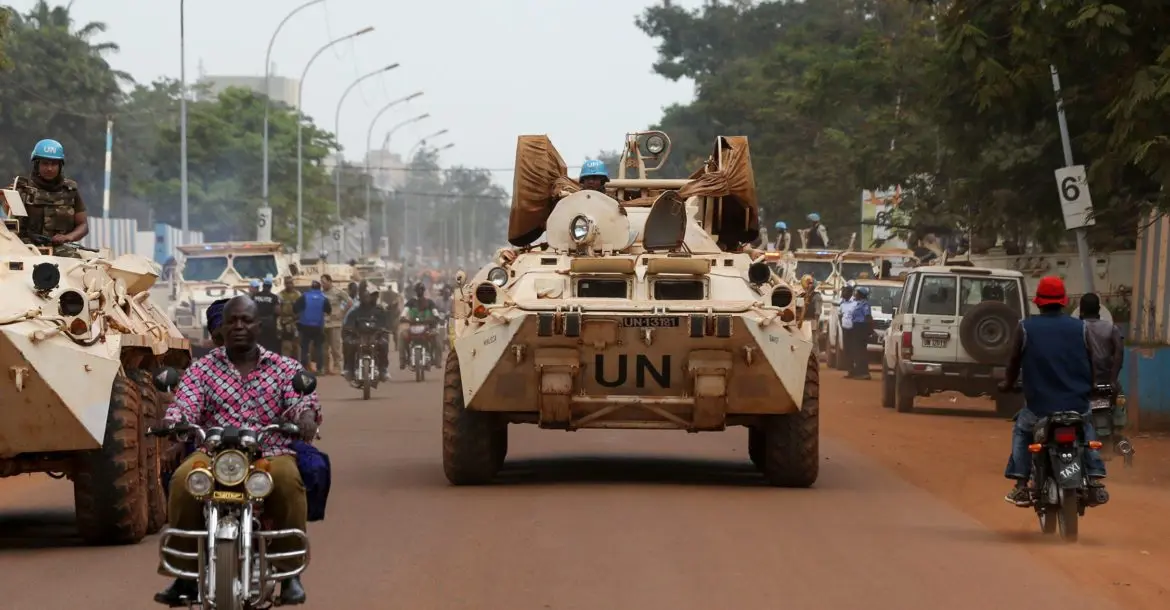
The Central African Republic (CAR) has been in turmoil since armed rebels seized power in 2013. Armed groups have since fought over most of the country, peace deal after peace deal has failed, and civilians have paid the price. In the author’s view the root of the crisis is bad government: a state that has shown again and again how weak and uncoordinated it is in confronting the armed groups.
Before the coup
Before 2012, CAR’s politics already involved several rebel factions, chief among them three armed opposition groups, the UFDR, the APRD and the FDPC. The APRD and the FDPC traditionally operated in the north-west, along the borders with Chad and Cameroon, while the UFDR was based in the north-east, on the border with Sudan. All the major armed opposition groups therefore came from the north, and their members were mostly Muslim. Between 2007 and 2012 the government signed many peace agreements with them.
In April 2007 the government and the UFDR signed a peace agreement in Birao. It granted the UFDR an amnesty, recognised it as a political party and provided for its fighters to join the army. Further talks produced the Libreville Global Peace Accord of 21 June 2008, which promised reconciliation, a unity government, local elections in 2009, and parliamentary and presidential elections in 2010.
The unity government was formed in January 2009. Security support had also changed hands. On 12 July 2008, as the Bush War wound down, the Economic Community of Central African States (ECCAS) replaced FOMUC, the force of the smaller CEMAC bloc, whose mandate was largely limited to security. Its successor, the Central African Peacebuilding Mission (MICOPAX), had a broader peacebuilding mandate (summary of the record). None of these agreements held.
The 2013 coup and its aftermath
In late 2012 Séléka, a predominantly Muslim rebel coalition backed by Chadian and Sudanese foreign fighters, began to occupy towns in the north of CAR. A short-lived peace agreement collapsed in March 2013, and the coalition took the capital, Bangui, ousting President François Bozizé. Sectarian violence and targeted killings escalated after the coup, as armed militias fought one another and took revenge on the population.
The election of President Faustin-Archange Touadéra in February 2016 brought an initial lull. Fighting resumed in late 2016 and early 2017 between armed groups, including ex-Séléka factions and anti-balaka militias, which between them controlled vast areas of the country.
By early 2019, AFP reported, 14 armed groups controlled about 80 per cent of the country. The fighting had killed hundreds and driven tens of thousands from their homes, and the attacks were taking on an increasingly sectarian character. Ex-Séléka factions were now fighting one another, in some cases alongside their former enemies. The anti-balaka, for their part, are frequently described as “self-defence” groups.
A displaced population
Violence and insecurity have forced a quarter of the population to flee their homes, and extreme poverty and the lack of basic services make living conditions worse still. As of 2017 more than 1.1 million people had been displaced in a country of about 5 million, the highest number ever recorded there. About half a million were refugees abroad and about 600,000 were displaced inside the country. Cameroon hosted the most refugees, more than 135,000. About 90% of them were Fulani, although the Fulani made up only 6% of CAR’s population.
Many Muslim communities are still displaced, especially in the west. The government has begun work to renew interfaith co-operation and ease tension between religious communities, but without proper reconciliation this has not achieved the results it sought.
The security situation remains volatile, with continued attacks on civilians, aid workers and peacekeepers. Relief agencies are working to help those affected, but insecurity and poor logistics have hampered their operations, particularly in the remoter parts of the country.
The UN response
It took a dramatic escalation in December 2013, when anti-balaka fighters attacked Bangui and brutal communal violence followed, for the outside world to grasp how serious the crisis was. Throughout 2013 Médecins Sans Frontières (MSF) had stepped up its advocacy to keep CAR on the international agenda and to demand that humanitarian aid be scaled up at once. ECHO, the European Union’s humanitarian arm, built up its own capacity in the country and took over important co-ordination tasks from the UN.
On 11 December 2013 the UN activated a system-wide Level 3 emergency response, its highest level. The upgrade was meant to let UN agencies expand their work by releasing more money, simplifying procedures and bringing in senior staff from other missions. The next day, 12 December 2013, MSF sent an open letter to Valerie Amos, the UN Under-Secretary-General for Humanitarian Affairs and Emergency Relief Coordinator, sharply criticising the UN aid system’s performance in CAR.
The gap showed most clearly in Bangui. In January 2014 OCHA estimated that more than 500,000 people were displaced in the capital alone (OCHA situation report, 7 January 2014). Fleeing the fighting between ex-Séléka and anti-balaka forces, civilians left their homes and sheltered mainly in religious compounds. Some 100,000 people camped at M’Poko airport, where the nearby international troops made them feel safer. This exodus happened in full view of the humanitarian community, yet the response was modest.
Many of the largest international NGOs and UN agencies were present in Bangui, but at first only a few mounted a proper response to the displacement. Once it was clear that people were too frightened to go home and that the camps needed a massive intervention, the agencies argued over whose job it was. In public and private meetings, UN agencies complained that they lacked implementing partners, while international NGOs said they needed more help from the UN with needs assessment, security analysis and funding.
Regional and international forces
The UN peacekeeping mission, MINUSCA, is trying to restore peace with about 11,650 soldiers and 2,080 police deployed across much of the country, according to Human Rights Watch’s World Report 2019. In November 2017 the UN Security Council approved 900 more troops, though not all of them had arrived by the end of 2018.
Under Chapter VII of the UN Charter, the mission may use all necessary means to protect civilians from the threat of physical violence and to carry out “the mission-wide protection of civilians strategy.”
Russia has also become a player. Russian civilian and military advisers arrived in December 2017 to train the national army, and some Russian instructors were posted with national forces outside Bangui.
Attacks on civilians
Human Rights Watch’s account of 2018 shows how much of the violence falls on ordinary people. Around Paoua, in Ouham-Pendé province, fighting between two armed groups, Révolution et Justice (RJ) and the National Movement for the Liberation of the Central African Republic (MNLC), killed scores of civilians between December 2017 and February 2018 and displaced up to 60,000 people. Many later went home, but fighters from both groups stayed in the area and kept threatening civilians.
In Ouaka province, on the road between Bambari and Ippy, anti-balaka fighters repeatedly clashed with the Union for Peace in the Central African Republic (UPC), a Séléka faction, and both preyed on civilians. In March, according to HRW, anti-balaka fighters killed at least 15 Peuhl herders, women and children among them. The UPC retaliated with two attacks on a church in Seko that killed an estimated 40 displaced people sheltering there.
In April a joint operation by the UN and national security forces, code-named “Sukula”, tried to dismantle the bases of “self-defence” groups in the PK5 neighbourhood of Bangui, some of them linked to Séléka. It inflamed tension between peacekeepers and those groups, and the violence that followed lasted two months and deepened the divide between Muslims and non-Muslims. At least 70 people died, some of them civilians.
Aid workers were increasingly targeted. In February unidentified gunmen killed six aid and education workers near Markounda, in Ouham province. In July, three Russian journalists were killed by unidentified attackers outside Sibut, in Kémo province. They were reportedly looking into Russia’s growing role in the country and the possible presence of Russian mercenary outfits.
The role of the African Union
On 21 March 2019 the African Union’s Peace and Security Council heard a briefing from its Commissioner for Peace and Security, Ambassador Smaïl Chergui, on talks held in Addis Ababa from 18 to 20 March 2019 between the government and the armed groups. In its press statement, the council took note of the AU Commission Chairperson’s statement of 19 March 2019 and of a joint communiqué from the AU, the UN and ECCAS.
Through Mr Chergui’s mediation, the parties that had signed the Political Agreement for Peace and Reconciliation in CAR reached a consensus on forming an inclusive government under Article 21 of that agreement.
What happened next
The February 2019 agreement, reached after AU-led talks in Khartoum between the government and 14 armed groups, was the eighth such deal since the war began in 2012, and it did not end the fighting. In December 2020 six armed groups, which together controlled about two-thirds of the country, formed the Coalition of Patriots for Change and accused Mr Touadéra of trying to rig that month’s election, which he won. Russian forces, including the Wagner Group, became the government’s main military backers, and Wagner was accused of killing at least 65 civilians in two villages in January 2022. In July 2025 the UPC and the 3R group signed agreements with the government to disarm and dissolve (summary of the record).
A 2023 referendum removed the presidential term limit, and on 28 December 2025 Mr Touadéra stood for a third term. Provisional results gave him 76.15% of the vote on a turnout of 52.42%, while the main opposition coalition boycotted the poll and two rival candidates alleged fraud, which the government denied, Reuters reported. The displacement has not ended. According to UNHCR, 737,705 refugees and asylum-seekers from CAR were living abroad at the end of September 2026, and 416,615 people were internally displaced at the end of August 2026.



