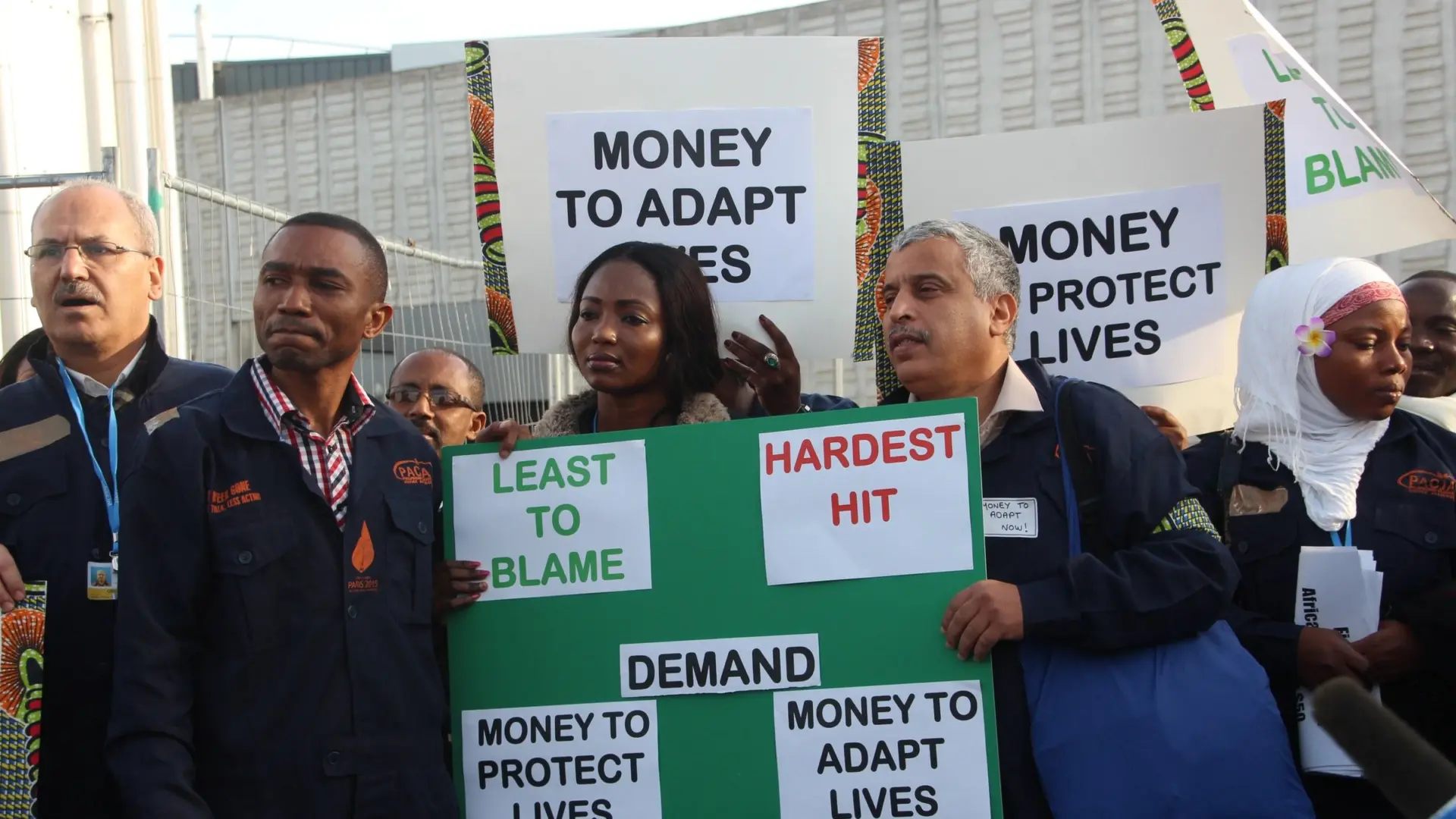
Africa’s difficulty in drawing on international climate finance is a product of design, not oversight. Accreditation demands at funds such as the Green Climate Fund, private finance that follows credit ratings and risk premiums, and slow disbursement under the Just Energy Transition Partnerships all filter out countries without the capacity to prepare bankable projects. The COP29 goal will be judged on whether its implementation changes that.
Wealthy nations pledged at Copenhagen in 2009 to provide $100 billion a year by 2020 to help developing countries address climate change. The pledge was met in a technical sense in 2022, two years late, under the OECD’s accounting framework, which includes public finance, mobilised private finance and export credits; its 2024 report recorded $115.9 billion in 2022. Africa’s share depends on the finance category, geography and period being measured; a global-flow share cannot be applied to the $100 billion pledge without matching the denominator. Africa contributes a relatively small share of historical emissions, yet it absorbs some of the most severe climate impacts on earth and holds some of the world’s largest remaining carbon sinks.
The format is the filter
The gap is a product of architecture. The Green Climate Fund requires project applications that meet procedural standards developed by multilateral development banks. Developing countries without the technical capacity to produce bankable project documentation (environmental impact assessments, financial models, risk frameworks) can struggle to obtain funding even where projects have merit, because preparing an application requires staff, data and technical expertise. The format is the filter, and the filter was not built with African institutional capacity in mind.
Africa did not fall through the gaps of the global climate finance system. It was excluded by the design of a system built around the institutional infrastructure of countries that already had it, and was never meaningfully retrofitted for countries that did not.
The private finance component compounds the problem. When wealthy governments count private investment towards their climate finance commitments, they are mainly counting flows that respond to commercial returns. Those returns sit in jurisdictions with regulatory certainty, deep financial markets and credit ratings that make project financing tractable for institutional investors. African renewable energy projects (solar, wind, geothermal) often have competitive technical fundamentals. Their financing cost is not competitive. Risk premiums that international capital markets apply to African sovereign and project risk add several percentage points to the cost of capital compared with equivalent projects in Europe or North America, which makes many viable African renewable projects unworkable on terms that function elsewhere. International capital pricing, designed without specific consideration of its climate implications, has become one of the main barriers to African clean energy deployment.
Partnerships and the new goal
The Just Energy Transition Partnerships (JETPs) negotiated with South Africa and Senegal since COP26 in 2021 were an attempt to provide more tailored climate finance packages. The South Africa JETP pledged $8.5 billion to support the transition from coal. Three years after its announcement, disbursement was far more modest. Funding commitments have been slow to become project-ready capital, and the South African government has contested the conditions attached to specific tranches as inconsistent with its developmental priorities. The gap between JETP announcement and delivery shows the same structural problem at a bilateral scale. The finance architecture is designed around the preferences and risk frameworks of the countries providing capital, not around the development and energy transition needs of the countries receiving it.
The new collective quantified goal on climate finance (NCQG), agreed at COP29 in Baku in 2024, set a goal of at least $300 billion annually by 2035. Developed countries are to take the lead, drawing on a mix of sources rather than public finance alone, within a broader goal of mobilising $1.3 trillion annually from all sources. African negotiators, working through the Africa Group of Negotiators, pushed for a larger public finance component and stricter definitions of what counts as climate finance. They also sought specific provisions on the access problem, the technical capacity gap that has kept African countries from drawing down existing pledges. Some of these concerns were acknowledged in the agreement text. The test is the implementation architecture: the fund designs, the accreditation standards and the eligibility frameworks. They will decide whether COP29 marks a genuine shift or another pledge that African countries struggle to draw down.
Africa’s position in climate finance negotiations is, in one sense, stronger than it has ever been. The continent holds some of the world’s best solar resources, and its forests represent irreplaceable carbon sequestration capacity. These are leverage points: wealthy nations need Africa to develop or preserve these assets to meet their own climate commitments. That leverage has not been translated into structural change in the climate finance architecture, because African governments have not consistently made the translation conditional. The architecture will not be redesigned without Africa’s organised demand.



