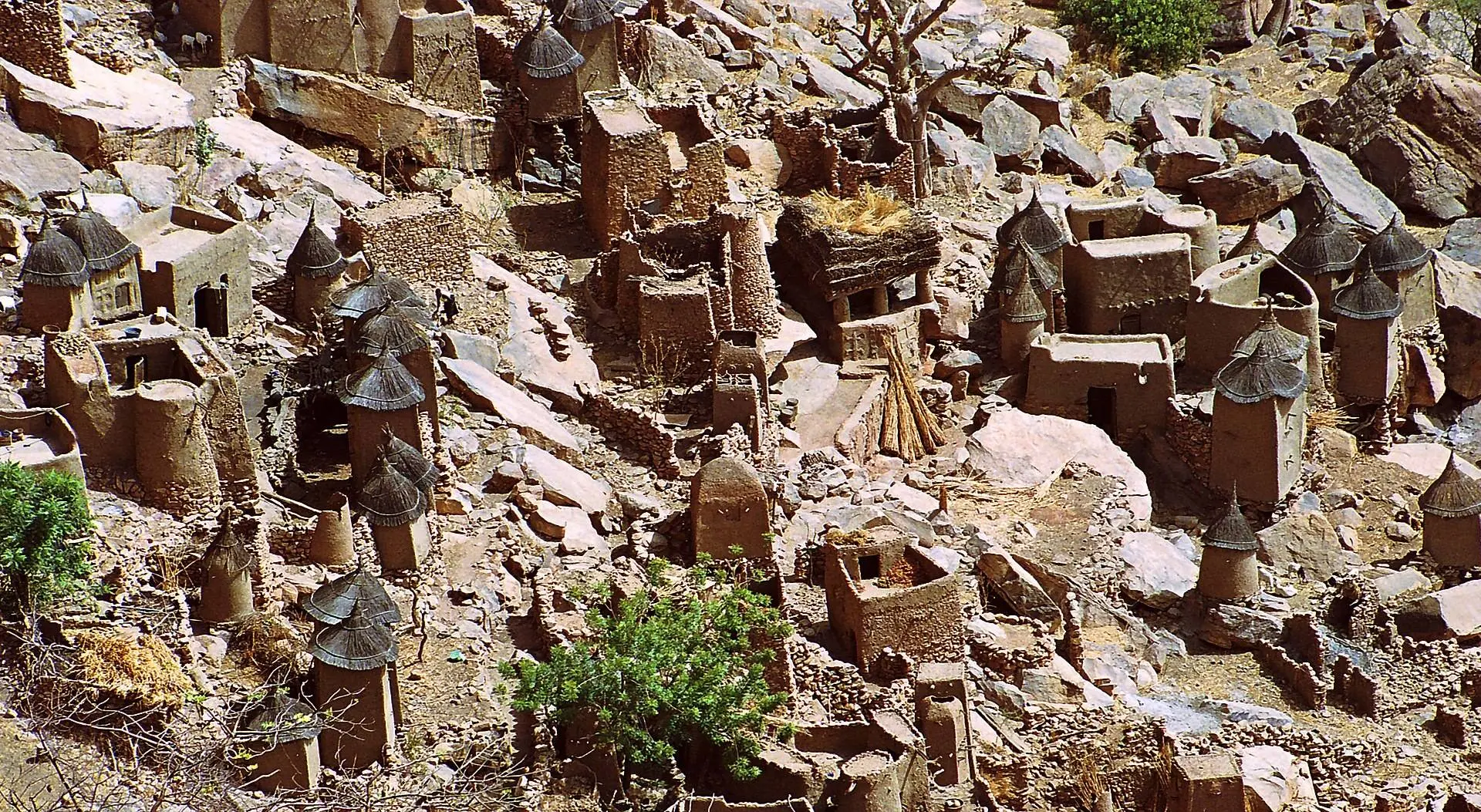
Conflict and displacement in central Mali threaten the Sigui, the ceremony of the Dogon people of the Bandiagara Escarpment that is tied to a roughly 60-year cycle and through which knowledge passes between generations. This analysis argues that such losses matter strategically as well as culturally, and that the systems built to measure crises do not record them.
When transmission is disrupted
Violence involving Dogon and Fulani communities has devastated central Mali since jihadist groups expanded south and east from the country’s northern regions after 2012. The March 2019 Ogossagou massacre killed Fulani civilians. Explaining that violence requires examining armed groups, state protection, land disputes and local political relationships.
The Sigui’s seven-year procession requires movement between villages, the gathering of initiated elders and the participation of the full community. Displacement from the escarpment’s outlying villages and restrictions on movement imposed by insecurity have changed the conditions on the ground. While those conditions persist, the ceremony cannot be held safely in the manner its structure demands, and no security force, UN resolution or development programme is designed to address that.
A civilisation that misses its ceremonial moment does not simply lose a tradition. It loses the mechanism through which knowledge crosses generations, and once that chain is broken, sixty years of accumulated meaning cannot be reconstructed from archives or oral summaries alone.
This kind of loss leaves no rubble, creates no refugee column visible to satellite imagery and generates no casualty count that triggers an international response. That is why standard security analysis tends to miss it. Claims about Dogon astronomical knowledge associated with Marcel Griaule’s work remain contested, and the case for protecting ceremonial transmission does not depend on them.
A wider cultural risk
The Dogon case points beyond its own geography. Elsewhere in the Sahel, knowledge systems tied to ceremonial cycles, seasonal governance and territorial memory can face the same combination of pressures: conflict-driven displacement, climate disruption of the conditions that ceremonies address, and the replacement of local governance by state bureaucracies that do not recognise it or by armed groups that suppress it. That loss does not appear in HDI scores or displacement statistics. It appears in the gradual thinning of the ties that make communities cohesive enough to govern themselves.
The Sigui is a civilisational clock, and the communities whose clock it represents are living in the moment when it either ticks forward or stops. What happens in the Bandiagara Escarpment will shape the cultural inheritance of the region long after the current security crisis has passed into historical memory. Civilisations that miss their moments do not always recover them. That is the war against time, and it is being lost quietly, in villages where no one is counting.



