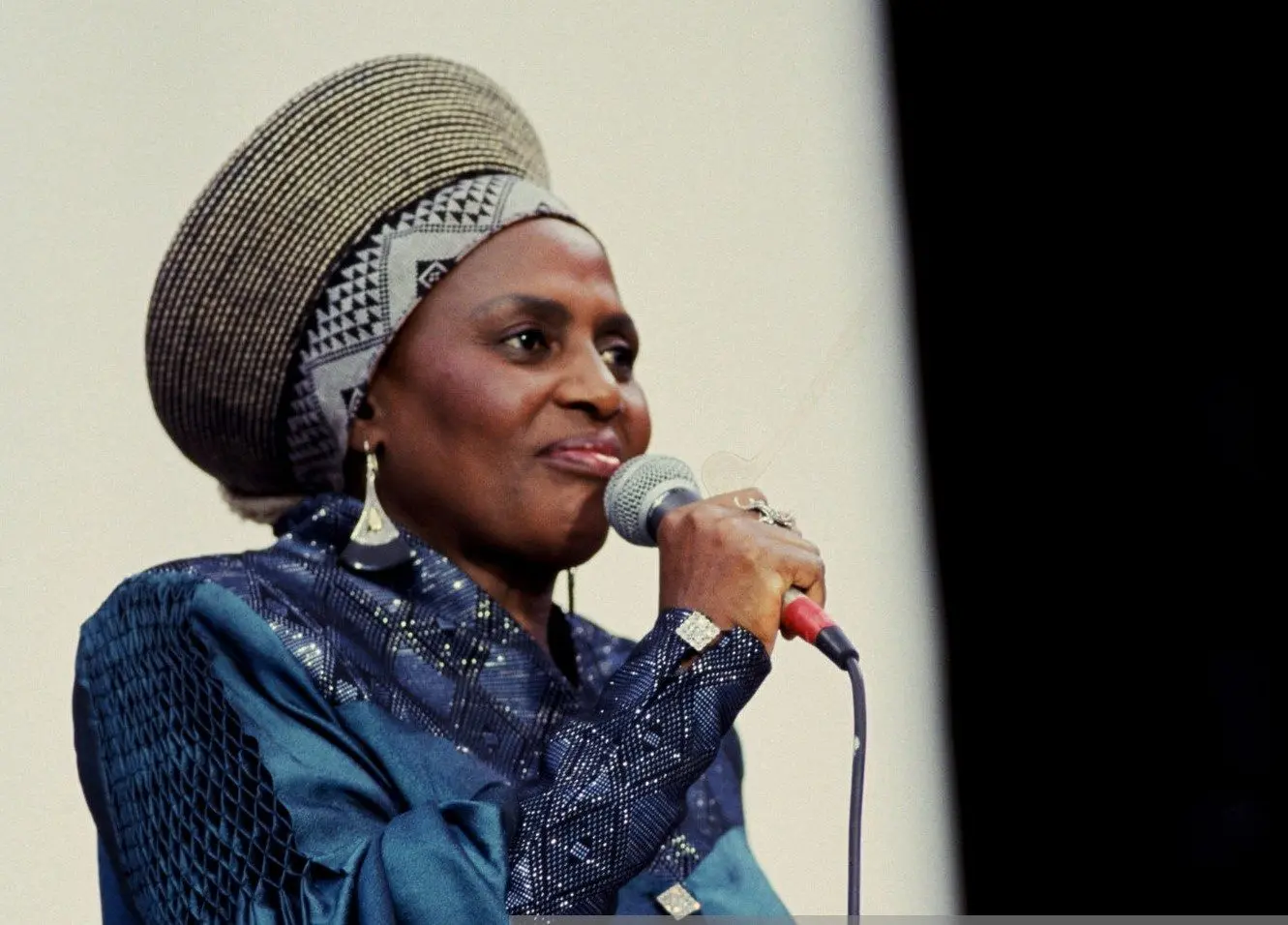
Miriam Makeba carried South African song to audiences around the world, and the apartheid state punished her for it. Her songs against the regime cost her the right to return home, and she spent three decades in exile. She became known as “Mama Africa”, a voice for Africans living under oppressive governments and above all for black South Africans living under apartheid.
Zenzile Miriam Makeba was born on 4 March 1932 in Prospect Township, near Johannesburg, to a Swazi mother and a Xhosa father. She sang in a school choir from an early age, but her father’s death forced her to find work while still a child. At 17 she entered a short first marriage, reportedly abusive, and in 1950 she gave birth to her only child.
From township stages to New York
Her voice was noticed in childhood, but she turned professional in the 1950s, singing with the Cuban Brothers, the Manhattan Brothers and an all-woman group, the Skylarks. Their music mixed jazz, traditional African melodies and Western pop. As a professional vocalist from 1954 she performed mainly in southern Africa, and by the late 1950s her singing and records had made her well known across South Africa.
A brief appearance in the documentary Come Back, Africa (1959) caught the attention of Harry Belafonte, who became her friend and mentor, and of other American performers. With their help she settled in the United States in 1959. New York took to her at once, and she recorded her first solo album there in 1960. The same year she tried to go home for her mother’s funeral, and the South African government stopped her.
Exile and the songs against apartheid
She sang many kinds of popular song, but her Xhosa and Zulu songs, which she introduced to Western audiences, were where she excelled. She became widely known for songs that attacked apartheid, and they were the reason she was kept out of South Africa. Her passport had been cancelled in 1960, the government banned her records, and after she testified against apartheid at the United Nations it revoked her citizenship and her right to return. She became involved in several civil rights campaigns.
In 1964 she married the trumpeter Hugh Masekela, another Belafonte protégé. They divorced two years later but kept working together. With Belafonte she won the Grammy for best folk recording for their 1965 album An Evening with Belafonte/Makeba, awarded in March 1966.
In 1968 she married Stokely Carmichael, the black American activist and a leader of the Black Panther Party (they divorced in 1978). The marriage damaged her career in the United States. She lost much of her white American audience and faced hostility from the US government, and the couple moved to Africa, settling in Guinea. She later moved to Belgium, and she kept recording and touring in Africa and Europe.
She went on performing, mostly in African countries, including at several independence celebrations. Her music grew more openly hostile to apartheid, as in “Soweto Blues” (1977), written by Masekela, about the Soweto uprising. Her autobiography, Makeba: My Story, written with James Hall, appeared in 1988.
Return to South Africa
Nelson Mandela, freed in 1990 after his long imprisonment, persuaded her to come home. She entered South Africa on her French passport on 10 June 1990 and performed there for the first time since her exile began. In 1991 she released an album with Nina Simone and Dizzy Gillespie that blended jazz, R&B, pop and traditional African music. It was an immediate hit across Africa, and she and Gillespie toured the world to promote it. Later that year she made a guest appearance on the American sitcom The Cosby Show.
In the 1992 film Sarafina, about students in the 1976 Soweto uprising, she played Angelina, the title character’s mother, a role The New York Times said she performed with “immense dignity”. On 16 October 1999 she was appointed Goodwill Ambassador of the Food and Agriculture Organization of the United Nations, and she used the post to campaign for humanitarian causes. Her album Homeland, produced by the New York label Putumayo World Music, was nominated for the Grammy for Best World Music Album in January 2000.
Later causes and last years
She worked closely with Graça Machel-Mandela, then South Africa’s first lady, for children living with HIV/AIDS, child soldiers and people with physical disabilities. She founded the Makeba Centre for Girls, a home for orphans, which one obituary called her most personal project. She took part in the 2002 documentary Amandla!: A Revolution in Four-Part Harmony, which traced black South Africans’ struggle against apartheid through the music of the time. A second autobiography, The Miriam Makeba Story, followed in 2004. She survived breast cancer, and after announcing her retirement in 2005 she began a farewell tour, performing despite osteoarthritis until her death. Her grandchildren Nelson Lumumba Lee and Zenzi Lee, and her great-grandchild Lindelani, sometimes joined her on stage.
Her best-known songs abroad included “Pata Pata” and the “Click Song” (“Qongqothwane” in Xhosa), both built on the click consonants of her native Xhosa. Over her career she made 30 original albums, as well as 19 compilations and appearances on many other musicians’ records.
Mama Africa
She was among the best-known Africans in the United States, and many Americans saw her as a symbol of the whole continent. Besides “Mama Africa”, she was called the “Empress of African Song”, the “Queen of South African music” and Africa’s “first superstar”. The music scholar J. U. Jacobs observed that her music had “both been shaped by and given shape to black South African and American music”. She was one of the most prominent celebrities campaigning against apartheid, and she popularised anti-apartheid songs such as “Meadowlands” by Strike Vilakezi and “Ndodemnyama we Verwoerd” (“Watch out, Verwoerd”) by Vuyisile Mini.
Death and tributes
On 9 November 2008 she fell ill at a concert in Castel Volturno, near Caserta in Italy, held to support the writer Roberto Saviano in his stand against the Camorra, the crime syndicate of the Campania region. She had a heart attack after singing “Pata Pata” and was taken to the Pineta Grande clinic, where doctors pronounced her dead.
Mandela called her “South Africa’s first lady of song” and said that “her music inspired a powerful sense of hope in all of us.”
From 25 to 27 September 2009 a televised tribute, Hommage à Miriam Makeba, was staged at the Cirque d’hiver in Paris. In 2014 the Belgian city of Ghent honoured her, with Nelson Mandela, Albertina Sisulu and Steve Biko, by naming a square the “Miriam Makebaplein”.



