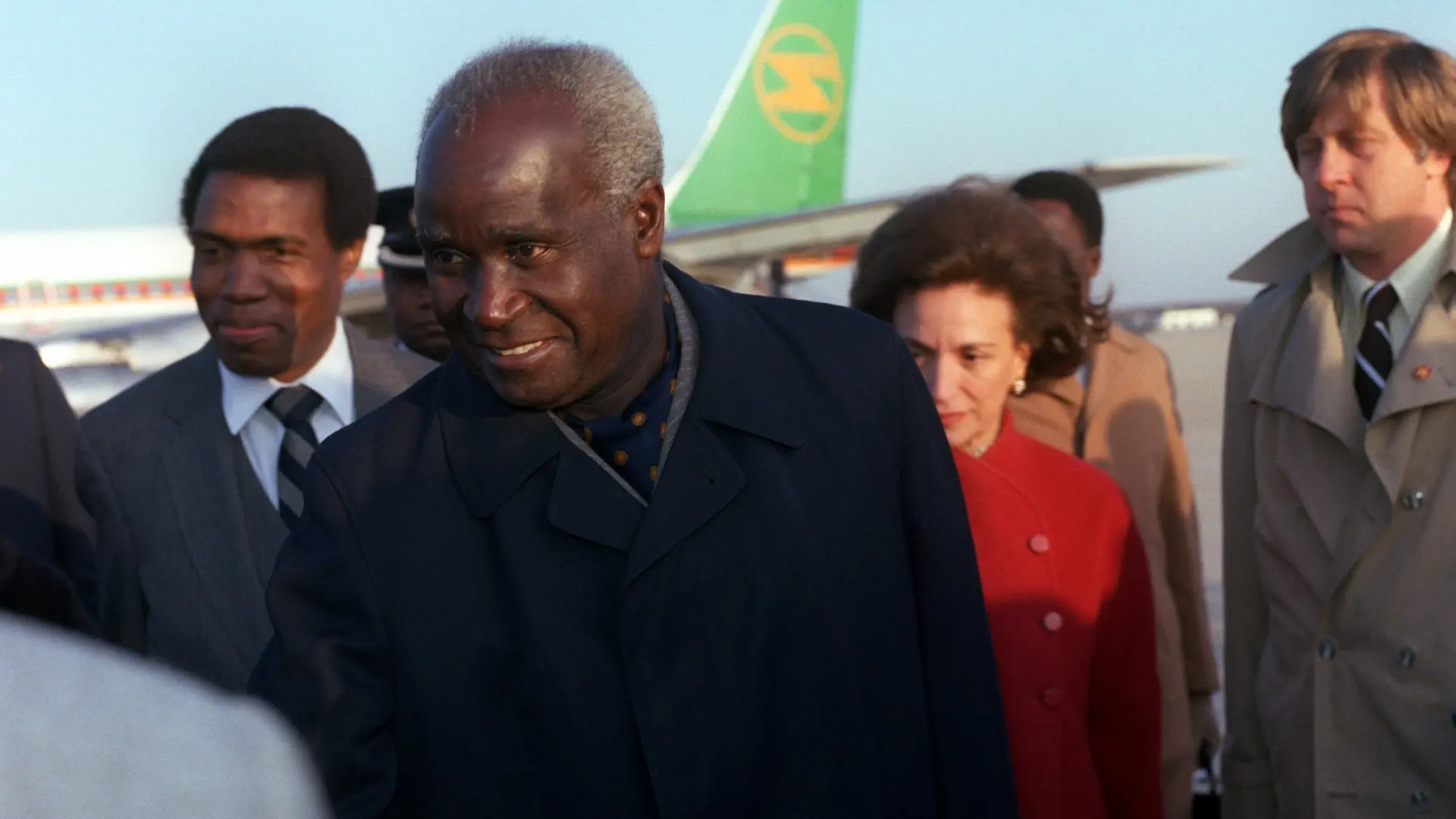
Kenneth Kaunda led Northern Rhodesia to independence as Zambia in 1964 and governed it for 27 years. His record has two halves that sit uneasily together. He held a new state of many ethnic groups together and opened its territory to the liberation movements of southern Africa, but he also banned every party but his own and presided over a long economic decline.
The way his rule ended belongs to the record too. In 1991, under pressure at home, he allowed a multiparty election, lost it heavily and handed over power. This profile, written in February 2020, follows the mission teacher who became a founding president, and argues that the liberator, the one-party ruler and the man who conceded defeat have to be judged together.
A teacher’s son from Lubwa
Kaunda was born on 28 April 1924 at Lubwa Mission, near Chinsali in the north of Northern Rhodesia, the youngest of eight children. His father, the Reverend David Kaunda, was a Church of Scotland missionary and teacher who had come from Nyasaland, now Malawi. His mother, Helen, also taught. According to Encyclopaedia Britannica’s biography, she was the first African woman to teach in colonial Zambia, and both parents worked among the Bemba of the north.
He was educated at Lubwa and at Munali in Lusaka, then the leading secondary school for Africans in the colony, and began teaching at Lubwa in 1943. In the mid-1940s he taught in Tanganyika, now part of Tanzania, and by 1948 he was teaching at Mufulira on the Copperbelt for the United Missions to the Copperbelt.
Politics followed from teaching. By 1949 he was active in the Northern Rhodesian African National Congress (ANC), the territory’s first major anti-colonial organisation. That year he also became interpreter and adviser on African affairs to Sir Stewart Gore-Browne, a liberal white settler on the Legislative Council, work that Britannica says taught him how the colonial government operated.
From Congress organiser to party leader
In 1953 Kaunda became secretary general of the ANC under its president, Harry Nkumbula. Their campaign against the Federation of Rhodesia and Nyasaland, created that year, did not stop it. In 1955 both men were jailed for two months for possessing banned literature. The arrests, in the assessment of Swarthmore College’s Global Nonviolent Action Database, “helped create an aura of martyrdom”.
The two leaders then parted. In the account of the Guardian’s 2021 obituary, Nkumbula was seen as not tough enough in standing up to white interests, and in October 1958 Kaunda and a group of younger radicals left to form the Zambia African National Congress (ZANC), with Kaunda as president. The party was banned in March 1959, and Kaunda was sentenced to nine months in prison, served in Lusaka and then in Salisbury.
While he was inside, Mainza Chona formed the United National Independence Party (UNIP) in October 1959. Kaunda was released on 8 January 1960 and elected UNIP’s president at the end of that month. In May 1960 he met Martin Luther King Jr in Atlanta, a meeting recorded by Alfred Eisenstaedt’s photograph for Life magazine, now in the King papers.
In 1961, after Britain revised a proposed constitution under pressure from the federal prime minister, Sir Roy Welensky, UNIP launched a civil disobedience campaign across the north and east of the territory, known as Cha-cha-cha. Kaunda urged campaigners to stay non-violent, and the Swarthmore database describes boycotts, pickets, rallies and roadblocks. The historians Jotham Momba and Fay Gadsden, drawing on the colonial government’s own account of the disturbances, describe a planned campaign of property damage meant to make the territory ungovernable. By that account, between July and October 1961, 64 bridges and 64 schools were destroyed and 20 African protesters were killed by the security forces. Britannica credits Kaunda’s campaigning against the Federation from the ZANC years onwards with two results. Britain eventually agreed to abandon the Federation, and the imprisonment of Kaunda and other leaders made them national heroes.
Independence in 1964
The October 1962 election was held under a constitution that gave European settlers a disproportionate share of the vote, yet the two African parties together won a majority of the votes. After by-elections that December, the settler-led United Federal Party held 16 seats, UNIP 14 and the ANC 7. With no clear winner, UNIP and the ANC formed the territory’s first government with an African majority, and Kaunda became minister of local government and social welfare. Britannica credits the result to his work in calming settlers’ fears and curbing factional splits among Africans.
In January 1964 UNIP won a landslide and Kaunda became prime minister of Northern Rhodesia. On 24 October 1964 the territory became independent as Zambia, with Kaunda as its first president and Reuben Kamanga as vice-president.
One party, and an economy tied to copper
Kaunda held a country of many ethnic groups together by balancing their claims within his party. The Guardian’s 2021 obituary describes him “shuffling his top party figures around in a chess game to balance ethnic groups and their claims to power-sharing”, and Britannica credits him with keeping ethnic rivalry from turning into civil war.
The same obituary notes “a ruthless streak which he deployed towards opponents”. After violence between parties at the 1968 election, and after his vice-president and old friend, Simon Kapwepwe, left UNIP to form the United Progressive Party, Kaunda had Kapwepwe imprisoned and in 1972 made Zambia a one-party state. A new constitution in 1973 guaranteed UNIP’s uncontested rule. Britannica records that he assumed emergency powers in 1976 and was re-elected as the only candidate in 1978 and 1983.
Abroad, he led the frontline states against the white-minority governments of Rhodesia and South Africa. Britannica notes that he imposed sanctions on Rhodesia in the 1970s “at great cost to his country’s own economy”, and Lusaka became the headquarters of South Africa’s ANC and of Swapo. He worked alongside Tanzania’s Julius Nyerere, whom he succeeded as chairman of the frontline states.
At home the economy declined. In the 1970s his government took a majority stake in the copper mines and took over the management of other industries. By Britannica’s account it poured money into mining, neglected agriculture and spent ever more on subsidised food for the urban poor, so that farm output fell and Zambia came to depend more heavily on copper exports and foreign loans. The Guardian dates the turn to the fall in copper prices in 1973, after which borrowing became a habit. Britannica adds the rising price of oil, the withdrawal of foreign aid and investment, and worsening corruption within his government. Whether copper can pay for wider growth was still the question in 2025, when Africa 360° examined Zambia’s mineral strategy.
Defeat and after
Coup attempts against him failed in 1980 and 1990. By 1990 his popularity was low, and the Movement for Multiparty Democracy (MMD) was holding rallies across the country. In December 1990 Kaunda signed a bill to make Zambia a multiparty state. At the October 1991 elections UNIP won 25 seats to the MMD’s 125, and the trade unionist Frederick Chiluba took office as president on 2 November 1991. To Chiluba, by the Guardian’s account, Kaunda said: “My brother, you have won convincingly and I accept the people’s decision.”
Out of office he clashed often with the new government. A constitutional change in May 1996 required presidential candidates to be second-generation Zambians, which barred Kaunda, whose parents had come from Nyasaland. On 25 December 1997 he was arrested on suspicion of treason over the coup attempt against Chiluba on 28 October 1997. He denied involvement. He was later moved to house arrest, and on 1 June 1998 Human Rights Watch welcomed his release after the state dropped all charges.
On 4 June 1998 he announced that he would step down as UNIP’s leader, but a dispute over his successor kept him in the post until 2000. In retirement he campaigned against HIV/AIDS, which had killed one of his sons in 1987. From 2002 to 2004 he was Balfour African President-in-Residence at Boston University, and in 2003 President Levy Mwanawasa awarded him the Grand Order of the Eagle. The safari-jacket outfit he popularised is still known as the Kaunda suit. When this profile was written in February 2020, he was 95.



