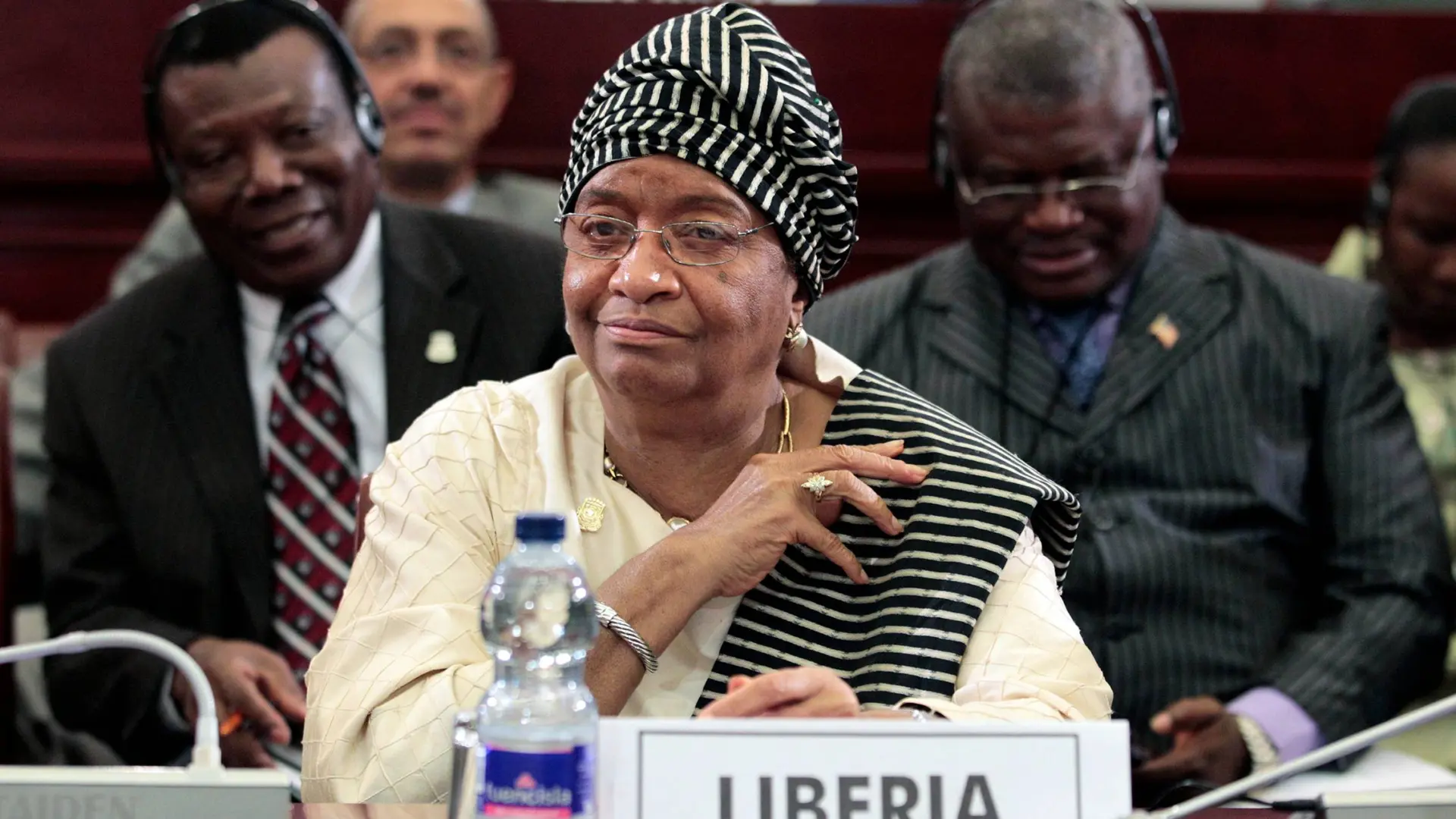
Ellen Johnson Sirleaf was the first woman elected head of state in Africa. She served as the twenty-fourth president of Liberia from 2006 to 2018, taking charge of a country shattered by civil war, and she won the Nobel Peace Prize along the way. To reach office she survived a coup, two spells in prison under Samuel Doe, a treason charge under Charles Taylor and years of exile.
She left office as she had promised, after two full terms, in the country’s first peaceful, democratic transfer of power in 73 years. For that, and for leading the country through its fragile recovery, she won the $5 million Ibrahim Prize for Achievement in African Leadership. Her record was not spotless, and corruption, nepotism and the Ebola epidemic all left their mark on it.
Early life
She was born in Monrovia, the capital, on 29 October 1938. Liberia, founded in the nineteenth century by freed slaves from the United States, is the oldest republic in Africa, and its society has long been strained by the divide between indigenous Liberians and the descendants of the American settlers. Three of her grandparents were of indigenous Liberian descent, and her paternal grandfather was a traditional chief of the Gola people. Her maternal grandfather was a German merchant who left the country during the First World War.
Her mother was a teacher. Her father was a lawyer and the first indigenous Liberian to sit in the national legislature, a body long dominated by the settler families. Her parents prized education, and from 1948 to 1955 she attended the College of West Africa, a leading secondary school in Monrovia.
At seventeen she married James Sirleaf, who worked in the Department of Agriculture. They had four sons in quick succession, and while many of her school friends went on to careers, she stayed at home, adding to the family income by keeping the books for a car repair shop. When her husband won a chance to study in the United States, the couple left their children with grandparents and went together. He took a graduate degree at the University of Wisconsin’s School of Agriculture while she studied accounting at Madison Business College.
Back in Liberia, he returned to the Agriculture Department, and in 1965 she joined the Treasury Department, later the Ministry of Finance. Two careers strained the marriage, and when, as she has described, her husband became violent and abusive, she divorced him. She went back to the United States to study, took a degree in economics at the University of Colorado, and in 1971 completed a master’s in public administration at Harvard University’s John F. Kennedy School of Government.
Coup, prison and exile
Under President William Tolbert she served as assistant minister of finance from 1972 to 1973, and from 1979 she was finance minister. She earned a reputation for personal financial integrity and clashed with both Tolbert and his successor.
On 12 April 1980, non-commissioned officers led by Master Sergeant Samuel Doe seized power. Tolbert was killed, and his body was thrown into a mass grave with 27 other victims of the coup. Ten days later, 13 senior officials of the old government were executed in public. Johnson Sirleaf and three other ministers were spared. She briefly headed the Liberian Bank for Development and Investment (LBDI), but life soon became dangerous for anyone who opposed Doe and his allies, and she fled the country.
Doe’s regime imprisoned her twice, and she narrowly escaped execution. She ran for the Senate in the 1985 national election and openly criticised the military government, which led to her arrest and a 10-year prison sentence. She was released after a short time and allowed to leave. In 12 years of exile in Kenya and the United States, while Liberia collapsed into civil war, she became an influential economist at the World Bank, Citibank and other financial institutions. From 1992 to 1997 she directed the Regional Bureau for Africa of the United Nations Development Programme.
After a fragile truce in the war, she ran for president in 1997 for the Unity Party (UP). She came second to Charles Taylor, whose government then charged her with treason, and she went back into exile. By 1999 the war had resumed. When Taylor went into exile in 2003, she returned to chair the commission on good governance, which oversaw preparations for democratic elections.
The first term
In 2005 she ran for president again, promising to end civil strife and corruption, unite the country and rebuild its ruined infrastructure. Known as the “Iron Lady”, she came second in the first round, then beat the football legend George Weah in the run-off on 8 November 2005. She was sworn in on 16 January 2006.
The challenges were immense. More than 15,000 United Nations peacekeepers were still in the country, and unemployment stood at 80 percent. She went straight to the international community for debt relief and aid. By late 2010 Liberia’s entire debt had been written off, and she had attracted millions of dollars of foreign investment. A Truth and Reconciliation Commission (TRC) began work in 2006 to examine the past and heal ethnic tensions. In 2009, in an irony of its own, a TRC report named her among those it recommended be barred from elected office for 30 years for having backed warring factions. In her case, the charge was that she had supported Taylor for a time very early in the war. The recommendations were not binding, and she drew wide support at home and abroad. To tackle corruption, which she had pledged to end, her government created the Anti-Corruption Commission in 2008.
Her administration made education a right. By executive order she established free, universal elementary education, and she enforced equal rights for women, which had been routinely ignored and abused during the war. Among other infrastructure projects, her government built over 800 miles of roads, and it drew substantial foreign investment into mining, agriculture, forestry and offshore oil exploration. A close ally of the United States, she addressed a joint session of the US Congress soon after taking office. China agreed to support the building of a new national university. She also gave weight to regional relations, including the Mano River Union, which promotes peace and economic co-operation among Liberia, Sierra Leone, Guinea and Côte d’Ivoire.
A contested second term
She had pledged to serve only one term, but in 2010 she announced that she would stand again in October 2011, saying she still had work to do. A month before the vote, a small opposition group challenged her eligibility in court. It pointed to a constitutional requirement that presidential candidates must have lived in Liberia for the 10 years before an election, which she and several other candidates did not meet. The government had tried, and failed, to remove the clause by referendum in August 2011. Six days before the election, the Supreme Court dismissed the challenge, reasoning that the authors of the 1986 constitution could not have foreseen the years of conflict that drove so many Liberians abroad. A further row broke out when she was awarded the Nobel Peace Prize just days before the poll, and rival candidates accused the Nobel Committee of meddling in Liberian politics.
More than a dozen candidates stood on 11 October 2011. She led with more than 43 percent of the vote. Winston Tubman, with Weah as his running mate, took about 32 percent. With no candidate above 50 percent, a run-off was set for 8 November. Tubman and his Congress for Democratic Change alleged irregularities in the first round. The claims were widely dismissed as unsubstantiated, but Tubman withdrew and urged voters to boycott the run-off. She won with slightly more than 90 percent, a victory clouded by his withdrawal and by a turnout less than half that of the first round.
Corruption remained a problem in her second term, despite her government’s efforts. Accusations of nepotism followed too, and in 2012 she came under fire because some of her children held senior posts in government or state-owned enterprises. The economy kept growing until the Ebola epidemic struck in 2014. Over the next two years the disease killed more than 4,800 Liberians, crippled the economy and wiped out many of the gains of the post-war decade.
Leaving office
As the country recovered from Ebola, she prepared to step down after the 2017 election, as the two-term limit required. Her vice-president and running mate in both her elections, Joseph Boakai, became the Unity Party’s candidate. After the first round, the party accused her of backing another candidate, her old rival George Weah. She strongly denied it, but the accusation stuck, and in January 2018 the party expelled her. Weah won a decisive victory in the 2017 run-off, and on 22 January 2018 she handed power to him. It was the first transfer of power between democratically elected leaders in Liberia since 1944.
In February 2018 she was awarded the 2017 Ibrahim Prize for Achievement in African Leadership, for leading Liberia through its transition from war and for the changes made under her administration. The prize committee said she “took the helm of Liberia when it was completely destroyed by civil war”. The $5 million award, endowed by the Sudanese-born British philanthropist Mo Ibrahim, goes only to democratically elected African leaders who leave office at the end of their constitutional terms. It is paid over 10 years, followed by $200,000 a year for the rest of her life, and the foundation may also give $200,000 a year for 10 years to charitable causes she supports.
A grandmother of eight, she has become a symbol of democracy and women’s rights in Liberia, across Africa and throughout the developing world. In 2011 she shared the Nobel Peace Prize with the women’s rights campaigners Leymah Gbowee of Liberia and Tawakkol Karman of Yemen. The Nobel Committee credited her contribution to securing peace in Liberia, to promoting economic and social development and to strengthening the position of women.



