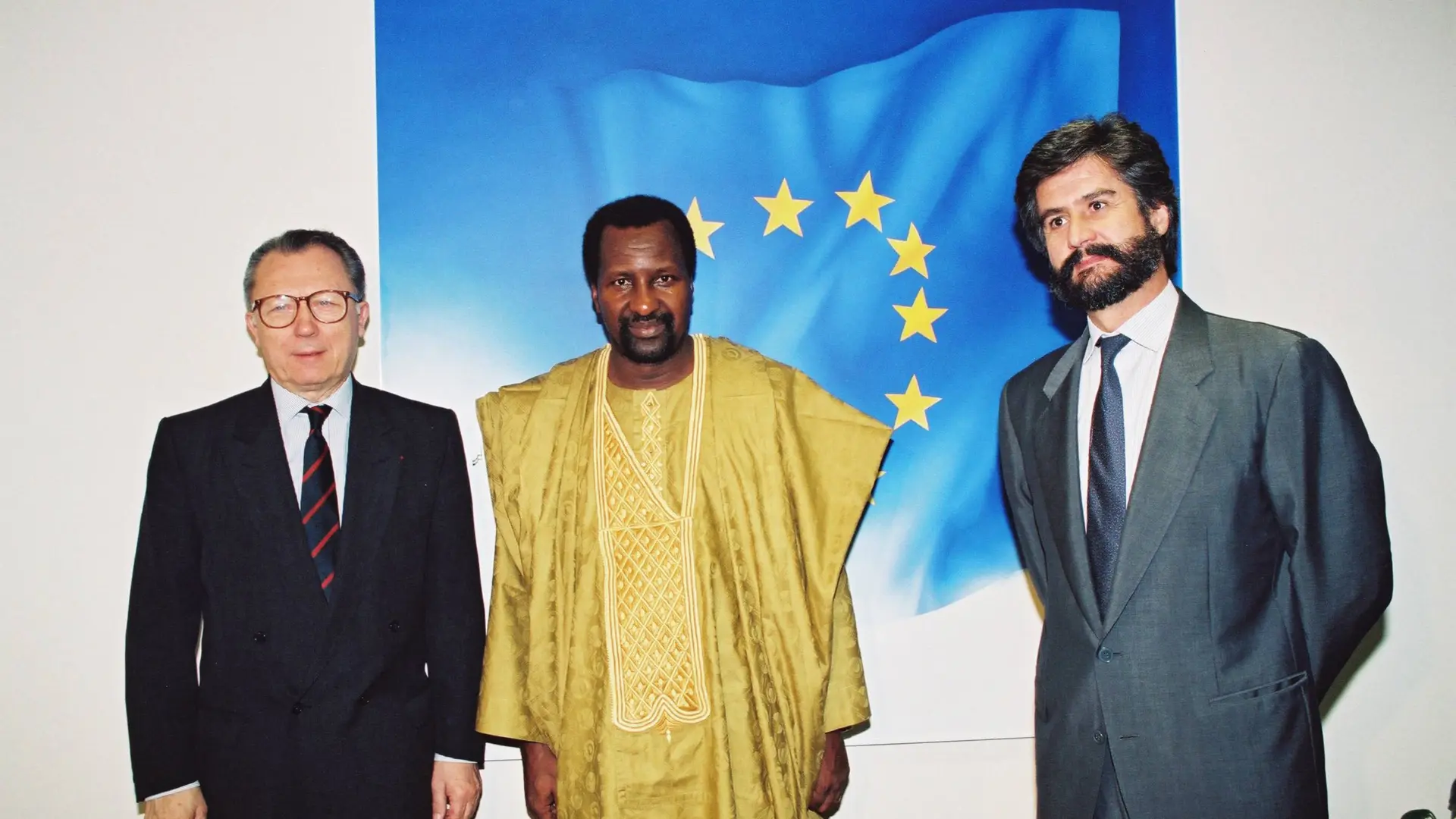
Few African heads of state have left power on schedule and then gone on to serve the continent. Alpha Oumar Konaré did both. A historian by training, he helped bring down Moussa Traoré’s one-party state, became Mali’s first democratically elected president, stepped down after two terms in 2002 and then became the first chairman of the African Union Commission.
His path to power ran through the classroom, the museum and the newsroom rather than the barracks. That background shaped a presidency that restored democratic politics in Mali and gave the country a voice in West African diplomacy.
A historian in the making
Konaré was born on 2 February 1946 in Kayes, in western Mali, the fourth son of a Bambara teacher and a Fula homemaker. He began his schooling in Kayes and went on to study in Bamako, Dakar and Katibougou. He then read history at the École Normale Supérieure in Bamako from 1965 to 1969 and took a doctorate in history and archaeology at the University of Warsaw between 1971 and 1975. His thesis looked at farming in the upper Niger basin between the 13th and 17th centuries, the period when the Mali empire prospered.
Politics came early. In 1967 he was elected secretary general of the youth wing of the US-RDA (Sudanese Union-African Democratic Rally), the party of Mali’s first president, Modibo Keïta, at the École Normale Supérieure. His working life began in teaching, first as a tutor in Kayes and then in secondary schools in Markala and Bamako. In 1974 he joined the Institut des Sciences Humaines du Mali as a researcher. From 1975 to 1978 he ran the historic heritage and ethnography service in the culture ministry, and he chaired the Museum Council until May 1978.
Minister, then dissenter
In 1978 Moussa Traoré’s military government made him Minister of Youth, Sports, Arts and Culture. His time in office left Mali with several new sports bodies. He did not stay long. In 1980 he resigned, in protest at Traoré’s grip on power, a year after Traoré had been confirmed as constitutional president in an election in which he was the only candidate. Konaré went back to academic life and to promoting culture.
Journalism became his next platform. In 1983 he founded and edited the cultural review Jamana, along with a cultural cooperative of the same name. In 1989 he founded the daily Les Échos. He also worked as a consultant for UNESCO and the United Nations Development Programme, and he led the West African association of archaeologists.
Bringing down a one-party state
Konaré returned to opposition politics in 1986, when Traoré’s Democratic Union of the Malian People (UDPM) was the only legal party. In 1990 he helped set up the Alliance for Democracy in Mali (ADEMA), an umbrella movement that brought the clandestine Malian Party of Labour (PMT) together with other groups opposed to Traoré. After Traoré fell in 1991, Konaré helped turn ADEMA into a registered party, ADEMA/PASJ, and represented it at the 1991 National Conference. In the same period he founded the independent station Radio Bamakan.
When the transition led by Amadou Toumani Touré ended, Konaré won the presidential election of 1992, taking 69.01% of the vote in the second round against the US-RDA candidate, Tiéoulé Mamadou Konaté. He was re-elected in 1997, although opponents boycotted the vote in protest at the annulment of that year’s legislative elections, and he was sworn in for a second term on 8 June 1997.
Konaré in power
Under Konaré, democracy returned to Mali. He paid public tribute to Modibo Keïta and built a memorial to him in Bamako. Opposed to the death penalty, he commuted the death sentences passed on Moussa Traoré and his wife to life imprisonment in 2002. Many Malians remember him as the president who brought the Africa Cup of Nations, the continent’s most prestigious football tournament, to Mali in 2002.
Abroad, he worked for peace and integration in West Africa. In 1999 he chaired the Economic Community of West African States (ECOWAS), which gained its own parliament in 2000, and in 2000 he chaired the West African Economic and Monetary Union (UEMOA).
A regional mediator
Konaré was an active player in regional diplomacy. In 1997 he mediated in the crises in the Central African Republic and in the Democratic Republic of the Congo, then still known as Zaire. Malian troops served in the Inter-African Mission to Monitor the Implementation of the Bangui Agreements (MISAB) and in the United Nations mission that followed it in 1998 (MINURCA), as well as in the ECOWAS peacekeeping force, Ecomog, in Liberia, Sierra Leone and Guinea-Bissau. He condemned the military coups in Niger in April 1999 and in Côte d’Ivoire in December of the same year. With Konaré in office, Mali ratified the Constitutive Act of the African Union, adopted at Lomé in July 2000.
Leaving office
The economy grew during these years, and Mali asked international lenders to cancel or restructure part of its foreign debt of about $3 billion. Konaré’s party, however, was split by a feud between Prime Minister Ibrahim Boubacar Keïta and the finance minister, Soumaïla Cissé. Keïta left the government in 2000, and in December Cissé’s faction won control of the party and its nomination to succeed Konaré in 2002.
The former military leader Amadou Toumani Touré and the government candidate, Cissé, reached the second round of the 2002 election, which Touré won with 64.35% of the vote. Konaré handed over power to him that year. One of his last acts as president was to pardon Traoré and his wife, and Traoré was freed in 2002.
At the African Union
On 10 July 2003, at a summit in Maputo, Konaré was elected chairman of the Commission of the African Union. According to several news accounts, leading African states, South Africa and Nigeria among them, believed that the new body, created to replace the Organization of African Unity, would gain credibility from being led by a former head of state. He was the only candidate, because Amara Essy, who had held the post on an interim basis, withdrew before the vote. In the vote, 35 countries backed him, six voted against and four abstained.
On 25 January 2007 Konaré said he would not seek another term. On 1 February 2008 Jean Ping of Gabon was elected to succeed him as chairperson of the Commission.



