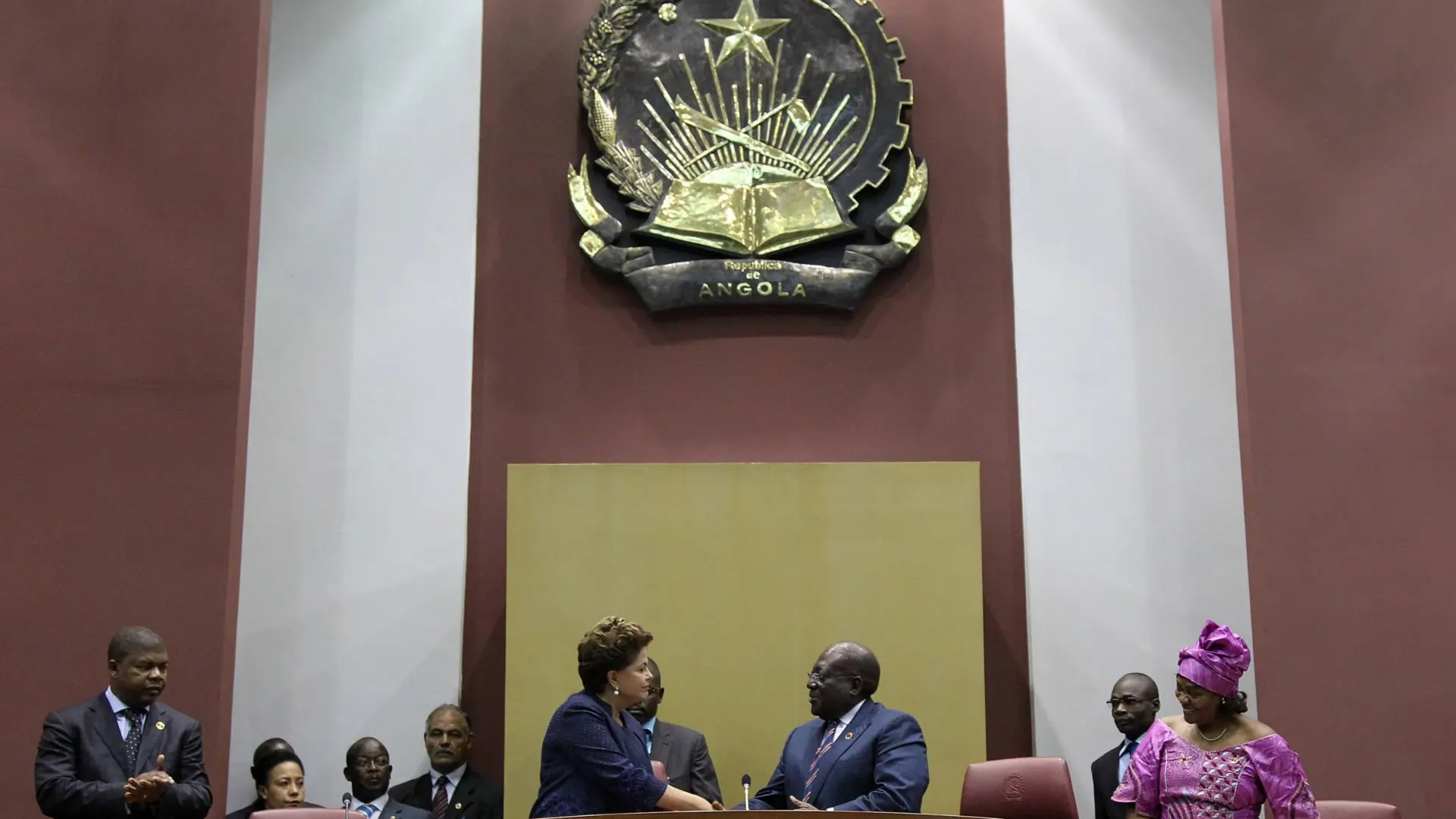
José Eduardo dos Santos governed Angola from 1979 to 2017, through civil war and a post-war oil boom. War, reconstruction and petroleum revenues shaped both the capacity of the state and the patronage networks around his presidency. The result was a country with the form of multi-party democracy and the substance of one-party rule, and his legacy raises a question that reaches beyond Angola: what a liberation movement does with public institutions once it has consolidated power.
War and the Cold War
Angola’s independence from Portugal in November 1975 followed failed transition arrangements and came in the middle of a three-way civil war. The MPLA, the People’s Movement for the Liberation of Angola, was rooted in urban, creole and mestiço political networks; the FNLA was based in the north; and UNITA, Jonas Savimbi’s movement, in the south and east. The MPLA, backed by Cuba and the Soviet Union, consolidated control of Luanda and declared independence. The United States and apartheid South Africa backed its opponents. Angola’s liberation struggle was at once a genuine anti-colonial movement and a Cold War battlefield. That dual character shaped the MPLA’s governance culture from the beginning: a movement that had fought for sovereignty while depending on external military support, and whose claim to represent Angolans was contested through a civil war that would not end until 2002.
Dos Santos came to the presidency at thirty-seven, following the death of Agostinho Neto, Angola’s founding president and the poet-statesman who had given the liberation movement its most powerful voice. An engineer by training, dos Santos inherited a country in active civil war, a collapsing economy and a party that had not yet settled its internal politics. That he held the position for thirty-eight years is itself a political analysis, a study in how a leader manages coalitions, patronage and the periodic crises that would have ended less durable systems.
The oil economy
The expansion of oil production and revenues through the 1990s and 2000s was the material foundation of the dos Santos system. Angola became sub-Saharan Africa’s second-largest oil producer, and its revenues funded the end of the civil war, the physical reconstruction of Luanda and a patronage network whose scale left little room for genuine political competition. The national oil company, Sonangol, became both an economic instrument and a symbol of the family’s position at the centre of Angolan capital accumulation, especially after dos Santos appointed his daughter Isabel as its chair in 2016. Isabel dos Santos went on to become, for a period, the wealthiest woman in Africa. The relationship between her wealth and her father’s power was not incidental.
Oil revenues reduced the government’s dependence on domestic taxation and helped finance reconstruction and patronage. That can weaken some pressures for accountability, but it does not mean citizens have no influence or that every oil-funded state is unaccountable.
The peace that ended the civil war in 2002, following Savimbi’s death in combat, gave the dos Santos system the stability it needed to complete its consolidation. UNITA was absorbed into the formal political system as an opposition party. Elections were held. The MPLA won, repeatedly and by large margins, in an environment where the ruling party’s control of state resources, state media and the institutions of the electoral process tilted the field heavily in its favour.
Accountability after the transition
When dos Santos handed power to João Lourenço in 2017, the transition was managed within the MPLA and was constitutional in form. Lourenço’s subsequent pursuit of corruption cases, including against Isabel dos Santos and other members of the former president’s inner circle, marked a significant shift in Angolan politics: a successor using state legal mechanisms against the networks of the predecessor who had elevated him. Whether that represents institutional accountability asserting itself or factional politics using the language of accountability is a question Angola’s courts, its international partners and its civil society are still working through.
Angola’s story, from the fire of liberation to the furnace of leadership, is a compressed version of a question the continent has faced since independence. What does a movement become when it wins power, and how does it turn itself from a vehicle for collective liberation into an institution of accountable governance? The MPLA’s answer was the dominant-party state. Angola’s test now is whether the institutions that state produced can be redirected towards the accountability they were nominally designed to provide. What is being forged is not yet decided.



