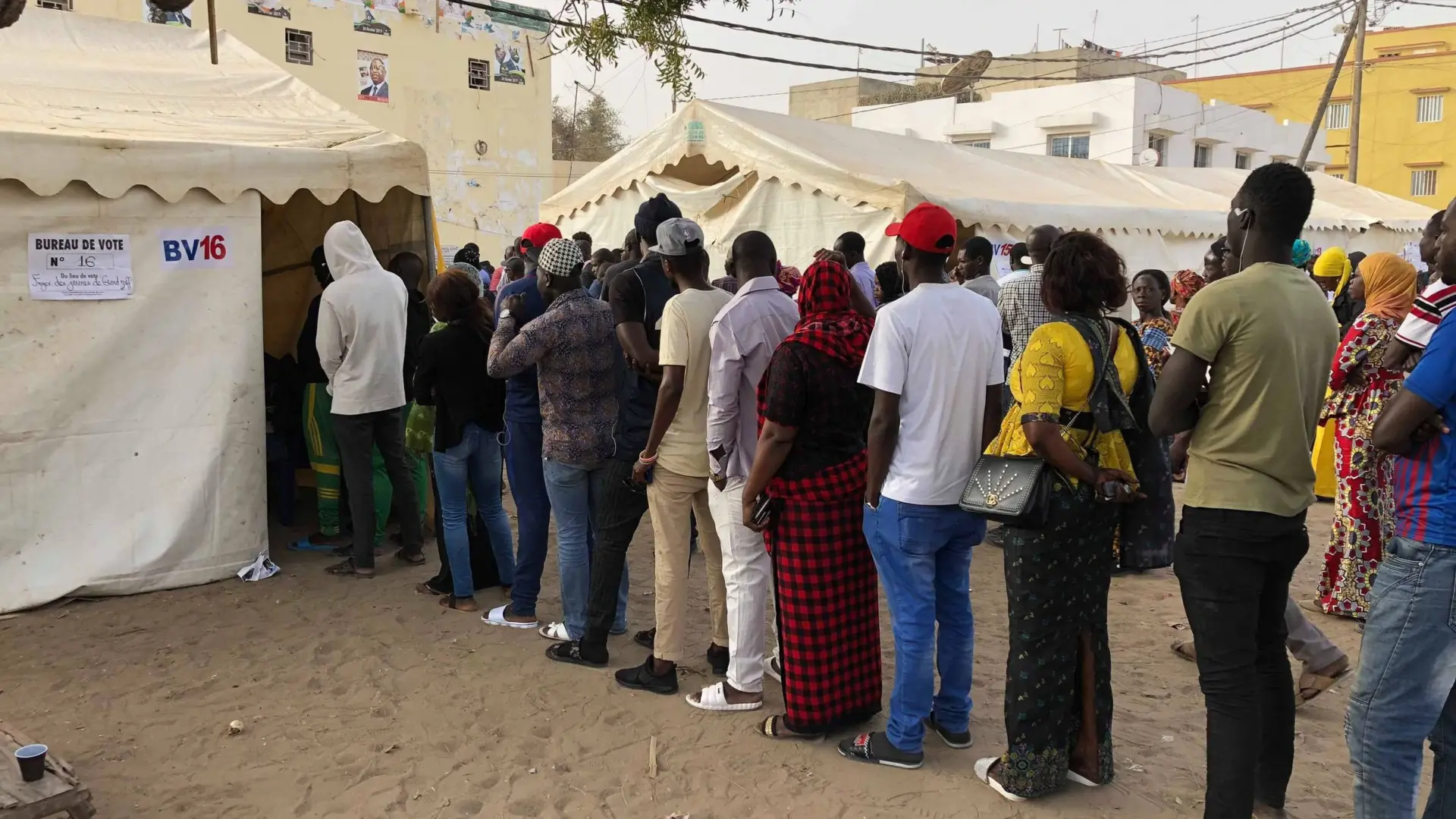
Electoral integrity in West Africa was tested from two directions in the same week of February 2019. In Senegal, Prime Minister Mahammed Dionne declared President Macky Sall the winner of the 24 February presidential election hours after polls closed, days before official figures appeared. In Nigeria, the 23 February presidential poll followed a postponement announced in the small hours of the original polling day, and observers documented intimidation, vote suppression and ballot snatching. The two cases failed differently, but they point to the same weak point: the moment of result, when counting, collation and proclamation decide whether voters accept the outcome.
Senegal and the early victory claim
Senegal’s test was about who has the authority to announce a result. Early on Monday 25 February 2019, at a news conference in Dakar, Dionne cited the ruling coalition’s own tallies to claim that Sall had won 13 of the country’s 14 regions and at least 57 per cent of the vote, enough to avoid a run-off. Neither the National Vote Counting Commission nor the Constitutional Council had yet published figures.
The claim proved close to the final count. On 5 March 2019 the Constitutional Council confirmed Sall’s first-round re-election with 58.26 per cent of valid votes, against 20.51 per cent for Idrissa Seck and 15.67 per cent for Ousmane Sonko, as the BBC reported. Opposition candidates rejected the outcome but filed no formal petitions. They pointed instead to the exclusion before the vote of two prominent challengers, Khalifa Sall and Karim Wade. The episode showed why a governing party’s statements must be kept distinct from the authority of the bodies responsible for tabulation and proclamation.
Nigeria’s troubled poll
Nigeria’s situation was structurally different and materially worse. Polls were due to open at 8am on Saturday 16 February 2019. After an overnight meeting, INEC Chairman Mahmood Yakubu announced at about 3am that the presidential vote would move to 23 February and governorship polls to 9 March, roughly five hours before voting was due to start. The late postponement was met with suspicion.
The contest between President Muhammadu Buhari and former Vice President Atiku Abubakar then ran on regional lines. According to INEC’s Kano State collation, Buhari won the state by 1,464,768 votes to 391,593, a margin of more than a million, while Atiku performed strongly in the south-east and parts of the south. Buhari was re-elected. The process mattered as much as the result. The European Union Election Observation Mission’s final report, published in June 2019, documented widespread intimidation, vote suppression, ballot-box snatching and destruction, and obstruction of observers and journalists. Domestic monitors, including the Situation Room and Yiaga Africa, reported similar problems, and INEC cancelled votes in several states because of disruption. The pattern of violence is examined further in our analysis of Nigeria’s electoral violence.
Observers focused on the count. In its preliminary statement of 25 February 2019 the EU mission warned that “results’ collation procedures were not sufficiently robust, and inadequate information was provided to the public.” The African Union mission, led by former Ethiopian Prime Minister Hailemariam Desalegn, and the ECOWAS mission, led by former Liberian President Ellen Johnson Sirleaf, urged INEC and the parties to ensure transparency during collation. A count conducted out of public view will attract suspicion whatever its accuracy.
Atiku challenged the result. On 11 September 2019 the Presidential Election Petition Tribunal unanimously dismissed his petition, finding that he had not proved his allegations, and on 30 October 2019 the Supreme Court unanimously dismissed his appeal, giving its full reasons later. The case took eight months to resolve.
Why electoral integrity in West Africa remains fragile
Neither case was an isolated failure. Nigeria’s INEC was established in 1998, ahead of the 1999 return to civilian rule, and its administrative weaknesses in 2019 were not new. In Senegal, the problem was not the count but the governing coalition’s readiness to pre-empt it. Both point to institutional design: whether the bodies that tabulate, proclaim and adjudicate results are independent enough to be trusted when incumbents are on the ballot.
The two cases matter beyond their results. Nigeria, one of the continent’s largest economies, and Senegal, long regarded as an institutional reference point in Francophone West Africa, carry weight in the region, and how their institutions handle a contested result is watched beyond their borders.
What changed after 2019
Later cycles show both the reach and the limits of reform. Nigeria’s Electoral Act 2022 introduced electronic voter accreditation and an online results viewing portal. Yet in the presidential election of 25 February 2023, failures in uploading results in real time drew criticism in the EU observation mission’s 2023 final report for eroding public trust, and the old disputes over tabulation returned. In Senegal, Sall’s attempt in February 2024 to postpone the presidential election triggered mass protests until the Constitutional Council struck down the delay. Opposition candidate Bassirou Diomaye Faye then won in the first round on 24 March 2024 with 54.28 per cent, a test of Senegal’s institutions examined in our analysis of Faye’s resource promises.
Senegal’s court held the line in 2024, and Nigeria’s technology did not settle the count in 2023. The accountability gap exposed in 2019 has narrowed in places but remains open. Credible elections require transparency through counting, collation and legal review as well as during voting. West Africa’s democratic consolidation will be advanced not by any single clean or contested result but by building independent institutions that keep their integrity when incumbents would prefer they did not.



