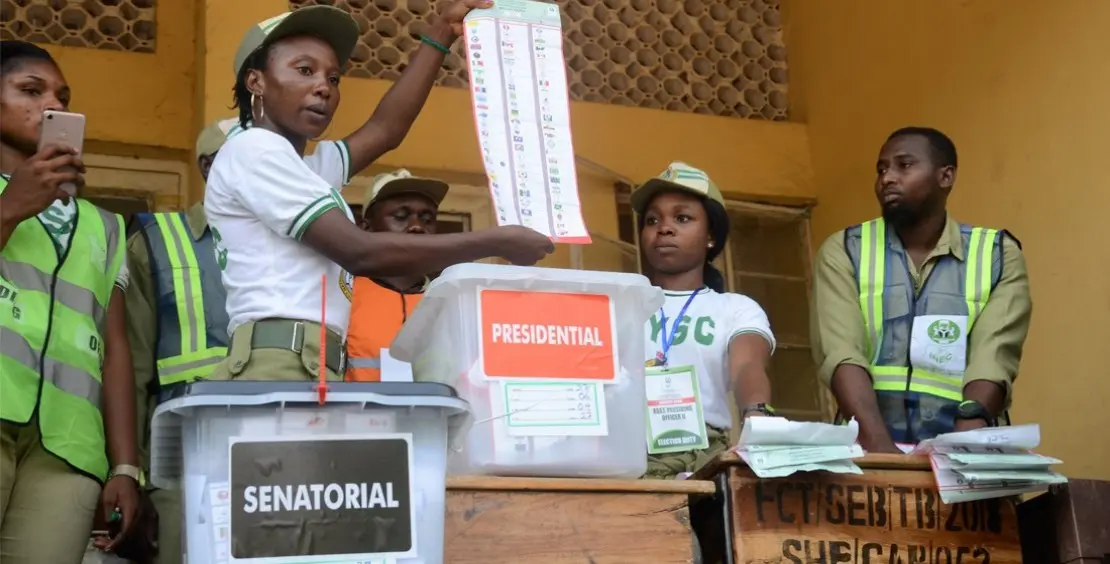
Nigeria’s presidential election was postponed on 16 February 2019, hours before voting was due to begin. The week-long delay, the rescheduled vote and the legal challenges that followed amounted to a stress test of Nigerian electoral administration, and they showed precisely where the system was breaking.
The seven-day postponement of the presidential election (announced by INEC Chairman Mahmood Yakubu at 2:38 a.m. on the morning balloting was scheduled to begin) set the register for what followed. Logistical failure was the stated reason. Smart Card Readers and result sheets had not reached sufficient polling units. The procedural explanation was plausible. What it also demonstrated was that an electoral management body responsible for organising the vote of 84 million registered Nigerians had reached election morning without the operational certainty that its own systems would function. In a country where elections had been held consistently since the return to democracy in 1999, that gap between institutional form and institutional capacity was itself a data point.
The rescheduled vote on 23 February 2019 returned incumbent President Muhammadu Buhari with 56 per cent of the declared vote, against Atiku Abubakar’s 41 per cent. The margin was sufficient to preclude a constitutional runoff but not sufficient to prevent a legal challenge. Atiku’s petition, heard by the Presidential Election Petition Tribunal and subsequently by the Supreme Court on appeal, contested the result on grounds of widespread irregularities, non-compliance with electoral guidelines, and allegations of falsification in several states.
Nigerian elections consistently reveal the same structural architecture. It combines electoral administration that is formally independent but operationally constrained; security agencies with no reliable neutrality precedent; and a tribunal system that consistently sets the standard of electoral malpractice above the level that petitioners can sustain.
The tribunal and Supreme Court dismissed the petitions, applying the established Nigerian evidentiary standard. This requires that electoral irregularities must be substantial and must have affected the result. The court found that while irregularities were documented, the evidence did not meet the required threshold to void an election conducted nationally across 36 states and the FCT. This is not, on its own, a perverse finding; election litigation standards in mature democracies require that petitioners demonstrate not merely that irregularities occurred but that they were decisive. The problem is not the standard. It is that the standard, consistently applied across twenty years of Nigerian electoral litigation, has meant that no presidential election result has ever been successfully challenged, regardless of the volume of documented irregularity. The standard functions, in practice, as structural insulation for declared results.
The Senate and National Assembly elections conducted alongside the presidential vote (and the governorship elections held in March 2019) provided additional evidence of the same structural patterns. In Rivers State, the security and electoral dynamics were sufficiently compromised that INEC cancelled results in several local government areas. In Kano, INEC declared the governorship election inconclusive and held supplementary voting on 23 March 2019. EU observers reported intimidation and interference. This is not the dysfunction of a failing democracy. It is the dysfunction of a democracy whose formal architecture has been captured by the logic of competitive clientelism, where the stakes of electoral outcomes are so high, because the Nigerian state controls so much of the country’s productive economy, that few actors within the competition have a rational interest in the neutral administration of the contest.
The 2019 cycle did produce one structural advance worth noting. The Smart Card Reader system, despite its logistical failures in deployment, represented a genuine attempt to reduce the ability of political actors to inflate results through ballot stuffing, a technique that had characterised earlier Nigerian elections. The experience underscored the need to improve accreditation, counting and public scrutiny of collation. Technology could help, but equipment alone could not guarantee credible results.
Read from that distance, the 2019 elections were not simply a democratic failure. They revealed where the system was breaking and what structural interventions could interrupt those break points. The reforms that followed (imperfectly implemented, contested at every stage by political actors whose advantage lay in the old opacity) were the product of the 2019 evidence. That is not a vindication of what happened. It is a description of how institutional change occurs in a democracy that is not broken but is genuinely under contested construction.



