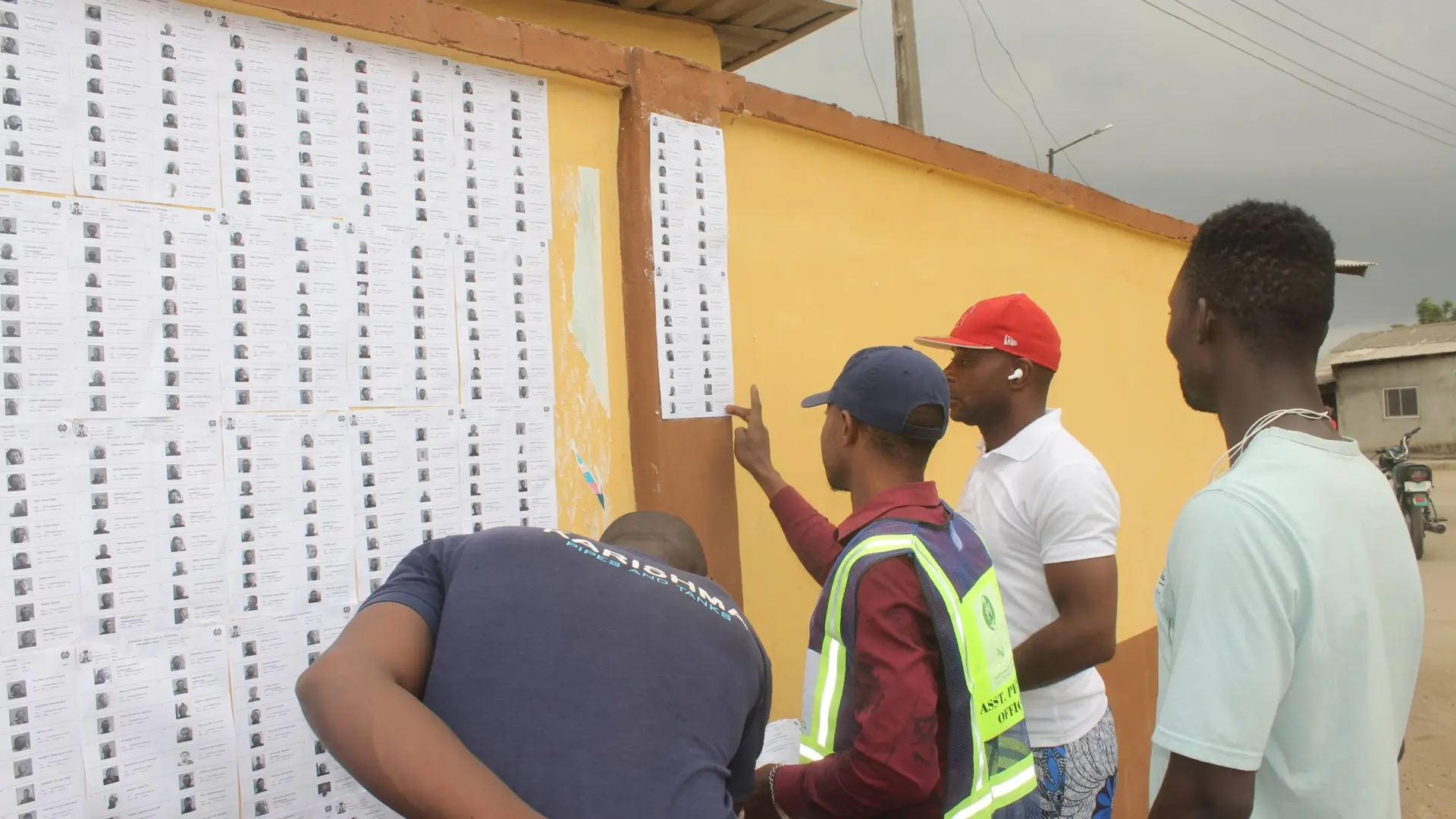
Since Nigeria’s return to civilian rule in 1999, every general election cycle has produced documented violence. This includes pre-election intimidation, ballot snatching at polling units, post-result clashes, and the selective targeting of candidates, officials and voters whose political allegiances made them strategic threats.
The 2015 cycle, judged relatively peaceful, still recorded at least 108 fatalities. The 2019 elections were conducted against a backdrop of campaign violence that had already claimed lives before a single ballot was cast. Electoral violence in Nigeria is not a crisis that arrives suddenly. It is a standing condition of the political system, documented in advance by the International Crisis Group and other monitoring bodies, identifiable by geography and political configuration, and consistently not prevented by the institutions whose function includes preventing it.
The map of risk
The six states identified by the International Crisis Group as highest risk for the 2019 cycle, Rivers, Akwa Ibom, Kaduna, Kano, Plateau and Adamawa, share structural features that explain their vulnerability. Each combines at least two conditions from the same set: an intensely personalised rivalry between major political actors who have used violence as a competitive tool; an ethnic or religious cleavage that election campaigns activate; security forces whose neutrality is compromised by proximity to incumbent interests; and an Independent National Electoral Commission presence that lacks the logistical and institutional authority to enforce process in a hostile environment. These combinations are not unpredictable.
The Rivers case
Rivers State is the diagnostic case. Governor Nyesom Wike’s bitter rivalry with his predecessor Rotimi Amaechi was not a 2019 development. It had been active for years, and its consequences for electoral security had been documented in preceding cycles. Armed groups, predominantly linked to cult organisations, had been established as instruments of political competition in Port Harcourt and across Rivers State well before the 2019 elections were scheduled. The suspension of a Port Harcourt bye-election in August 2018 because of violence, the kidnapping and murder of an APC official in November 2018, and gun attacks on rallies of both major parties were not warning signs. They were the pattern itself, a preview of what the general election’s competition would produce.
Kaduna, Kano, Plateau and Adamawa
Kaduna shows the ethnic and religious dimension of electoral violence in Nigeria at its most embedded. The state had recorded more than half the national death toll from election violence in 2011. By 2019, the religious tension created by Governor Nasir El-Rufai’s decision to select a Muslim running mate, breaking the Muslim-Christian power-sharing convention that had managed interfaith tension, was operating alongside a herder-farmer conflict that had displaced tens of thousands and killed hundreds in recent years. Southern Kaduna’s communities, Christian-majority and historically marginalised in the distribution of state power, entered the 2019 elections already carrying grievances that the campaign had not eased. The conditions for violence were documented, mapped and analysed. The prevention matched to that analysis was inadequate.
Kano’s scale, with more than eleven million residents and five million registered voters, makes it central to national electoral calculations. It had also produced the rivalry between Abdullahi Ganduje and Rabiu Kwankwaso, two northern political heavyweights whose followers had a documented history of physical confrontation. Kwankwaso supporters attempting to hold rallies faced systematic obstruction. Monitoring organisations assessed and documented the risk that Kano would again become a flashpoint in 2019, as it had been in 2011. Election management and security deployment did not match that risk.
Plateau, in the Middle Belt, is one of Nigeria’s most complex electoral environments. It is a patchwork of ethnic communities with overlapping “indigene” and “settler” designations whose legal ambiguity political actors have exploited for decades, overlaid by herder-farmer violence that had killed over 1,800 people in two years. In Jos North, allegations of voter importation across state boundaries drew retaliatory threats from communities who saw demographic manipulation as an existential threat.
In Adamawa, where PDP presidential candidate Atiku Abubakar and Aisha Buhari, wife of then-President Muhammadu Buhari, both held homeland political significance, and where youth gangs known locally as Shila Boys had been documented as instruments of political intimidation, the election was a contest for symbolic territorial dominance as well as for votes.
The prevention gap
Electoral violence in Nigeria will not be addressed by acknowledging its existence after each cycle. The International Crisis Group’s pre-election mapping identifies these conditions in time to act on them. Acting on them requires INEC logistical capacity matched to the security environment, security forces deployed under rules of engagement that put civilian protection before incumbent preference, and enforceable rules against parties and candidates who organise or incite violence. None of these conditions fully held in 2019. The assessment of which states would experience violence was accurate. The prevention infrastructure was not equal to it. That gap is not a failure of intelligence. It is a failure of institutional will.



