South Sudan’s independence in July 2011 raised hopes for peace after decades of conflict. Fourteen years later, renewed fighting threatens those hopes. The country is again close to civil war, with ethnic violence, political betrayal and a humanitarian crisis of great scale.
What makes South Sudan’s crisis different from ordinary state failure is not its depth but its witnesses. The African Union and the United Nations, the institutions designed to prevent this unravelling, have not done so. Despite peace agreements and one of the world’s most expensive peacekeeping operations, both have failed to protect civilians. South Sudan’s slide back into conflict is a tragedy for its people and a test of the limits of modern diplomacy.
At the heart of the latest collapse is the Revitalised Agreement on the Resolution of the Conflict in South Sudan, signed in 2018 after a civil war that left nearly 400,000 dead. It was designed to create a unity government between President Salva Kiir and his longtime rival Riek Machar. In March 2025, Machar was placed under house arrest, accused of fomenting rebellion. His detention effectively ended what little remained of the accord.
The failures of the accord
A key failure lay in the promised integration of armed forces. The Joint Defence Board collapsed. Only about 7 per cent of the promised 83,000 unified forces were ever deployed, a clear signal that South Sudan’s rival factions remained armed and hostile.
The power-sharing government existed on paper more than in practice, with deep mistrust beneath every formal arrangement.
The AU’s limited response
The African Union has long presented itself as the guardian of peace on the continent. In South Sudan, its response has been marked by indecision. Repeated communiqués condemned Kiir’s breaches of the peace deal, but carried no consequences. Unlike ECOWAS, which imposed sanctions on Niger’s military authorities in 2023, the AU has held back, fearing that pressing Kiir too hard might provoke total collapse. Mediators shuttled between African capitals, issued press statements and extracted no concessions. The AU remains chronically underfunded and overly reliant on external donors, a dependency that constrains its autonomy, leaving it cautious and reactive rather than bold and decisive.
“The AU remains chronically underfunded and overly reliant on external donors, a dependency that constrains its autonomy, leaving it cautious and reactive rather than bold and decisive.”
UNMISS and civilian protection
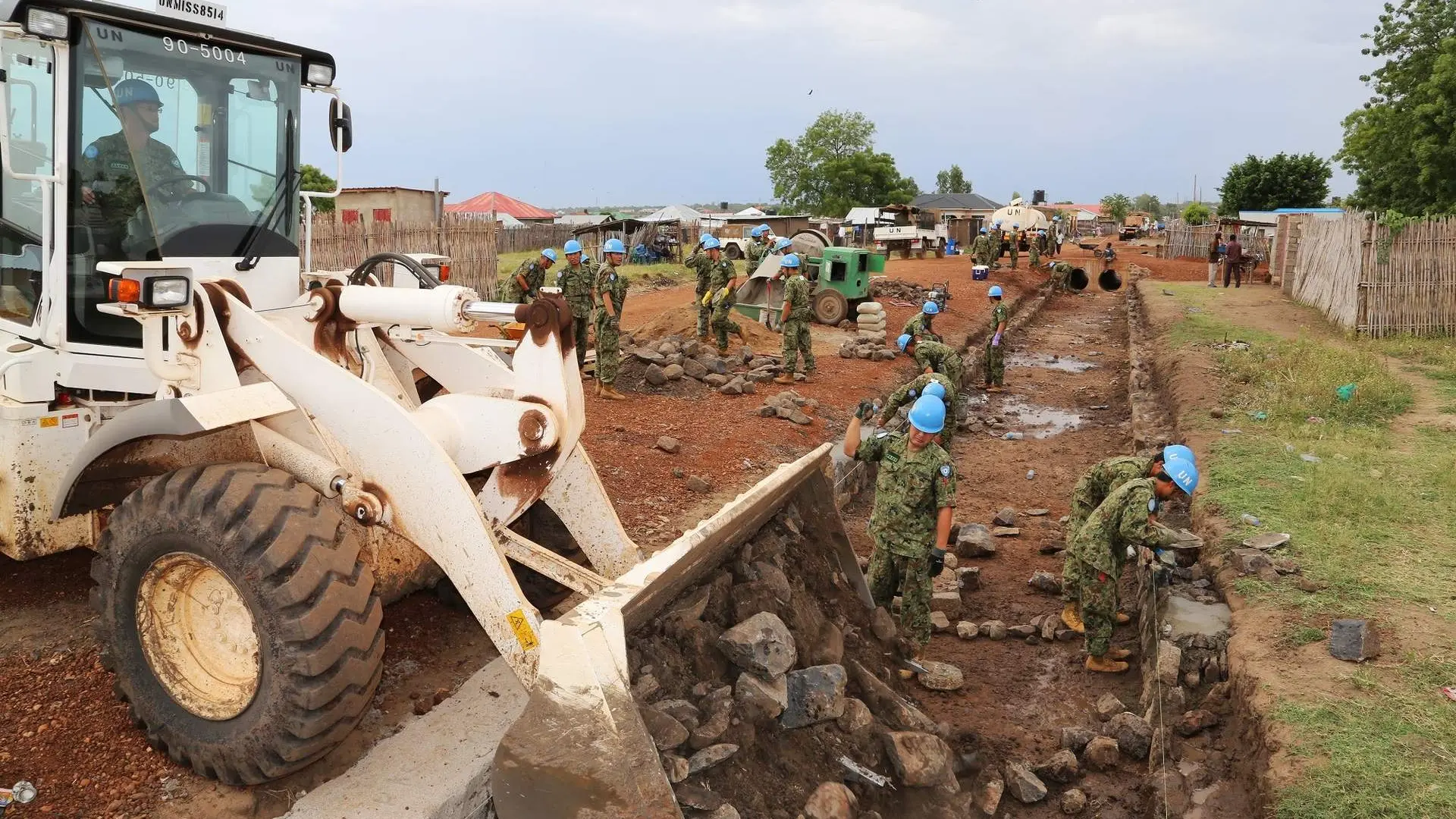
The United Nations Mission in South Sudan, one of the UN’s largest and costliest peacekeeping operations, has not fulfilled its most basic mandate of protecting civilians. On 7 March 2025, a UN helicopter evacuating government troops from Nasir came under fire, killing a crew member and several South Sudanese soldiers. The Security Council attributed the attack to the White Army, which was fighting government forces. The incident exposed the danger facing peacekeepers attempting to de-escalate the conflict.
UNMISS depends on Kiir’s government for access and security cooperation, which limits what it can do. The results are visible. There are 2.3 million refugees and 2 million internally displaced people, and ethnic clashes continue. The failure is not one of resources. It is one of architecture: a peacekeeping doctrine designed for places where host governments are partners, applied where the host government is a belligerent.
The war has an economic engine that the diplomacy rarely names. South Sudan’s government is financed almost entirely by oil, piped north through Sudan and now hostage to Sudan’s own civil war, and the revenue that does arrive is distributed through the patronage networks the peace agreement was supposed to dissolve and instead formalised. A power-sharing deal between armed elites is, in fiscal terms, a revenue-sharing deal, and each faction’s willingness to keep the peace lasts as long as its share of the revenue. When the pipeline falters, as it has repeatedly since Sudan’s war began, the pool shrinks, the arithmetic breaks, and the guns resume. The fighting is not a breakdown of the settlement. It is a renegotiation of it, conducted in the only currency the settlement recognises.
Options for regional diplomacy
Regional dynamics compound the crisis. Uganda continues to provide military backing to Kiir. Sudan’s civil war has spilt across the border, disrupting vital oil exports and deepening economic turmoil. South Sudan has become a forgotten crisis, with the 2024 humanitarian response plan funded at just 40 per cent as donor attention turns to Ukraine and Gaza.
South Sudan is a test of whether African and international diplomacy can move beyond statements into decisive action. Paths forward exist: the immediate release of Machar, targeted sanctions on hardline spoilers, an overhauled UNMISS mandate with genuine protection powers, and regional mediation through IGAD backed by states with real leverage over Juba. But they require political will that has not yet materialised. Without it, renewed conflict will continue to put civilians at risk and weaken the institutions charged with protecting them.



