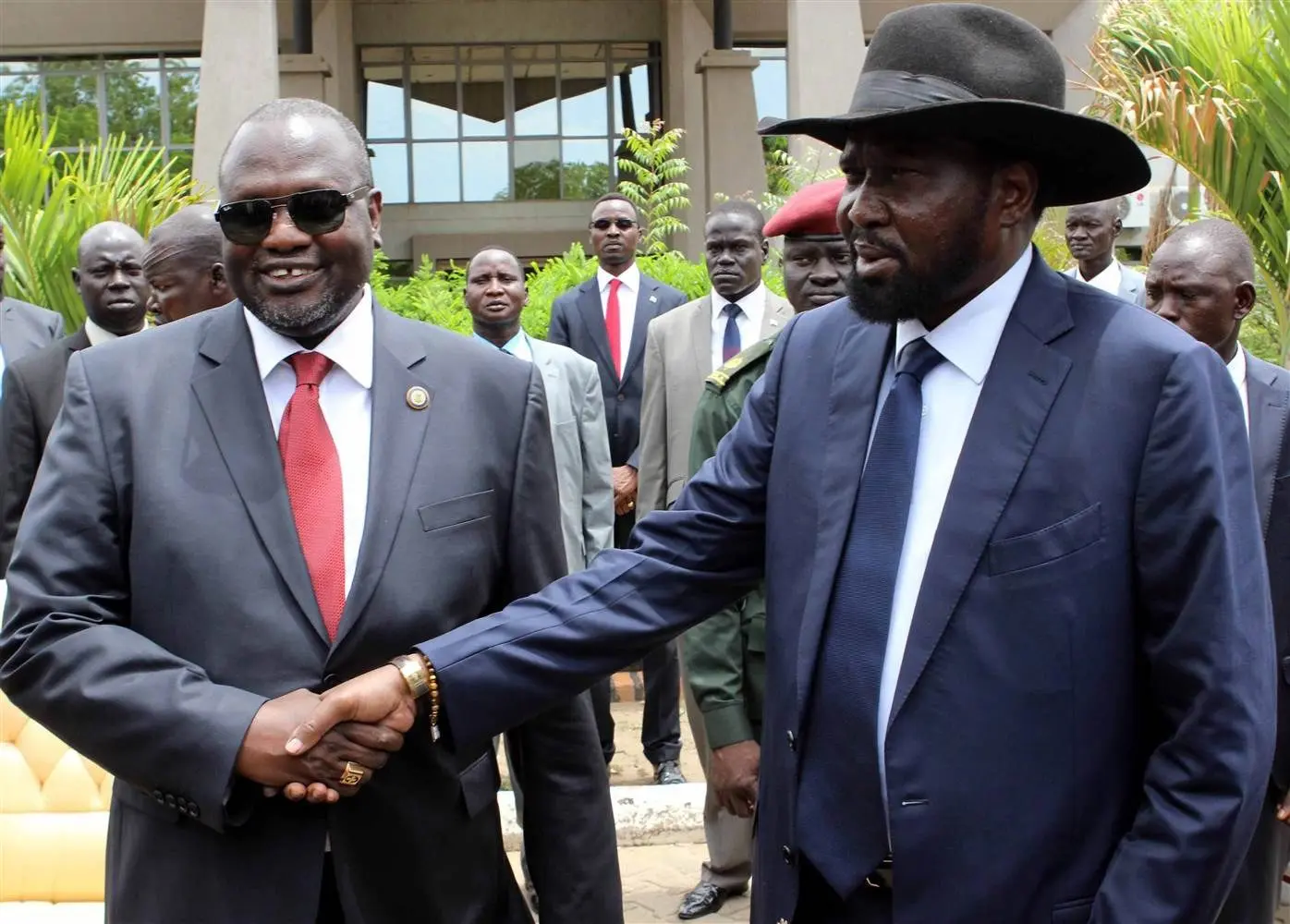
With the US threatening sanctions and weary aid agencies warning that they might pull out, South Sudan’s rival parties and feuding leaders finally formed a new coalition government on 22 February 2020, in a bid to bring peace to the country.
The former rebel and opposition leader Riek Machar was sworn in as first vice-president, sealing a peace deal meant to end six years of civil war that has killed almost 400,000 people and driven millions from their homes. It is the third time since independence that he has been sworn in as vice-president. Similar agreements between the two sides have collapsed twice before, and many observers can only hope that this one lasts.
Among the other vice-presidents named by President Salva Kiir were Taban Deng Gai, a former ally of Machar who switched to the government’s side, and Rebecca Garang, the widow of John Garang, who led the long fight for independence from Sudan.
The transitional government is meant to lead the country to elections in three years’ time. At the swearing-in ceremony President Kiir declared “the official end of the war, and we can now proclaim a new dawn”.
The deal may mark the end of the war, but it does not guarantee peace. This analysis argues that the new government rests on fragile ground: two leaders who had to be pressured into it, neighbours pursuing their own interests, and a state whose public money has been diverted while its people go hungry.
Broken dreams
Before independence from Sudan, South Sudan, a country the size of France, had only 186 miles (300 km) of paved road, and 90 per cent of its people had no access to electricity or clean water.
Barely two years after independence, which ended two decades of guerrilla war against the north, South Sudan was plunged into civil war. The cause was the political rivalry between two of the country’s founding fathers, Salva Kiir and Riek Machar.
Since the civil war broke out in 2013, there have been more than 800 violent events a year on average, and an estimated 400,000 deaths. Many ceasefires were declared, but each was quickly followed by a sharp rise in violence. About four million South Sudanese, a third of the population, have been driven from their homes, and two-thirds of the population, 7.5 million people, need humanitarian assistance.
Years of war have left the country in ruins, with corruption widespread and human rights atrocities committed with impunity.
Key events since independence
On 14 July 2011 the UN General Assembly admitted South Sudan as the organisation’s 193rd member. Salva Kiir became president under a clause in the Transitional Constitution, and Riek Machar was appointed vice-president in 2011 as part of a transitional unity government.
In June 2013 President Kiir removed the finance minister, Kosti Manibe, and the cabinet affairs minister, Deng Alor, over a financial scandal involving millions of dollars, and lifted their immunity from prosecution. In July 2013, amid a power struggle within the governing Sudan People’s Liberation Movement (SPLM), he dismissed his entire cabinet and Vice-President Machar.
On 16 December 2013 President Kiir accused forces loyal to Machar of attempting a coup, and civil war broke out. Rebel factions took several regional towns, thousands of people were killed and many more fled.
On 21 February 2014 members of the UN Security Council received a report on human rights in South Sudan. It set out violations in Central Equatoria, Jonglei, Unity and Upper Nile states, among them the deliberate targeting of civilians in extrajudicial and mass killings, enforced disappearances, gender-based violence and torture, committed by forces on both sides.
In April 2014 the UN accused pro-Machar forces of killing hundreds of civilians in the oil town of Bentiu, and warned that the attack might amount to a war crime.
On 1 July 2015 the Security Council’s 2206 South Sudan Sanctions Committee imposed travel bans and asset freezes on six military figures.
In August 2015 the Intergovernmental Authority on Development (IGAD), a bloc of eight East African countries, brokered the Agreement on the Resolution of the Conflict in South Sudan, the first peace agreement of the war.
In April 2016 Machar finally returned to Juba and was sworn in as first vice-president in a new unity government.
Thousands of people were displaced by clashes in Wau on 24–25 June 2016, in which members of the Fertit community were targeted. In July 2016 fighting broke out again in Juba, and Machar fled the country on foot and went back into exile.
In November 2016 the UN sacked the Kenyan commander of its peacekeeping mission for failing to protect civilians during the July violence in Juba.
On 23 December 2016 the Security Council voted on a draft resolution to impose an arms embargo on South Sudan and targeted sanctions (asset freezes and travel bans) on three senior government and opposition figures, including Machar. The draft failed, with seven votes in favour and eight abstentions. A UN human rights commission had also warned that ethnic cleansing was under way in several parts of the country, a claim President Kiir denies.
In February 2017 famine was declared in parts of South Sudan, in what the UN described as a man-made catastrophe caused by civil war and economic collapse.
In May 2017 President Kiir declared a unilateral ceasefire, months after initiating a national dialogue.
In September 2018 the two sides signed the Revitalized Agreement on the Resolution of the Conflict in South Sudan. The deal provides for new parties to the conflict to join an expanded transitional government and for the many armed groups to be merged into a single security force. It also calls for an Independent Boundaries Committee to settle the number and boundaries of states before the new government is formed. Under the deal, Machar returns to government as one of five vice-presidents.
The deal then missed its deadline twice, putting the fragile country’s peace at risk. The main signatories failed to meet a key milestone, the formation of a government of national unity, by the deadline of May 2019, which was extended to 12 November 2019.
The parties then extended the 12 November 2019 deadline by 100 days. The one-hundred-day extension expired on 22 February 2020, and the question of the number and boundaries of states was finally settled in favour of 10 states, as at independence.
The role of South Sudan’s neighbours
South Sudan was born of a split from Sudan, so the region has always loomed large in its conflict. Its neighbours, above all the four “frontline” states of Ethiopia, Kenya, Sudan and Uganda, have strong stakes in South Sudan. Their influence has at times inflamed the conflict and at times calmed it.
Economic interests
After independence, South Sudan drew investors large and small from Kenya, Uganda, Ethiopia, Eritrea and Egypt into many sectors of its economy. Protecting those investments became one reason for their later involvement.
Oil matters most. Secession cost Khartoum more than 70% of its oil revenue. To make up some of the loss, the Sudanese government charges steep transport, processing and transit fees for moving South Sudan’s crude through its pipeline to Port Sudan on the Red Sea. Crude oil accounts for 98 per cent of South Sudan’s revenue.
Soon after independence, the high cost of shipping its crude pushed South Sudan to look for alternatives. The options included a new pipeline, either through Kenya to the Indian Ocean, or through Ethiopia to the Red Sea ports of Djibouti or Eritrea.
Because Sudan depends on the revenue from its pipeline, it has little interest in a stable South Sudan able to build an alternative.
The dispute between Ethiopia and Egypt over the Grand Ethiopian Renaissance Dam (GERD) has also drawn South Sudan into regional rivalries.
The Nile Waters Agreement signed between Egypt and Britain in 1929 gave Egypt an unprecedented monopoly over the management and use of the Nile’s water, even though 97% of the water that flows into the Nile comes from outside Egypt’s territory. Egypt relies on the Nile for all its domestic, agricultural and industrial water, yet the Ethiopian highlands, where the Blue Nile rises, contribute about 85 per cent of the river’s overall flow. The rest comes from the rivers and lakes of the riparian states south of South Sudan (Burundi, Tanzania, Rwanda, Uganda and Kenya).
Ethiopia’s GERD, with a reservoir that can hold 74 billion cubic metres of water, did not go down well in Egypt, which reportedly threatened Ethiopia with war if the Nile’s flow were disrupted. Egypt and South Sudan do not share a border, but Egypt’s concern for secure access to the Nile’s water shapes its interest in South Sudan.
As the dispute over the GERD went on, the government of South Sudan, allegedly with Uganda’s help, strengthened its ties with Egypt in order to weaken the influence of Sudan and Ethiopia in South Sudan. Sudan, unlike South Sudan, sided with Ethiopia on the GERD, and relations between those two countries improved.
Kenya’s economic interests lie mainly in banking and air transport. Kenyans also formed a large part of the young hospitality industry and ran many small businesses. When the South Sudanese economy contracted sharply after the conflict began in 2013, those interests suffered.
Political interests
Khartoum granted South Sudan’s independence reluctantly. Soon after the partition, Sudan had to issue a new currency as its economy struggled with the permanent loss of more than a third of its revenue.
The fear that Khartoum might try to reverse southern independence shaped relations not only between the two former enemies but also between the West and both countries.
In 2012 relations between Sudan and South Sudan worsened, and South Sudan’s army seized the disputed oil fields at Heglig, a small town claimed by both countries on the border between Sudan’s South Kordofan state and South Sudan’s Unity State.
Khartoum’s courting of key opposition figures after the civil war broke out in 2013 shows how much it wanted to influence events in Juba.
No regional leader has more sway in Juba than Uganda’s President Yoweri Museveni, a long-standing political ally of President Kiir.
Uganda threw its weight behind Kiir and continues to back the status quo in Juba. Over the course of the conflict President Museveni has spent heavily, in money and men, on keeping President Kiir in power, starting with the military intervention from December 2013 that stopped the rebels’ advance on Juba. He has also tried to bring disaffected members of the SPLA/M back into the fold and to rally them behind Kiir and the government’s national dialogue.
Security and territorial interests
The security and territorial interests of IGAD’s member states have shaped the conflict as well. Ethiopia played a leading part in the peace talks that produced the 2015 agreement, but the rapprochement between Cairo and Juba complicated its relations with South Sudan.
In response to reported Egyptian overtures to South Sudan, and to improve its own relations with Juba, Ethiopia signed a security agreement under which both countries pledged not to host rebels or groups opposed to each other’s government.
Sudan, for its part, has strategic security interests in South Sudan and has more leverage over it than any other IGAD member.
Sudan shares the longest border with South Sudan, much of it still disputed or unsettled. The final status of Abyei, in particular, remains a source of tension between the two. A weak and embattled South Sudan lets Khartoum entrench and exploit the status quo in Abyei. It also lets Khartoum extract cheap commitments from Juba to stop backing rebels in Sudan’s Blue Nile and South Kordofan states.
The rivalry between Sudan and Uganda has fed the conflict in South Sudan. During Sudan’s civil war Uganda long supported Sudanese rebel groups, including the Sudan People’s Liberation Army, the guerrilla movement that eventually became South Sudan’s national army.
Sudan, meanwhile, supported Ugandan rebel groups, including the Lord’s Resistance Army. When conflict boiled over in South Sudan in 2013, Uganda and Sudan each picked a side. Uganda sent troops to support Salva Kiir and the government, while Sudan gave limited support to Riek Machar and his faction, the Sudan People’s Liberation Movement in Opposition. After the July 2016 fighting in Juba, Machar, with assistance from the UN, went into exile, first to Kinshasa and then to Sudan.
Both Uganda and Sudan were instrumental in bringing South Sudan’s rival parties to the table to sign the revitalised peace deal of 2018, and in negotiating the latest 100-day extension for forming a unity government. Their continued role as brokers of the agreement, however self-interested, will be essential to its survival.
If the region and the wider international community keep putting their own national interests first in South Sudan, the country’s future is likely to be one of continuing trouble.
Cracks in the wall
The formation of the government on 22 February is an important landmark, but ending a war is one thing and repairing its damage is another. The government has agreed to return the country to 10 states. President Kiir had replaced them with 28 states in October 2015 and raised the number to 32 in January 2017, a move many analysts saw as an attempt to gerrymander the country along ethnic lines. The return to 10 states will create new problems of its own, including tensions over lost government posts and newly unresolved boundaries.
There is also the hard task of merging opposition fighters and government soldiers into one national army, which has not yet been achieved.
Then there is the tussle over who gets which ministry. Dr Machar’s Sudan People’s Liberation Movement in Opposition (SPLM-IO) recently complained that President Kiir’s side has not only taken all the key ministries but has been offering ministries to other signatories without consultation. According to an SPLM-IO representative, the Kiir camp wants to keep the finance, petroleum, defence, interior and foreign affairs portfolios. The opposition wants the four ministries split between the two sides, and is claiming petroleum and interior.
The dispute suggests that the leaders’ priority is the division of power and revenue, and that the government was formed as much to ease external pressure as to serve the public.
Diverted revenue and a hungry population
In a report released days before Machar’s third swearing-in, the UN Commission on Human Rights in South Sudan found that millions of dollars had been diverted from the National Revenue Authority, “depleting resources that could have been used to protect, fulfil and promote the vital economic, social and cultural rights of millions of vulnerable civilians”. More than 55 per cent of civilians, it said, faced acute food insecurity.
The commission said it has reasonable grounds to believe there has been a “steady diversion” of non-oil revenue to an operating account of the National Revenue Authority. By law the authority may keep only 2 per cent of what it collects, and the rest must go to the government’s consolidated account. Yet the commission says it holds credible evidence that in September 2019 the authority’s account received 56 per cent of all non-oil revenue, and that in October and November almost 80 per cent was diverted to it.
The commission was also told that millions of dollars in public revenue vanished in September and October alone. On that basis it said it had reasonable grounds to believe that members of the government had engaged in “acts that amount to economic crimes”, including money laundering and using public funds for personal gain.
Government forces and armed groups alike, the commission found, have pursued policies that starved civilians in Wau and Unity states. “Such policies were envisaged and implemented as part of a wider strategy to deprive enemy communities of resources and thus force their capitulation, allow soldiers and militias to reward themselves, forcibly displace communities from ancestral lands that could then be expropriated or simply to compel individuals to join different factions engaged in the conflict,” the report says. The state, it adds, has neither prevented, investigated nor punished these crimes. The commission concluded that South Sudanese civilians are “deliberately starved, systematically surveilled and silenced, arbitrarily arrested and detained and denied meaningful access to justice”.
Hunger is deepening. A separate multi-partner survey of hunger in South Sudan, released in the same week, said about 40,000 people in eastern Jonglei state now face famine conditions, after severe flooding late last year compounded the insecurity.
Aid workers are targets too. The UN humanitarian office in South Sudan reported that a quarter of the 319 violent incidents against aid workers and assets last year were attributed to state security forces, and that state security forces or civilian authorities were blamed for 70% of the 216 non-violent incidents, such as bureaucratic obstruction. “Humanitarians were requested to pay bribes by both state and non-state actors, which led to the detention of staff and threats of eviction. Humanitarian operations were disrupted by active hostilities and military operations,” the office said.
One hundred and sixteen aid workers have been killed in South Sudan since the civil war began.
What happened next
The transition dragged on. Elections were postponed again in 2022 and in September 2024, and are now scheduled for 22 December 2026, the first since independence. In March 2025 Machar was placed under house arrest in Juba. In September 2025 he was charged with murder, treason and crimes against humanity over an attack in Nasir that March, and was suspended as first vice-president. He appeared in court for his trial later that month. The charges remain allegations. On 21 September 2026 President Kiir signed a law dissolving the transitional government ahead of the vote.



