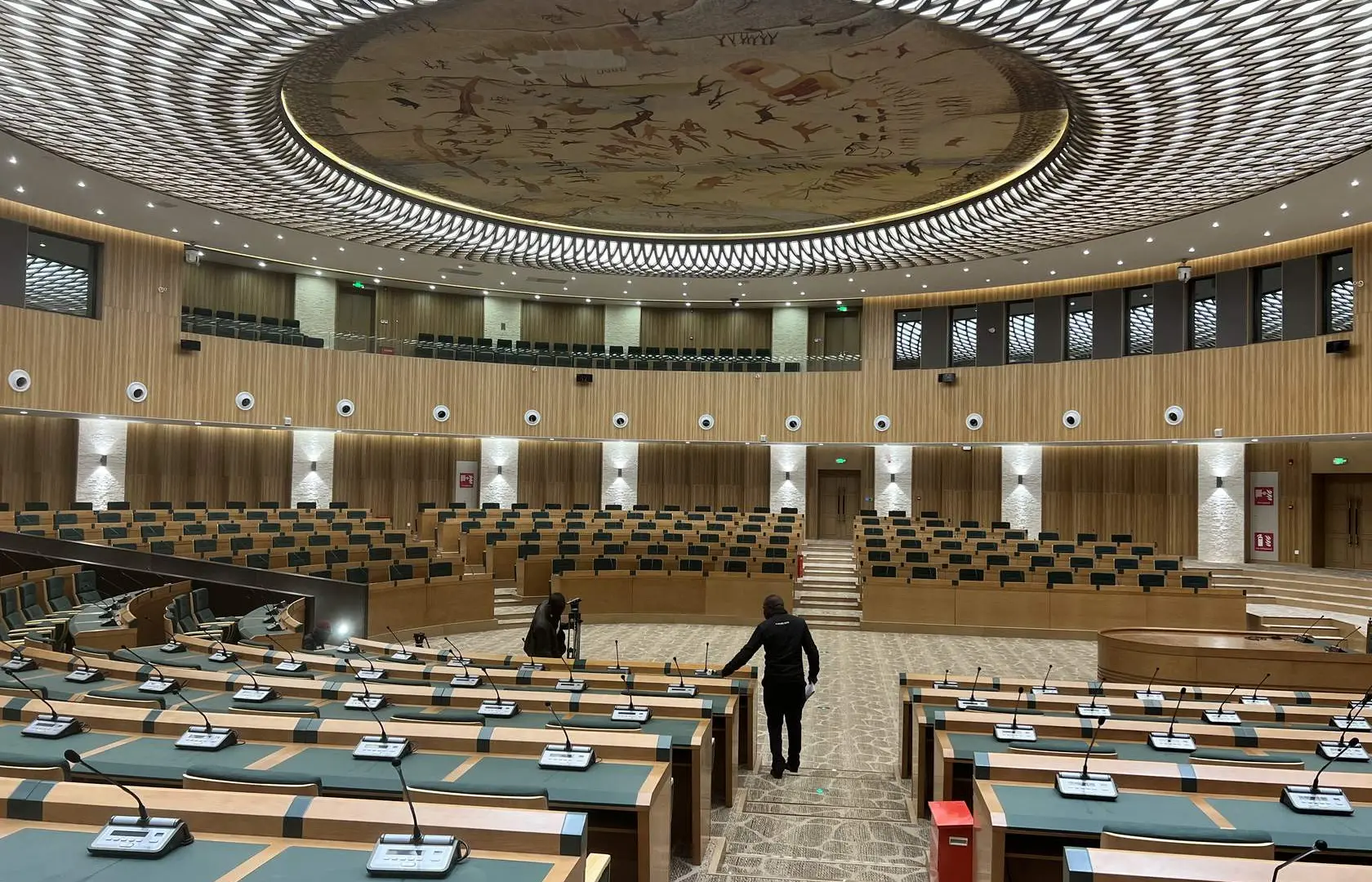
Zimbabwe’s proposed administrative centre at Mt Hampden, northwest of Harare, promises new government facilities and room for urban expansion. Its economic case depends on financing, public services and the priorities it displaces.
President Emmerson Mnangagwa’s government presented the Mt Hampden project as part of Vision 2030, Zimbabwe’s declared roadmap to middle-income status by the end of the decade. The new Parliament building, funded through a grant from China, was presented as the anchor of an administrative hub designed to relieve Harare’s congestion, modernise government infrastructure and signal Zimbabwe’s emergence from the crises of the Mugabe era. The symbolism was intentional: a new capital for a new Zimbabwe, one that could attract investment and restore international confidence.
The symbolism does not resolve the economics. Zimbabwe entered this decade with an economy scarred by hyperinflation, dollarisation, de-dollarisation and the reintroduction of a national currency the market did not find credible. Roads, electricity generation and water treatment reflected decades of underinvestment and deferred maintenance. In that context, a new capital city needed answers to questions the government’s communications did not consistently address.
Chinese financing
China’s funding of the parliamentary complex at Mt Hampden (a grant reportedly in the range of $140 million) is the most concrete financial commitment in the project. It also follows a familiar pattern: China has funded government buildings in several African countries. Such buildings are gifts, but a physical presence in the architecture of governance can bring continuing relationships, including maintenance arrangements and diplomatic goodwill.
For Zimbabwe, the grant removes a significant funding obstacle for the project’s most visible element. But a parliament building is the beginning of a capital city, not its completion. The residential zones, commercial districts, ministry buildings, services and transport links that would make Mt Hampden a functioning administrative centre require financing that has not been secured at the scale the project’s ambition demands.
A parliament building is the beginning of a capital city, not its completion.
The opportunity cost
Zimbabwe’s electricity generation has been insufficient for years, with load-shedding schedules that disrupt both household life and commercial production. Roads, rural health facilities and public education all face funding pressures of their own.
Against this backdrop, a capital city project invites a standard prioritisation question: does Zimbabwe’s greatest need lie in a new administrative complex, or in the systems that determine whether citizens can obtain power, healthcare, clean water and education? The government’s answer, that Vision 2030’s ambitions require modern administrative infrastructure, is not implausible. Nor is the counter-argument, that symbolic infrastructure without improvements in basic services serves the government’s image more than citizens’ welfare. Both can be true at once.
Other capital projects
New capitals are not unprecedented in Africa. Nigeria built Abuja and moved its federal capital there from Lagos; Tanzania has moved its capital functions progressively to Dodoma; Egypt is building a New Administrative Capital east of Cairo. Each carried its own political logic and economic risks. None has been uniformly judged a success on the terms originally declared, though each has produced real infrastructure.
Whether Mt Hampden becomes an economic anchor or an administrative island depends less on the ambition of its designers than on how well it integrates with the surrounding economy. A capital that civil servants commute to from Harare, that lacks the housing to attract genuine relocation and that generates little employment around it produces administrative continuity, not economic transformation. The test is whether the financing to close the gap between the parliament building and the full capital city will materialise before Vision 2030’s deadline forces a reckoning with what was built and what was promised.



