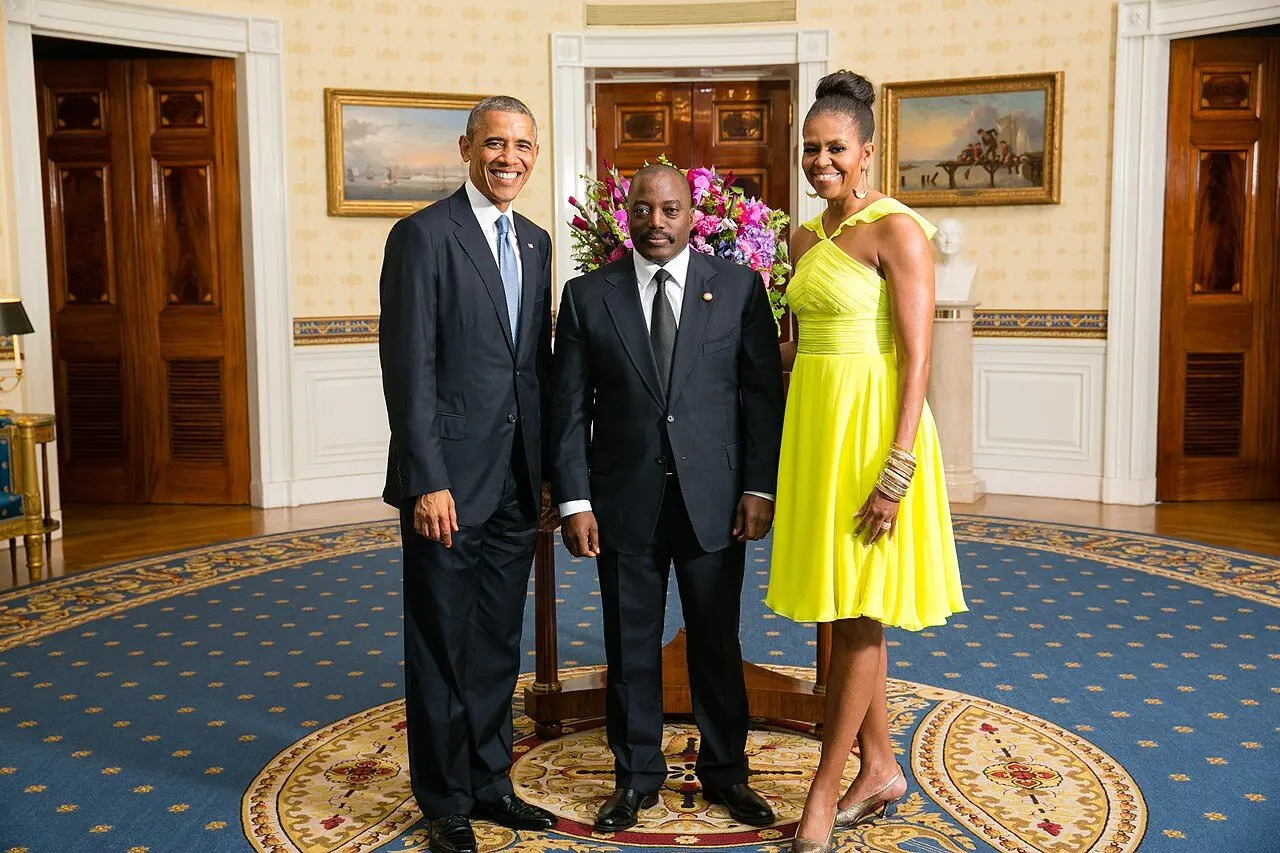
The US Treasury imposed sanctions on former Congolese President Joseph Kabila on 30 April 2026, accusing him of supporting M23 and the Congo River Alliance. The designation targets one node in eastern Congo’s conflict economy. The wider system, fragmented territorial control and mineral supply chains built to keep working despite instability, remains standing.
The decision to freeze assets and restrict financial access tied to Kabila over alleged links to rebel activity comes as fighting persists in the country’s mineral-rich east. For years violence there has disrupted extraction without fully halting it.
Eastern Congo’s conflict involves mineral trade, particularly gold and the tin, tantalum and tungsten supply chains. The country’s main copper-cobalt belt lies farther south. These critical minerals are used in electric vehicles and data infrastructure, and as demand grows, so does the sensitivity of supply chains to disruption. What happens in North Kivu is a variable in industrial planning and geopolitical competition, not a distant security issue. The sanctions treat conflict as an economic risk with downstream consequences as well as a humanitarian concern.
Power beyond office
The Congolese state has long struggled to assert territorial control over its eastern regions, leaving space for armed groups, political intermediaries and cross-border networks. Power there is held through influence over territory, logistics and access routes as well as through formal office. Sanctioning a former president acknowledges that authority in Congo extends beyond current officeholders into networks that outlast electoral cycles.
Resource governance in the east is negotiated through overlapping layers of control: military presence, local alliances and informal taxation that determine who extracts, who transports and who profits. Control of minerals remains fragmented because territorial control is contested, and each condition reinforces the other.
Supply chains that tolerate instability
Supply chains are built to function despite instability, not necessarily to resolve it. As long as minerals keep flowing, even imperfectly, the incentive to restructure the system remains weak. Sanctions are both a signal of concern and an acknowledgement of limited leverage, a formal gesture at the edge of a problem that no financial restriction alone can resolve.
What may be shifting is the cost calculation. As demand for critical minerals rises, tolerance for disruption is narrowing, and governments and companies increasingly treat supply security as a strategic priority rather than a commercial one. That draws attention back to places like eastern Congo, where the gap between resource abundance and governance capacity is widest.
For the continent, the DRC is an extreme case of a recurring pattern. Access to minerals does not automatically translate into leverage. Without control over extraction, processing and trade, value is captured elsewhere. The persistence of conflict in eastern Congo is not simply a failure of security policy. It reflects an economic model that externalises stability while internalising risk.
Some actors profit from instability, but their interests and responsibility must be established through evidence. A conflict that persists keeps the Congolese state too weak to renegotiate the terms on which its minerals leave the ground. Sanctioning a former president touches one node and leaves the wider architecture standing. Until the supply chains that buy the output face the same scrutiny as the actors who fight over it, the conflict economy is likely to keep functioning as it has.



