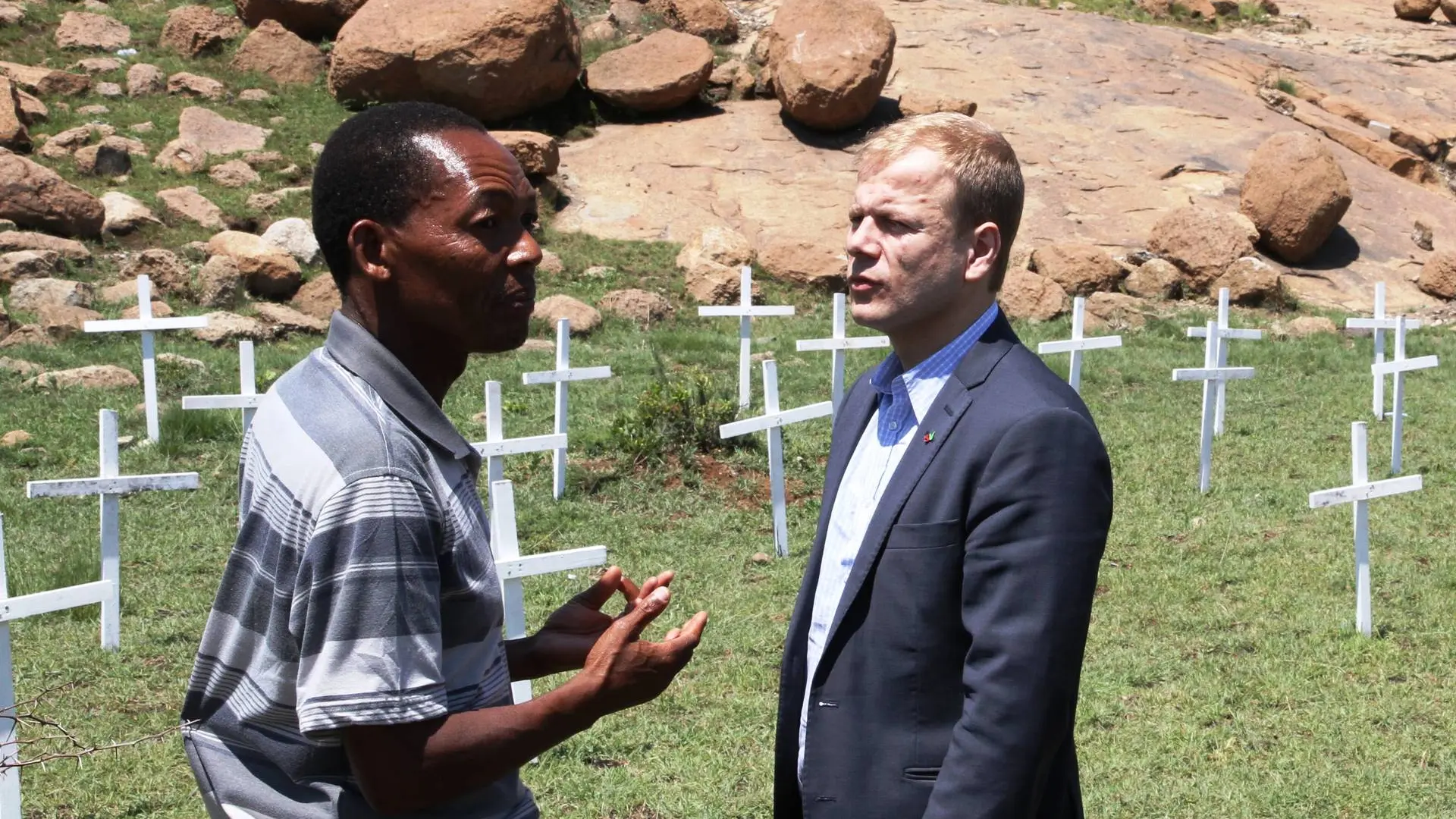
On 16 August 2012, officers of the South African Police Service (SAPS) opened fire on a large crowd of striking mineworkers at Marikana, in North West Province, about 100km (60 miles) north-west of Johannesburg. They shot 112 men, killing 34 and seriously injuring 78. The scenes brought back memories of the massacres of the apartheid era.
The shootings ended a week-long wage strike at Lonmin’s platinum mine. At almost every turn that week, the company, the miners’ union and the police chose force or silence over talks, and the deaths that followed were avoidable.
The beginning
The miners were on a wildcat strike, a stoppage called by union members without the approval or support of their union’s leadership.
The strike began on Thursday 9 August 2012. About three thousand rock-drill operators, who did potentially dangerous work in stifling heat for relatively meagre pay, gathered at the Wonderkop football stadium near the administrative buildings at the heart of the mine complex. Their employer was Lonmin, a British mining company, and they wanted a living wage. In his reconstruction of the strike for The Guardian (republished by the Mail & Guardian), the journalist Nick Davies reported that Lonmin’s security men asked the police watching the gathering to disperse it. The police reportedly answered that the strikers were causing no trouble. Lonmin security then fired more than 40 rubber bullets at them.
The cause
On 11 August 2012, a large group of strikers went to the local office of the National Union of Mineworkers (NUM) to ask their union for support. They were met with live gunfire, and two of them were shot and wounded.
Pay was at the root of the dispute. The strikers earned roughly $490 to $610 a month at the exchange rates of the time, while Lonmin had announced annual net earnings of $273m for its shareholders in 2011, the year before the massacre. Word had also reached them that rock-drill operators at the Impala platinum mine near Rustenburg, a town about 29km (18 miles) away, had come out of a long and sometimes violent strike with new pay rates. The Lonmin men were still on 4,000 to 5,000 rand a month (about £315–395 at the time), and they were angry. They demanded 12,500 rand (about £985) and agreed that they would not turn up for work the next day.
The collapse of trust between the miners and their union made a volatile situation worse. The miners and their families were trying desperately to be heard and to have their needs met, but the strikers could secure no meeting with either NUM or Lonmin.
Between 12 and 14 August, at least four miners, two police officers and two security guards died in the violence that followed. On 13 August, 30 miners were sent across the veld towards another Lonmin mine, Karee, where workers were also on a wildcat strike. Security staff turned the 30 back before they could meet the Karee miners. On their way back they ran into a police contingent which, according to eyewitnesses cited by South African History Online, numbered about 10 Nyalas (armoured police vehicles) and two police trucks. The police blocked the road and ordered the workers to lay down their pangas (machetes). The workers refused, saying they needed them for everyday life in the bush.
The police let the miners walk on. When the men were about 10 metres away, officers allegedly opened fire, first with rubber bullets and then with live ammunition, and the miners fought back. Davies reported that the North West provincial police commissioner, Lt Gen Mirriam Zukiswa Mbombo, was sitting with Lonmin managers at that moment, watching the strikers on closed-circuit television. Mbombo had joined the police in 1980 and risen quickly through the ranks after apartheid ended. According to evidence before the Farlam inquiry, as Davies reported it, she set up a joint operations centre in Lonmin’s office, where her officers worked not only with the company but also with NUM officials who were helping them identify strike leaders.
Police video shows several minutes of calm before some officers threw tear gas and stun grenades at the strikers. Whether anyone ordered them to do so has never been established. What followed was a disaster. Two police officers and three miners were killed in the clash, and others were badly injured.
Barnard Mokwena, then Lonmin’s executive vice-president, wrote an internal memo, later disclosed to the Farlam inquiry, which advised that the company should not tolerate demands that were “outside the collective bargaining structure”. The strikers had rejected their own union, accusing it of siding with the bosses. With the union not involved, the company could decline to recognise the strike and refuse to negotiate. Mokwena urged that, instead of talking, Lonmin should dismiss the strikers and call in the police to deal with them.
The strike went on all the same, without NUM’s support and without any formal commitment from Lonmin’s management to negotiate. The miners stood together for a shared goal, a better quality of life and the dignity it brings. Their families largely backed the protest, joining demonstrations and bringing supplies when they were needed.
Because neither NUM nor Lonmin formally addressed their grievances, the protesters met hostility from security staff, the police, union officials and management alike.
The day of the massacre
On 16 August, the police moved against the strikers in full force. More than 400 officers were deployed, most of them in camouflage and armed with R5 or LM5 assault rifles. Barbed wire was laid along the outer perimeter to hem the miners in, and armoured police vehicles and helicopters were brought to the scene. The deployment alarmed the strikers. About a dozen miners were filmed being shot directly, and the footage caused outrage around the world. Most of those killed and wounded, however, were out of sight of the cameras. Some bodies were reportedly found behind boulders, and some men appear to have been shot as they retreated. Many of the dead and injured had gunshot wounds in their backs, and some miners had injuries from being run over by Nyalas.
The inquiry and the courts
At a press conference, SAPS said its officers had fired in self-defence after the miners tried to attack them with machetes, spears and clubs.
The Marikana Commission of Inquiry, chaired by the retired judge Ian Farlam, was set up to investigate the killings. It first sat on 1 October 2012 and held its final sitting on 14 November 2014, and its report was submitted to President Jacob Zuma on 31 March 2015.
The report cleared several senior political figures who had been accused of a hand in the events leading to the massacre. They included Cyril Ramaphosa, a non-executive director of Lonmin at the time of the shootings and Deputy President by the time of the report, the former police minister Nathi Mthethwa and the former mineral resources minister Susan Shabangu. It did not clear the National Police Commissioner, Riah Phiyega, but recommended an inquiry into her fitness to hold office. It found that Lonmin had failed to engage with its workers, and that the two unions in the sector, NUM and the Association of Mineworkers and Construction Union (AMCU), had not had full control of the members who joined the unprotected strike.
The former North West deputy police commissioner William Mpembe and three co-accused, Gideon van Zyl, Dingaan Madoda and Oupa Pule, were tried in the North West High Court. The state alleged that they had failed to disclose that a mineworker, Modisaotsile van Wyk Sagalala, died in police custody on the Lonmin mine premises on 16 August 2012. Mpembe was charged with contravening the Commissions Act and the Independent Police Investigative Directorate (IPID) Act and with defeating the ends of justice. Van Zyl, Madoda and Pule were charged with defeating the ends of justice and contravening the IPID Act. The court later acquitted all four on every charge, finding that the state had failed to prove its case.
Lonmin’s response
After the shootings, Lonmin issued a statement that expressed regret for the loss of life, stressed that the police were responsible for security during the strike and separated the violence from the industrial dispute. It told the strikers to return to work on 20 August or risk dismissal. Simon Scott, Lonmin’s acting chief executive, said after the shootings that the company needed to “rebuild the Lonmin brand and rebuild the platinum brand”. The workers rejected the ultimatum and vowed to keep protesting until their wage demands were met, since anything less would be an “insult” to the dead. Lonmin then extended the deadline by 24 hours, as Zuma called for a period of mourning.
Lonmin had halted production when the strike began, and it said it was unlikely to meet its full-year guidance of 750,000 ounces (about 23.3 tonnes) of platinum. It said it would have to monitor its bank debt levels because of the disruption, and its ability to refinance that debt was called into question.
The massacre also brought renewed public calls for wide reform of South Africa’s extractive industries, and it helped give rise to a new political party, the Economic Freedom Fighters.
Marikana has become a symbol of what happens when a company, a union and the police choose force over negotiation.



