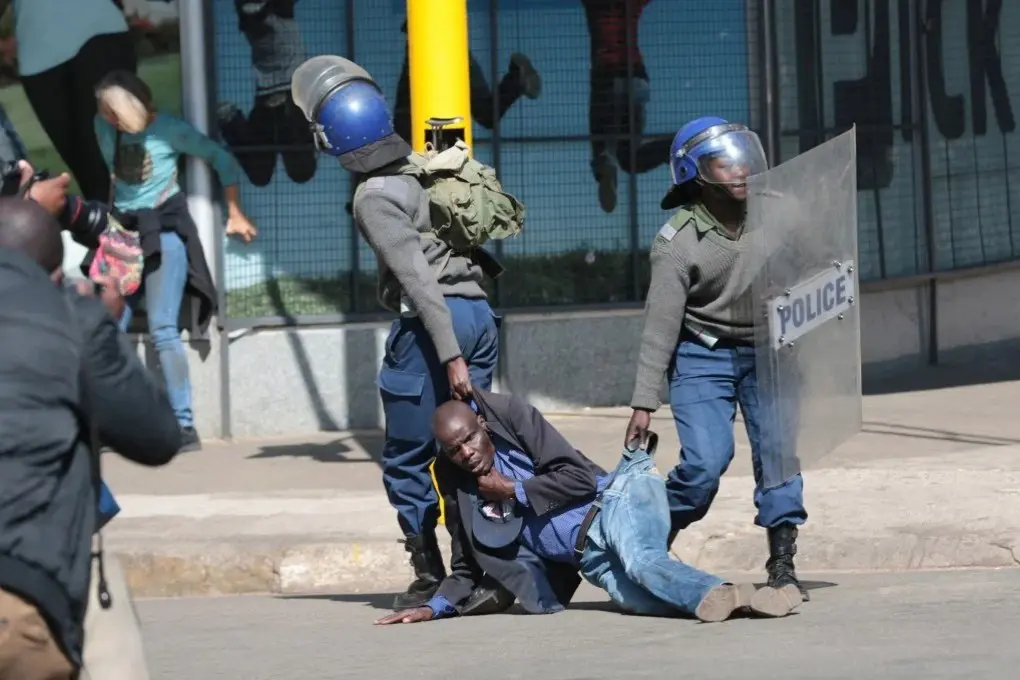
Police violence against civilians recurs in African countries with very different histories, from apartheid-era and post-apartheid South Africa to Nigeria, Kenya and even Botswana. The abuse ranges from unlawful arrest, assault and looting to killing. This piece argues that much of it stems from poor training, and that reform cannot wait.
In countries such as South Africa and Nigeria, police conduct has drawn criticism from human rights observers around the world. In Nigeria, the police have lately been in the news after killing innocent civilians, adding to calls for the Special Anti-Robbery Squad (SARS), a unit drawn from the police, to be scrapped after countless abuses by its armed officers.
In South Africa, the conduct of police officers in 2012 and 2013 caught the world’s attention. In February 2013, eight officers in Daveyton, east of Johannesburg, tied Mido Macia, a Mozambican taxi driver, to the back of a police van and dragged him for about 500 metres along the street. He died. This came only months after police opened fire on striking mineworkers at Marikana, killing 34 of them.
A long and ugly record
The Sharpeville Massacre of 21 March 1960 is one place to start. Police fired live rounds into a peaceful crowd, killing 69 people by the count in their own records. In the Soweto Uprising of 16 June 1976, police killed pupils in Soweto, cementing their role in the service of the apartheid government. Then came the Marikana Massacre on 16 August 2012, when the South African Police Service killed 34 mineworkers. In each case the police turned their guns on the unarmed civilians they were supposed to protect.
In Nigeria, the police slogan “Police is your friend” rings hollow for many. The recent killing of an innocent bystander, Kolade Johnson, is one example.
On Saturday 13 April 2019, two more people were reported to be the latest victims of police brutality in the country. A 20-year-old woman, Ada Ifeanyi, was killed, allegedly by officers from Trinity Police Station in Ajegunle, Lagos. Emmanuel Akomafuwa, 32, was injured and is still fighting for his life. The alleged killing, at about 7am, has prompted more anger on social media, and Nigerians are asking when police brutality will stop.
Relations between the Nigeria Police and citizens are marked by deep distrust. The force and the federal government will need to work continuously to improve those relations and earn the respect and trust of citizens.
Botswana and Kenya
Even Botswana, widely regarded as having the best police force in Africa (as at 2017, when it topped the continent in the World Internal Security and Police Index), has a record of brutality. Its riot police have used sjamboks, or whips, on protesters, as when they whipped members of the Botswana National Front Youth League picketing Parliament in August 2016, Mmegi reported.
In Kenya, police left Boniface Manono by the roadside during a demonstration in Nairobi in May 2016 after kicking and stomping on his motionless body, Human Rights Watch reported. Doctors X-rayed his back, and he was left walking with a limp. He told the Daily Nation that journalists helped him up after the police left. He insisted he had been walking from the Uber offices, where he was activating his account as a driver, when he found himself caught up in the demonstration, and ran when a tear gas canister exploded at his feet.
“I started running away and that’s when one policeman hit me on the leg and I fell on the pavement,” he said.
Muthoni Wanyeki, Amnesty International’s regional director for East Africa, the Horn and the Great Lakes, said the day after the protest: “The brutal beatings by police yesterday amount to arbitrary and abusive use of force, which is illegal under Kenyan, regional and international law” (Amnesty statement).
Training the police properly
In the author’s view, inadequate training lies behind much of this conduct. Training is an art that requires not only the ability to perform tasks but the ability to explain why and how they are done, including to the public during raids and stop-and-search operations.
Where training does not address the challenges officers face on the street, they fall back on illegal methods of restraint and arrest, and on methods of interrogation that break the law and violate citizens’ human rights.
Training needs to be reassessed and improved, with a focus on how police should behave at public protests, during raids and in stop-and-search operations. As a society, it is in our interest to have a well-educated, well-trained police force that can handle a variety of situations and a diversity of people, while upholding life, liberty and the law.
Police brutality must be taken seriously and dealt with urgently. The police need to be reined in, so that they cannot abuse their power and exploit the people they are meant to protect, and whistle-blowers and human rights activists should keep calling for an end to the misuse of power by armed forces.
What happened next
In South Africa, all eight former officers involved in the death of Mido Macia were convicted of murder in the North Gauteng High Court on 25 August 2015 and each was sentenced to 15 years in prison, according to the case record. The Farlam Commission into Marikana, which reported in 2015, criticised police strategy and conduct, but also the strikers, the unions and mine management (summary of the inquiry).
In Nigeria, the calls to scrap SARS grew into the #EndSARS protests. The police announced the unit’s dissolution on 11 October 2020, saying a new Special Weapons and Tactics (SWAT) unit would replace it (record of the unit). On 20 October 2020, protesters at the Lekki toll gate in Lagos were reportedly shot at by soldiers, an allegation the army and the government deny. Amnesty International counted at least 12 people shot dead in Lagos that month, while the government confirmed two (overview of the protests).



