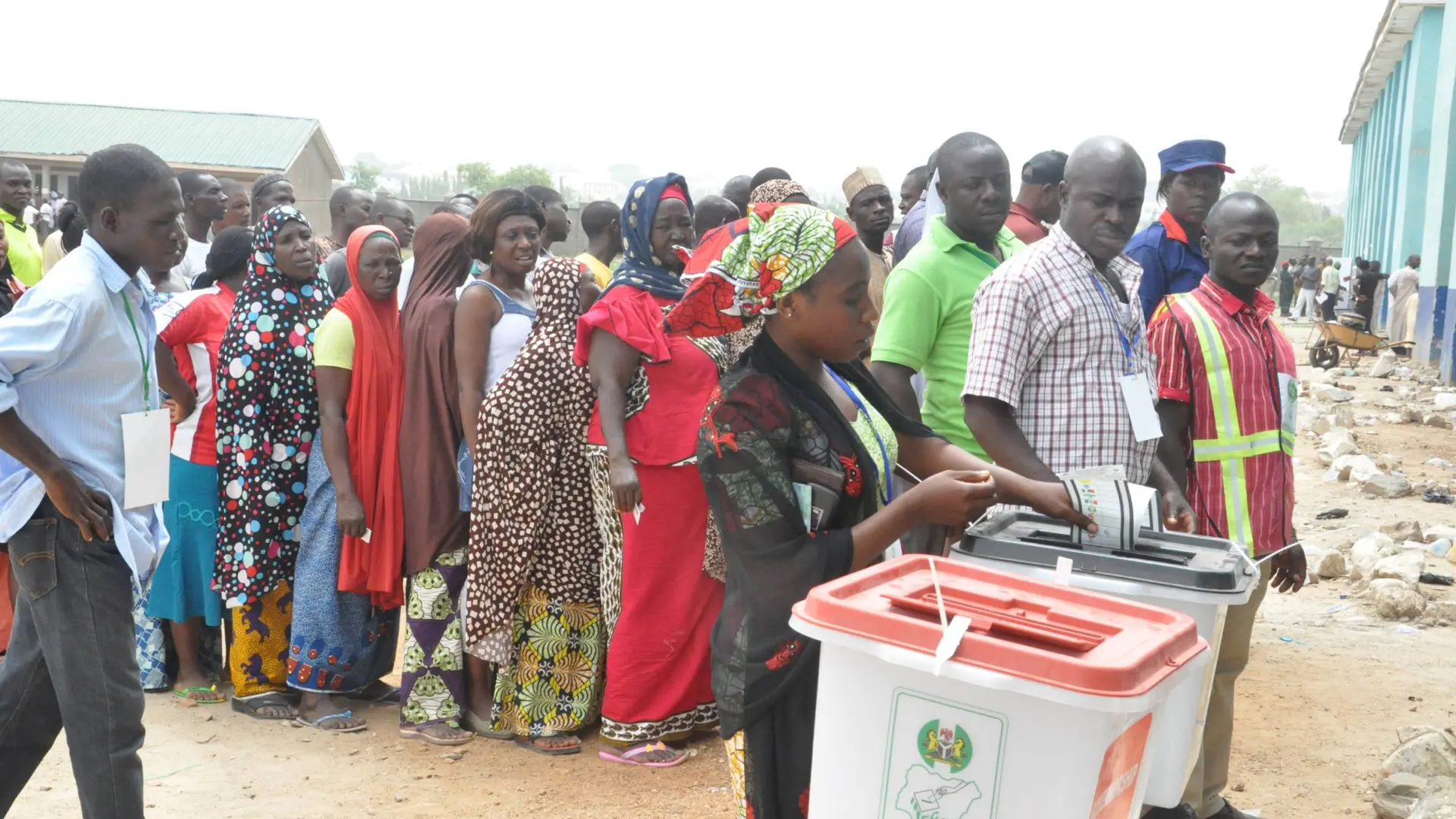
Disputed elections have become one of the gravest threats to peace in Africa. Where incumbents meddle in the vote, the electoral bodies that should guard the people’s choice lose the public’s trust. Technology, used fully and openly enough that voters can follow the count, offers those bodies a way to prove their independence.
On 9 April 2018, Abuja hosted a conference of election management bodies (EMBs) from West and Southern Africa. It was chaired by the head of Nigeria’s Independent National Electoral Commission (INEC), Prof Mahmood Yakubu, who made the following remarks:
“…we have to contend with the disturbing but rapidly increasing incidence of election-meddling through the deployment of counter-technology on a global scale by state and non-state actors. Nevertheless, technology has come to stay and its benefits are immense… we shall be better prepared in making the choice of the appropriate and cost effective technology that increase the public confidence in the electoral process. This will also help us further protect the sanctity and integrity of the ballot”.
Election crises
The African Union (AU) has identified elections and political transitions as among the main threats to peace and security on the continent over the past two decades. The 2013 African Governance Report of the UN Economic Commission for Africa says that in the decades after independence electoral bodies were weakened by executive whims, because judiciaries and legislatures were weak too. Since 2000, political space has widened, and as more people take part in governance, there is more room for opposition to challenge established leaders.
In a 2016 article for Africa Renewal, Zipporah Musau cited the Brookings Institution’s list of African countries where elections had aggravated social divisions and political violence. It featured Angola, Burundi, Central African Republic, Congo, Kenya, Nigeria and Zimbabwe.
The umpires
The pressure falls hardest on the umpires. Election is the most acceptable way of creating a legitimate leadership, so electoral bodies have to be completely neutral. Their duty is neither to favour newcomers nor to protect incumbents and those they have groomed. The choice must be the electorate’s alone. Where incumbents meddle, directly or indirectly, the electorate loses confidence in the umpire.
According to John Mukum Mbaku of the Brookings Institution’s Africa Growth Initiative, quoted in Africa Renewal, to be truly independent an electoral body should have:
- decisional independence, to decide freely
- institutional independence, to perform its functions without undue interference from the government
- adequate resources
- a system of accountability
- a procedure civil society can use to file complaints against members of the electoral body for illegal or unethical conduct.
Where manual counting fails
Electoral malpractice will not vanish as long as much of the process is done by hand, away from public view. At every such point, figures can be doubled, halved or doctored.
Zimbabwe’s 2018 election shows the risk. Many had hoped for something closer to an e-election, but results were still collated by hand, and the handwritten figures that emerged show how easily manual collation invites dispute.
In Mali, the 29 July presidential election was followed by accusations of malpractice against the electoral body, and the country is now completing a runoff. The accusations persist in part because voters cannot see how the votes are counted.
Nigeria tried to close that gap in 2015. The plan was to accredit voters with card readers, so that each accredited card would be picked up by the central collation unit and polling units would be in sync with the centre. But card readers failed in many places on polling day, including when President Goodluck Jonathan himself tried to be accredited, and voting had to be extended to 29 March. Where the readers failed, INEC allowed polling units to accredit voters manually, and that opened avenues for irregularities.
Voters are already counting
While electoral bodies are still “considering” the cost of going fully digital, the electorate has moved ahead. While an election is under way, people at polling stations post “results” on Facebook, WhatsApp and Twitter, only to see something different hours later. That gap breeds protest. Parallel vote tabulation (PVT) is also on the rise in Africa. People want to know every detail of an election, which is their right, and once the electoral body hides any detail, trouble looms.
As President of the ECOWAS Network of Electoral Commissions, Prof Yakubu has noted the “immense benefits” of technology in elections. What is needed is committed investment in devices that record votes as they are cast, so transparently that losers know they lost, and in a count that every citizen can follow online. In the AU’s 2018 election calendar, many more parliamentary, presidential and general elections are to come after those of Djibouti, Sierra Leone, Egypt, Zimbabwe and Mali, and South Africa and Nigeria, the two heavyweights, will hold theirs in 2019. Electoral bodies that want to be trusted have no choice but to make full use of technology and to open their counts to public view.
What happened next
The doubts the author raised did not go away. In Zimbabwe, Emmerson Mnangagwa was declared winner of the 2018 presidential vote with just over 50%. The opposition MDC Alliance said the declared figures did not match the V11 result forms posted at polling stations, and its court challenge was dismissed on 24 August 2018. In the August 2023 election, ballot-paper shortages forced voting to be extended by a day, and observer bodies including SADC described the vote as not free and fair.
Mali’s runoff on 12 August 2018 returned Ibrahim Boubacar Keïta with 67.16% of the vote. Two years later, on 18 August 2020, the army removed him, and Colonel Assimi Goïta seized power again in May 2021. In May 2025 Mali’s military government dissolved all political parties, and in July 2025 the transitional council gave Goïta a five-year presidential term, renewable without an election.
Nigeria did invest in technology. INEC replaced the card reader with the Bimodal Voter Accreditation System (BVAS), first used widely in the Anambra governorship election of November 2021, and the Electoral Act 2022 gave such devices legal backing. BVAS was used nationwide in the 2023 general election, but the European Union’s observers reported substantial delays in uploading presidential polling-unit results to INEC’s IReV portal; when the result was declared, more than a quarter of the forms were still not online. The Electoral Act 2026, which repealed the 2022 law, now names BVAS expressly.



