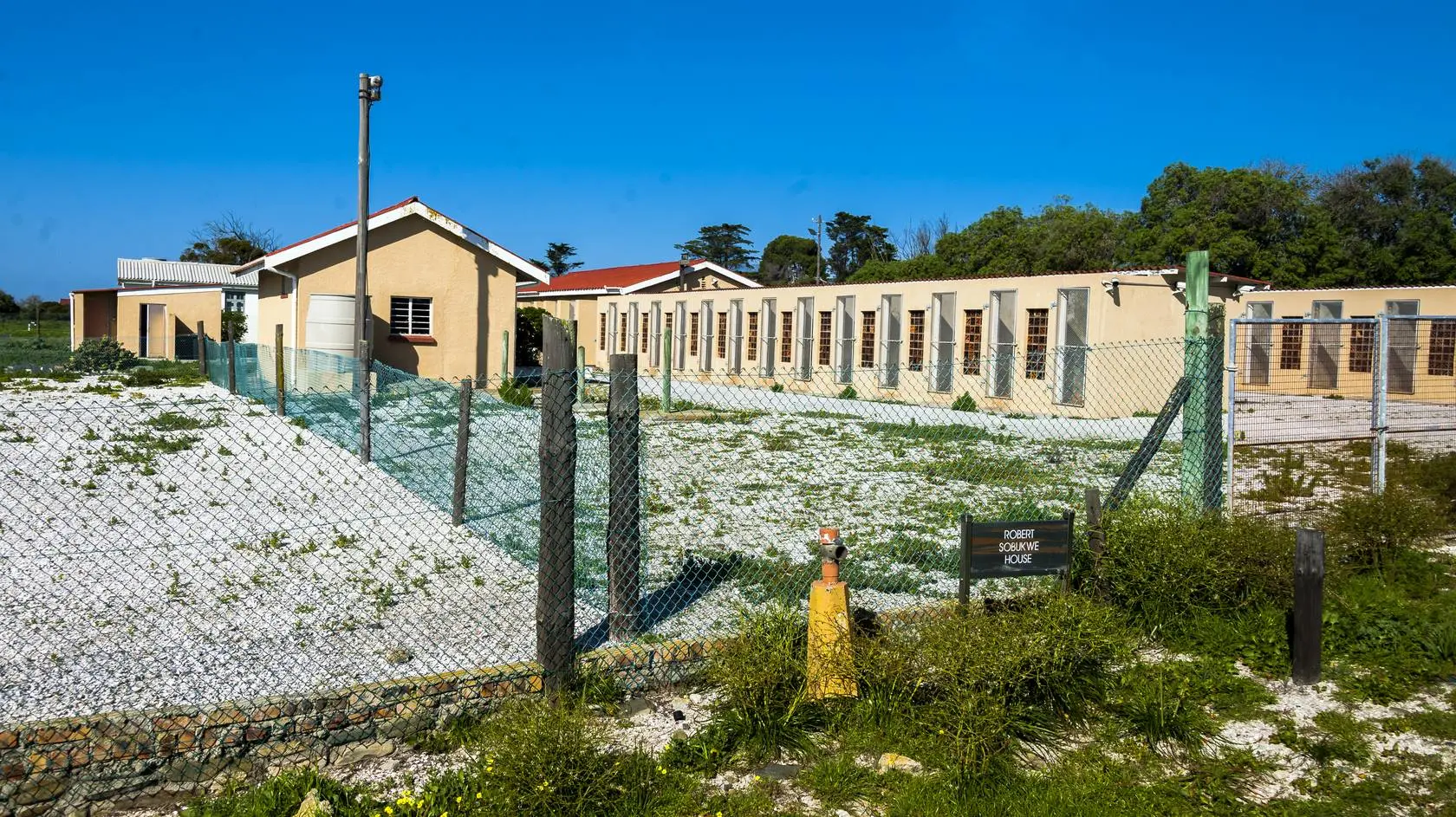
Few leaders of the struggle against apartheid unsettled the South African state as much as Robert Sobukwe. He believed in an Africanist future for the country and rejected strategies that depended on alliances with non-African organisations. To him, an African was anyone who lived in Africa, was loyal to it and backed African majority rule. Accusing the ANC of letting non-Africans interfere in its affairs, he broke away and founded the Pan Africanist Congress (PAC), which elected him its first President in 1959. His central concern was how black South Africans could “liberate themselves” without the help of non-Africans, and his activism inspired many of the people and organisations of the Black Consciousness Movement.
The state’s answer to him was a law written with his name on it. When his prison sentence ended, Parliament passed a clause that let the government keep him locked up, and no one else was ever held under it.
A poor boy from Graaff-Reinet
Sobukwe was born on 5 December 1924 in Graaff-Reinet, in the Cape Province, the youngest of six children, five boys and a girl, according to South African History Online. The family was poor. His father was a municipal labourer who cut wood part-time, and his mother was a domestic worker who also cooked at a local hospital.
Books reached him early, through his eldest brother. After a mission school in Graaff-Reinet and Standard 6, he spent two years on a Primary Teachers’ Training Course, only to find no teaching post at the end of it. So he went back to school. At the Healdtown Institute he studied for six years, with financial help from the headmaster, George Caley, and lost time in 1943 when tuberculosis put him in hospital. A bursary from the Department of Education and a loan from the Bantu Welfare Trust then took him to Fort Hare University in 1947, where he registered for a BA in English, Xhosa and Native Administration. Literature stayed his great interest, poetry and drama above all.
Fort Hare and the making of an Africanist
He arrived at Fort Hare with little interest in politics. Native Administration changed that, and so did one of his lecturers, Cecil Ntloko, an ardent follower of the All African Convention (AAC). The university had already politicised generations of young black South Africans and black students from elsewhere in Africa, and Sobukwe was no exception.
In 1948 he and three friends launched Beware, a daily publication that argued for non-collaboration and criticised the Native Representative Councils and Native Advisory Boards. The same year he joined the African National Congress Youth League (ANCYL), which Godfrey Pitje, a lecturer in African Studies who later became the league’s president, had set up on campus. Sobukwe and his classmates had held back at first, believing that the African National Congress (ANC) had lost its ideals.
Elected president of the Fort Hare Students’ Representative Council (SRC) in 1949, he proved a gifted speaker, and his last speech as president, in October 1949, made his name among his peers. That December Pitje chose him as National Secretary of the ANCYL. The writings of Anton Lembede moved him towards an Africanist position inside the ANC. Later in 1949 he met Veronica Mathe, then training as a nurse at Alice Hospital, and they married in 1950.
Teacher, lecturer and editor
In 1950 he took a teaching post at a high school in Standerton. Speaking out for the Defiance Campaign cost him the job in 1952, though he was later reinstated. He remained secretary of the ANC’s Standerton branch but took no direct part in its activities.
A move to Johannesburg in 1954 brought a lectureship in African Studies at the University of the Witwatersrand, and with it the nickname “the Prof”. Within the ANC he sided with the Africanists, and in 1957 he became editor of The Africanist newspaper. In 1958 he completed his Honours dissertation at Wits, “A collection of Xhosa Riddles”.
The anti-pass campaign and Sharpeville
In December 1959, a week after the ANC announced its anti-pass campaign, the PAC announced a campaign of its own against the pass laws, with the aim of freeing South Africa by 1963. On 16 March 1960 Sobukwe wrote to the Commissioner of Police, Major General Rademeyer, to say that the PAC would hold a five-day, non-violent, disciplined and sustained protest against the pass laws, starting on 21 March.
When the campaign began on 21 March 1960, Sobukwe resigned his lectureship and walked to Orlando police station in Soweto to give himself up. He and most of the marchers with him were arrested and charged with sedition. The same day, at Sharpeville, police opened fire on a crowd of an estimated 5,000 protesters outside the police station, killing 69 people and injuring 180 others, in what became known as the Sharpeville Massacre.
A law for one prisoner
An order of 25 March 1960 banished him to the Driefontein Native Trust Farm in the Vryburg District (Northern Cape, now North West Province). He never served it, because he was jailed for incitement instead. On 4 May 1960 he was sentenced to three years in prison for inciting Africans to demand the repeal of the pass laws. He refused to appeal, although he could have done so.
As the sentence ended on 3 May 1963, Parliament passed a General Law Amendment Act containing what became known as the “Sobukwe Clause”. It gave the Minister of Justice the power to extend the detention of any political prisoner indefinitely. Sobukwe was moved to Robben Island and held there in solitary confinement for six more years. The clause was never used against anyone else, yet the government renewed it every year.
Banished to Kimberley
Released in May 1969, he was banished to Galeshewe in Kimberley, where his family joined him. He lived under twelve-hour house arrest, and his banning order barred him from any political activity. In 1970 he won a teaching post at the University of Wisconsin in the US, but the apartheid government refused him a passport, even though the US government had assured him of a visa. When he applied in 1971 to leave South Africa for good with his family, he was refused again.
He was allowed to attend family gatherings outside Kimberley. He also took up law, served his articles in the town and opened his own firm in 1975.
Illness and death
Not long after he opened the practice, he fell ill. In July 1977 he asked for permission to seek treatment in Johannesburg, and after Benjamin Pogrund, a close family friend, intervened, he was allowed to travel there under strict conditions on 9 September. Doctors found lung cancer, and he was transferred to Groote Schuur Hospital in Cape Town, where the security branch told the staff to admit no visitors except his family.
His wife asked the Cape magistrate to let him stay with a family friend, Bishop Pat Matolengwe. The government delayed the request, but on 14 October he was temporarily discharged, and the bishop took him from the hospital. He was then sent back to Kimberley, from where he was due to return to Cape Town for more treatment, and he had to report to the police every time he left the town.
The government held him to the conditions of his restrictions even as his health plainly failed. He died of lung complications at Kimberley General Hospital on 27 February 1978, and he was buried in Graaff-Reinet on 11 March 1978.



