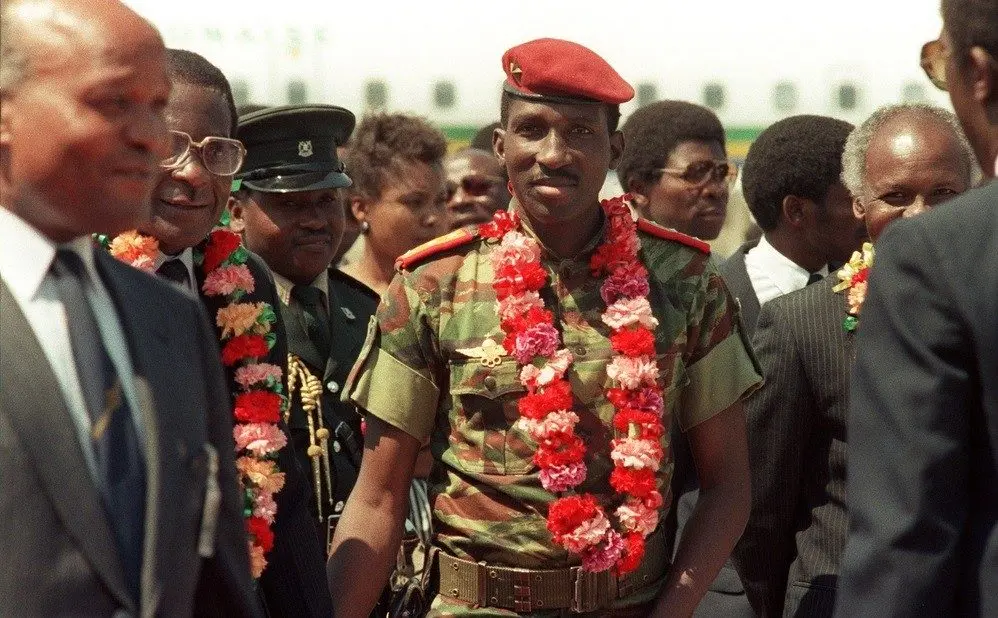
When we discuss the failures of national leadership, I often hear compatriots close the conversation with a hopeless line: “It’s not easy to be a leader.” The implication is that we should not hold leaders to account, because they are “trying” their best. Thomas Sankara of Burkina Faso, who achieved more in four years than many African leaders have in decades, shows why that excuse will not do.
Of course leading is not easy. No job, no research, no worthwhile undertaking is easy. What governance needs is the spirit of “let’s do this”, not “it’s not easy”. Governance, the organisation and direction of a society’s life and systems, is a collective job. It requires a constant pooling of ideas and a search for the best people to carry out the vision of those in charge.
The excuse of difficulty
To head a country or a state is to accept responsibility for the lives entrusted to you. It becomes your task to build a system in which:
- food is available and affordable;
- good health care is accessible;
- lives and property are secure;
- children and young people are educated, so that there is a steady flow of skilled workers;
- industries are created.
Too often, in the author’s view, leaders are torn between their personal and family needs and the needs of society, and choose the first. While they race to satisfy their own ambitions, the systems are compromised and become tangled in haphazard programmes and policies that cannot be implemented. Then they look at the mess, turn to the people and say it is not easy up here. Yet the same leader who tells us how uneasy lies the head that wears the crown will do everything to keep it.
Governing needs specialists in management, policymaking, analysis and strategy, but politics, a game of crisscrossing interests, gets in the way. The people’s wishes are mortgaged to personal or group interests, and everything becomes distracting for those who should be thinking about food, housing, health care, security, education and industry. To gain and keep control, leaders take uncivil and careless steps that open a divide between the leaders and the led.
Any leader who sets aside personal goals for the good of society therefore becomes exceptional. This is where Thomas Isidore Noël Sankara becomes our example.
Enter Thomas Sankara
Many young Africans, sadly, know little about this pan-Africanist. This essay does not set out to detail his programmes and policies, nor to claim that he made no mistakes. Its point is that whatever the challenges, the will to do what is necessary makes the impossible possible. His record shows that identifying and providing what people need is the reason governments exist at all.
He was a military ruler who took power before his thirty-fifth birthday, in a country that depended on foreign aid. He rejected loans from the IMF and preached self-reliance, though he did accept some aid. How he cut that dependence is a marvel only because we are used to things not working. He simply got to work. What he did was not impossible before he did it; in the author’s view, the governments before him had simply never made the people’s needs their first concern.
Distorted priorities
Nigeria is a case in point. Part of Ghana’s electricity is generated with Nigerian gas, delivered through the West African Gas Pipeline, yet a steady power supply would be a wonder to Nigerians, when it is part of the job description of those they have elected over the years. Distorted priorities.
Sankara remains a great example of self-denial for the common good. He refused to use air conditioning in his office because few Burkinabe could have it. Within four years, by the assessment of UN analysts, an aid-dependent nation had become self-sufficient in food, and he did it without the IMF.
He rallied people across the country to build schools and health centres. Two million Burkinabe were vaccinated between 1983 and 1985. He was the first African leader to appoint women to major cabinet posts, and he did so as a military ruler. He made sure girls were educated alongside boys, and his government banned female genital mutilation. Millions of trees were planted to hold back the advancing desert. He slashed the cost of government.
In private, Sankara owned very little. As president he cut his own salary to $450 a month and kept his possessions to a car, four bikes, three guitars, a fridge and a broken freezer.
He made mistakes, and his assassination cut short his plans for Burkina Faso. But he was ready to do whatever was necessary to see his country grow, and that is governance. It is the organisation of people and other resources in line with a people’s agenda, to build a thriving society. In 2014, 27 years after his assassination, protests forced his successor to flee the country.
A vision and the will to work
Multinationals are run by people no different from those in the public sector. The difference is what drives each. In a well-run company there is a vision, a target everyone works towards, from the gateman to the chief executive. Government institutions too often lack that, because the top office has no vision to pursue and so nothing to give the workforce as a blueprint.
We are more interested in who did what with how much, while everything else is left to rot. Things work when people work them out. The best cities and places are built by human thinking, planning and implementation. If we think, plan and commit ourselves to carrying out the plan, distractions will fall away and governance will become much easier. Getting things right is not rocket science. Remember Thomas Sankara.



