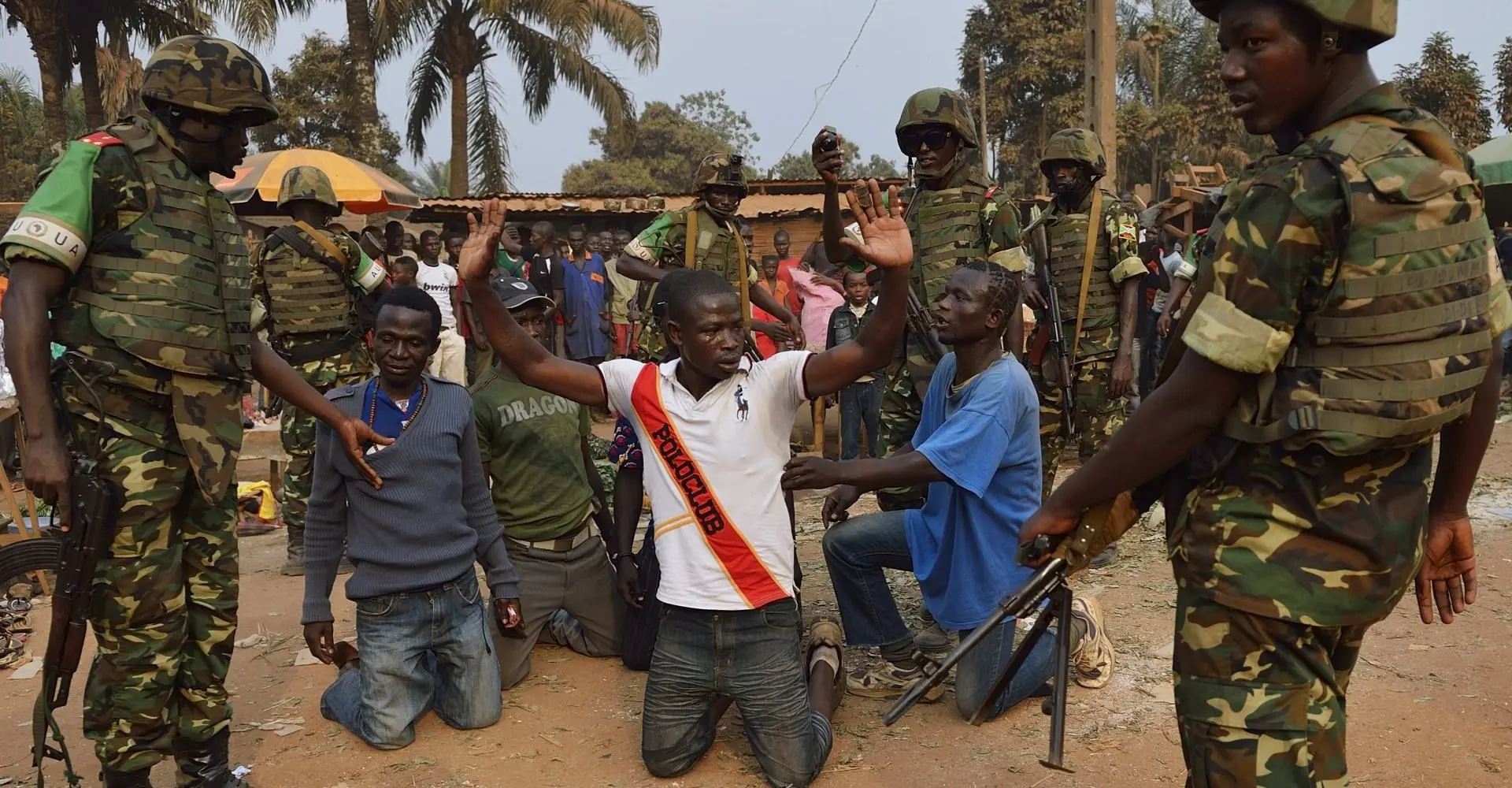
The Central African Republic (CAR) is home to one of the world’s gravest humanitarian crises and one of its least noticed. Two in three children in the country need humanitarian aid, UNICEF reported in November 2018. About 1.2 million people, almost a quarter of the population, had fled their homes: almost 643,000 were displaced inside the country and more than 573,000 had sought refuge in neighbouring states.
Years of coups and civil war have brought the state close to collapse, and armed groups profit from the disorder. Yet the crisis draws a fraction of the attention given to Syria or Yemen. For the people of CAR, the question is no longer development but survival.
CAR is a landlocked country of about 5 million people in the heart of the continent, bordered by Chad, Sudan, South Sudan, the Democratic Republic of the Congo, the Republic of the Congo and Cameroon. It gained independence from France in 1960 and has since consistently ranked among the ten poorest countries in the world, despite large deposits of minerals and other natural resources such as crude oil, gold, timber and uranium. The UN’s Human Development Index for 2018 placed it 188th of the 189 countries covered, just above Niger.
A humanitarian emergency
Since 2012 CAR has been in a civil war between factions and rebel groups. Armed groups attack health and education facilities and staff, mosques and churches, and the sites where displaced people shelter. Renewed conflict in 2017 spread insecurity across the centre, east, south-east and north-west, and the government has limited control outside the capital, Bangui. Armed groups have committed torture, killings, sexual assaults and looting.
The food security situation is damning. About 1.9 million people were severely food insecure, according to the 2018 IPC food security analysis, and four in ten children under five suffer chronic malnutrition, according to UNICEF. Because of persistent insecurity, families cannot farm productively, and their livelihoods have been steadily eroded.
Attacks on aid workers and officials have also cut civilians off from help. The UN-backed humanitarian response plan for 2019 counted 396 incidents against humanitarian workers in 2018, more than one a day. UNICEF and other agencies on the ground continue to work despite the violence directed at them.
A forgotten crisis
The crisis has received little attention from world leaders and the international community. CAR is a member of the United Nations, the African Union, the Economic Community of Central African States and other international organisations. Even so, it is one of the most poorly funded emergencies in the world, with its 2019 humanitarian appeal less than half funded. The crisis has been said to be on a par with those in Yemen and Syria in civilian casualties, deaths, sexual violence and other humanitarian emergencies.
Part of the reason may be geography. CAR lies near the middle of the continent, away from the major trade routes and population centres that draw geopolitical interest. The United Nations has often been accused of standing by. France, the former colonial power, ended its military mission, Operation Sangaris, in October 2016, after accusations that French soldiers had sexually abused children in displacement camps.
The civil war
The causes of the war are hard to pinpoint, but it grows out of political upheaval that has marked the country since 1981, when President David Dacko was overthrown in a coup. CAR has seen repeated coups and counter-coups. When François Bozizé seized power from President Ange-Félix Patassé in March 2003, he set up the conditions for violence and instability that have continued since.
The current crisis began when a coalition of rebel groups, known as Séléka, accused Bozizé’s government of reneging on peace agreements signed in 2007. Unable to defeat Séléka, Bozizé fled the country in March 2013, and the rebel leader Michel Djotodia declared himself president. Djotodia could not hold on to power for long. His rule was marked by continued fighting between Séléka and the anti-balaka militias, and he resigned in January 2014. The conflict has intensified since.
Much of the fighting runs along religious lines, between mostly Muslim Séléka fighters and mostly Christian anti-balaka fighters. Long-running disputes between farmers, who are largely Christian, and nomadic herders, who are mostly Muslim, overlap with that divide.
The economy is also a major driver. Armed groups on both sides mine and steal diamonds and gold and use violence to control the areas where they are found, and ex-Séléka factions run efficient tax systems, the Enough Project reported in 2015. Most of the money, it found, boosts the personal wealth of senior commanders. Every peace effort so far has failed to resolve the conflict.
Where things stand
The numbers have eased since 2019 but remain grave. In January 2025, 2.4 million people, 38% of the population, needed humanitarian assistance, down from 2.8 million in 2024, according to ACAPS. More than 460,000 people were internally displaced and more than 439,000 were refugees abroad, mainly in the DRC, Cameroon and Chad. On 19 January 2026, the Constitutional Court validated a third term for President Faustin-Archange Touadéra, who took 77.9% of the vote in the disputed election of 28 December 2025. Opponents alleged fraud, which the government denied. Russia, Reuters reported, has traded security assistance for access to resources including gold and diamonds.



