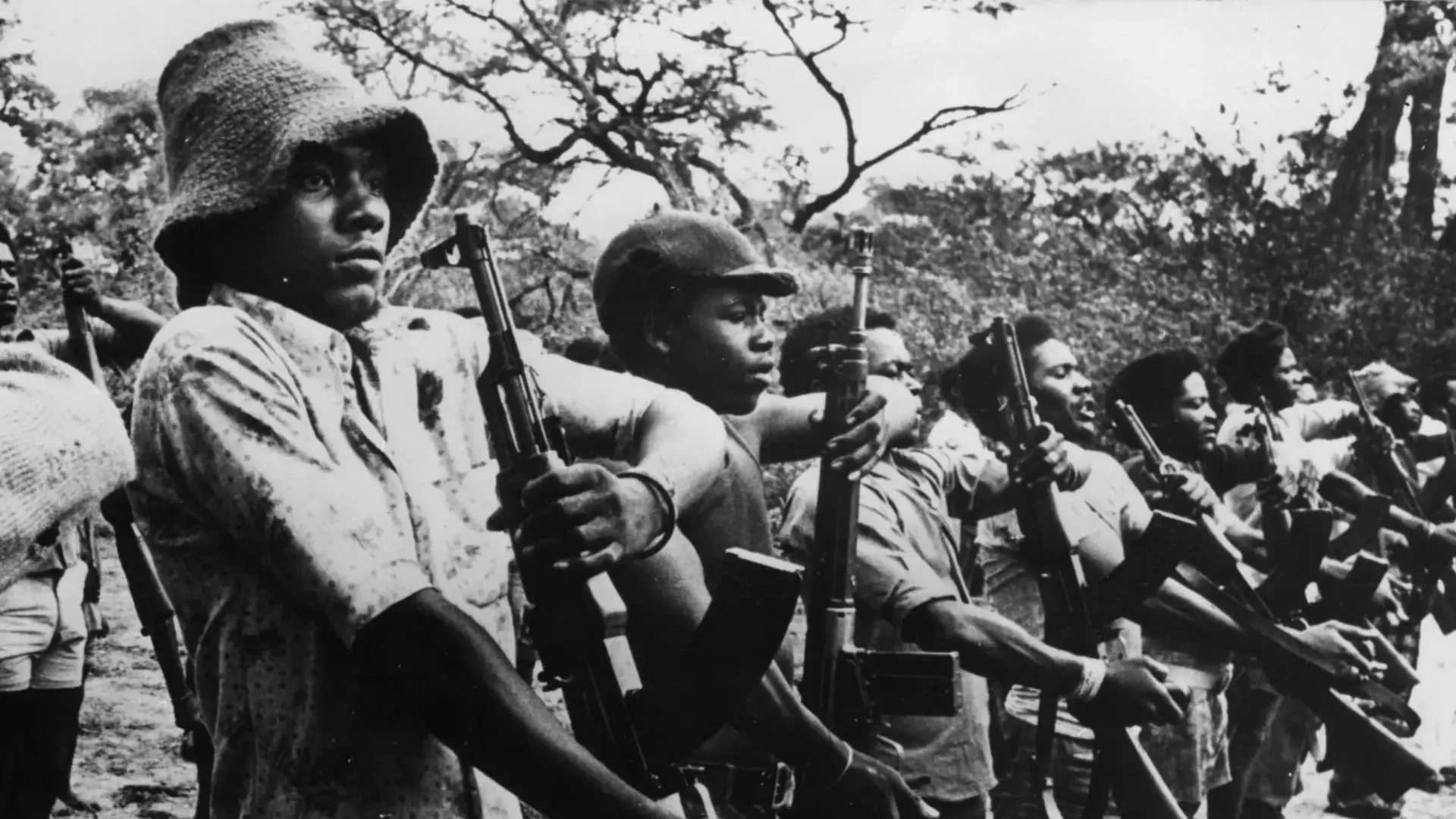
Angola won its independence from Portugal on 11 November 1975, but it did not win peace. Three liberation movements had fought the Portuguese, and they fought each other too. Each had its own ethnic base and its own foreign patrons. When Portugal walked away, the rivalry between them became a civil war that outlasted a generation and drove a third of the population from their homes.
The struggle began in 1961. A coup in Lisbon on 25 April 1974 ended the war against Portugal, and the war among Angolans ended only in 2002. To understand why it lasted so long, you have to see how the independence war was fought, and by whom.
Three movements, three constituencies
The Popular Movement for the Liberation of Angola (MPLA), led by Agostinho Neto, drew on the Kimbundu-speaking Mbundu and on the mixed-race intellectuals of Luanda. It had ties to the Portuguese Communist Party and to the Eastern Bloc. The National Front for the Liberation of Angola (FNLA), under Holden Roberto, was rooted among the Bakongo of the north and looked to the United States and to Mobutu’s regime in Kinshasa. The National Union for the Total Independence of Angola (UNITA), founded by Jonas Malheiro Savimbi in 1966, spoke for the Ovimbundu of the central highlands and was backed at various times by the People’s Republic of China and apartheid South Africa. A fourth, separatist movement fought for the enclave of Cabinda.
Unlike Portugal’s other colonies, then, Angola fought its coloniser on three fronts at once. The MPLA called for a united front of all anti-colonial forces, but its appeal rarely reached beyond the Mbundu, Angola’s second-largest ethnic group, and the mestiços. Its nationalism meant little to the Bakongo, who rallied to Roberto’s call to restore the old Kingdom of Kongo in the north. FNLA supporters were mostly rural and lived apart from colonial society. The Ovimbundu, though scattered, were more integrated into colonial life, and UNITA gave them a vehicle against the groups that backed its two rivals. UNITA would come to command the largest following of the three.
The war against Portugal
The armed struggle opened in early 1961. In January, workers in the Baixa de Cassanje rose against forced cotton growing. On 4 February, militants attacked in Luanda. On 15 March, the Union of Peoples of Angola (UPA), led by Roberto, crossed into northern Angola from its base in Congo-Léopoldville, the former Belgian Congo, with between 4,000 and 5,000 fighters. They seized farms, government posts and trading stations across the coffee country, killing officials and civilians alike, about 1,000 whites and 6,000 blacks in all, and wrecking houses, roads and bridges as they went. Survivors fled to the forests or to neighbouring districts. It was the start of Angola’s independence war and of Portugal’s wider colonial war in Africa.
In early April the UPA massacred the people of Cólua, a village near Aldeia Viçosa in Uíge. The UPA had expected the white settlers to flee. Most did not. Apart from some women and children evacuated to Luanda, they dug in at towns such as Carmona, Negage, Sanza Pombo, Santa Cruz, Quimbele and Mucaba, and held out with little help from the small army garrison.
The first year of fighting killed between 20,000 and 30,000 Angolans and sent between 300,000 and 500,000 refugees across the border into Zaïre. From there, the UPA kept up its raids, which created yet more refugees. The nationalist camp was already divided. On 9 October 1961, in what became known as the Ferreira incident, a UPA patrol captured 21 MPLA fighters and executed them, setting off further bloodshed between the two movements. The uprising drew the world’s attention, and in 1961 a sub-committee appointed by the UN General Assembly investigated conditions in Angola and reported unfavourably on Portuguese rule.
In March 1962, Roberto merged the UPA with the Democratic Party of Angola (PDA) to form the FNLA. UNITA launched its first attack on 25 December 1966, stopping trains on the Benguela railway at Teixeira de Sousa, on the Zambian border. It derailed the line twice more in 1967, hurting the Portuguese but also Zambia and the Congo, which shipped their exports through Angolan ports on that railway.
On 19 May 1968 the FNLA moved into eastern Angola and began its first violent operations against local people there. In October 1968 the Portuguese launched Operation Vitória (Victory) against the MPLA’s bases in the east, and Portuguese commandos overran Mandume III, headquarters of the MPLA’s Third Military Region, capturing important documents. By the late 1960s the FNLA and the MPLA were fighting each other as hard as they fought Portugal, and MPLA forces even helped the Portuguese track down FNLA hideouts.
Lisbon’s collapse and the Alvor Agreement
The end came from Lisbon, not from the bush. On 25 April 1974 the Armed Forces Movement (MFA) overthrew the dictatorship of Prime Minister Marcello Caetano in a largely bloodless coup. The officers were in revolt against authoritarian rule and against the colonial wars, above all the draining conflict in Portuguese Guinea. The new government pulled its remaining forces out and agreed to hand power quickly to the nationalist movements in Mozambique, Guinea-Bissau, Cape Verde, São Tomé and Príncipe, and Angola. The war against Portugal stopped, and a struggle among the Angolan movements and their allies began.
The leaders of the three movements met in Mombasa, Kenya, on 5 January 1975, agreed to stop fighting each other and set out terms for constitutional talks with Portugal. Days later they met Portuguese officials at Alvor, in the Algarve, and on 15 January signed the Alvor Agreement. It set up a transitional government, fixed independence for 11 November 1975 and promised elections to a first assembly in October 1975.
Why the peace failed
The power-sharing deal collapsed almost at once. The movements had never been willing to share power in a multi-ethnic state, and the departing colonial power did nothing to make them. Portugal would not impose peace or supervise elections, and it handed power to no single party. Its army simply left in 1975, and Angola’s future was left to whoever could seize it.
In 1975 the MPLA held the capital. It declared itself the government of independent Angola and won recognition from many African states. UNITA and the FNLA set up a rival government in Huambo and called on South Africa to drive the MPLA out of Luanda. Cuba sent troops to defend the MPLA. They pushed back the internationally isolated South Africans and took every provincial capital. The Cuban force, some 36,000 strong by 1976 and about 60,000 by 1988, stayed on to hold the country and fend off South African attacks.
A Marxist state at war
In 1977 the MPLA put down an attempted coup by one of its own leaders. After a sweeping purge, it declared itself a Marxist-Leninist party and added Partido Trabalhista (Party of Labour) to its name, becoming the MPLA-PT. It reorganised the economy on communist lines, with disastrous results. The exception was oil. Run by foreign companies, the industry grew fast enough to keep the state from economic and military collapse. Neto died in 1979 and was succeeded by his former planning minister, José Eduardo dos Santos.
The FNLA withered in exile. UNITA, by contrast, rebuilt itself with foreign help into an effective guerrilla army. South Africa backed it, hoping it would check the South West Africa People’s Organisation (SWAPO), whose guerrillas fought for Namibia from Angolan soil with MPLA-PT support. After the US Congress lifted the Clark Amendment in 1985, the Reagan administration resumed covert military aid to UNITA, and its campaigns grew sharper.
In 1987 the MPLA-PT launched large offensives against UNITA with armour and aircraft. South African forces came back, and the fighting spread across the country into stalemate. Late in 1988 South Africa agreed to grant Namibia independence and to stop supporting UNITA, and Cuba agreed to withdraw its troops by mid-1991. The MPLA-PT’s first response to the South African withdrawal was a push to take the airfield at Mavinga, a base from which it could strike at UNITA’s headquarters. The campaign was costly and it failed. Together with UNITA’s growing attacks on oil installations, that failure pushed the government towards compromise.
Elections and a return to war
In June 1989 dos Santos and Savimbi met for the first time, in talks brokered by Zaire, and agreed a ceasefire. It did not hold. But as communist regimes fell in Eastern Europe, the MPLA-PT lost its patrons and began to negotiate in earnest. In 1990 it gave up the one-party state and its strict Marxism-Leninism, and later dropped “Partido Trabalhista” from its name. A new constitutional order allowed elections open to all parties, UNITA included.
The elections were held in 1992 under UN supervision. Dos Santos took 49.57 per cent of the presidential vote in the first round and Savimbi 40.6 per cent. The MPLA won a majority in parliament, but UNITA ran strongly, especially on the Bié Plateau. Savimbi cried fraud, refused to take part in a second round and took UNITA back to war. In Luanda, thousands of UNITA supporters were killed in the days that followed, in what became known as the Halloween Massacre. Many accounts attribute the killings to the MPLA and the government’s forces.
By August 1993 UNITA controlled about 70 per cent of Angola, including the diamond fields that paid for its war. The fighting raged through 1993 as the government slowly won back ground and gained support abroad. International pressure on both sides grew. In September 1993 the UN imposed sanctions on UNITA after it ignored a ceasefire it had accepted, but with its huge stockpile of weapons it looked able to fight on for years.
The government and UNITA eventually concluded the Lusaka Protocol, completed with a ceasefire signed on 20 November 1994. It allowed UNITA into government on condition that the fighting stopped. Skirmishes continued, and over the next three years dos Santos and Savimbi met several times to settle the shape of a joint government. In August 1995 Savimbi accepted an offer of the vice-presidency, and in March 1996 the two men agreed to form a coalition government. The peace still did not hold.
The end of the civil war
The war ended only with Savimbi himself. Government troops killed him in Moxico province on 22 February 2002. Talks between UNITA and the MPLA followed, and on 4 April 2002 military commanders signed the Luena memorandum, closing a 27-year civil war.
The human cost was enormous. The war internally displaced 4.28 million people, one-third of Angola’s population. The country could breathe again after 27 years, but its government now faced the task of rebuilding roads, schools, clinics and a welfare system, much of which had been wholly destroyed.



