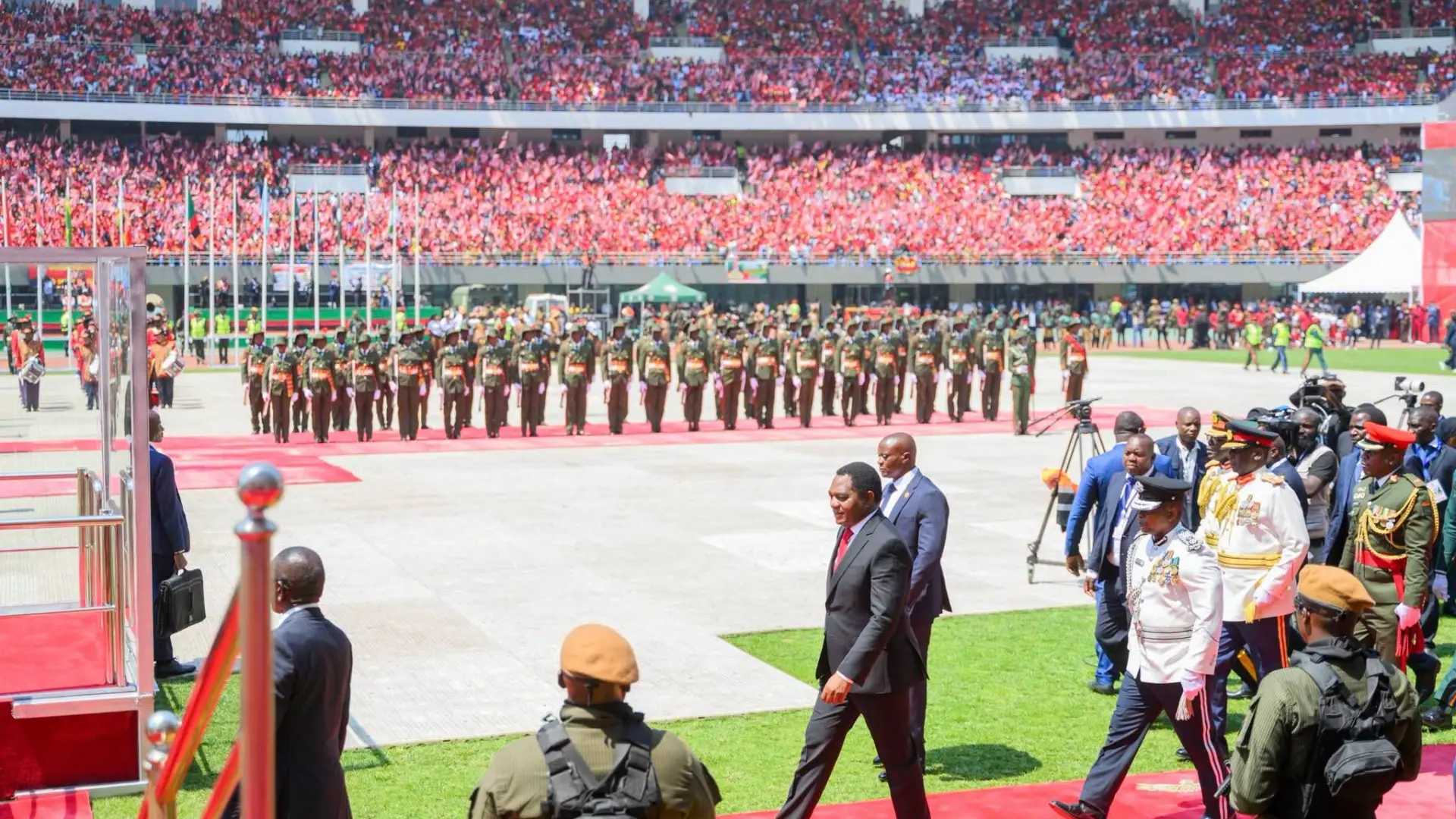
Hakainde Hichilema has won a second term as president of Zambia with about 60 per cent of the vote in the 13 August election, the Electoral Commission of Zambia declared on 18 August. Brian Mundubile, his principal challenger, took around 38 per cent, ahead of twelve other candidates. The Zambia election arrests at Mundubile’s house on counting night are a separate matter, and the size of the winning margin does not answer them.
What happened at Mundubile’s house
Hours after the polls closed, on the night of 13 to 14 August, a joint task force of police, military personnel and Drug Enforcement Commission officers, operating under the Central Joint Operations Committee, went to Mundubile’s residence in the Kabulonga area of Lusaka. The Inspector General of Police, Graphel Musamba, said the security forces came under fire when they arrived and returned it. Mutotwe Kafwaya, a former transport and communications minister, was fatally shot, BBC News reported. Eleven people were arrested at the property. Mundubile was not among them and went into hiding.
In statements on 14 and 15 August, the authorities said the operation was intelligence-led, that 7.3 million kwacha and high-grade military weapons, including AK-47 rifles, had been recovered, and that the eleven posed a threat to state security in connection with an alleged insurrection plot. Mundubile, speaking from hiding, has dismissed the insurrection and weapons claims as fabrications and described the raid as an attempt on his life. Before the final result was declared, during a suspension of tabulation, he had declared himself the winner and alleged rigging and ballot stuffing, without offering a verified tally to support the claim. He has said he will challenge the result in court.
Türk’s intervention
On 19 August the UN High Commissioner for Human Rights, Volker Türk, said he was “concerned by reports of arrests and detentions of opposition members in Zambia before and after the 13 August general election”. He urged the authorities “to stop arresting people arbitrarily and to uphold fully the due process rights of all those detained”, in a statement issued by his office. That is a direct intervention in a country that international commentary has described since 2021 as a democratic success story. Freedom House raised Zambia’s scores between 2022 and 2024, citing wider civic space, the repeal in December 2022 of the offence of criminally defaming the president, and the peaceful transfer of power in 2021. Lusaka co-hosted the 2023 Summit for Democracy with the United States.
Why the margin and the Zambia election arrests need separate scrutiny
A lead of some 22 points does not establish that an election was fair, just as an allegation from the losing side does not establish fraud. The same separation applies to the arrests. Whether the eleven were lawfully detained, and whether the allegation against them is a prosecutable case, depends on evidence and process, not on who won.
Hichilema’s own history as a detained opposition leader makes the use of security powers under his administration particularly consequential. In April 2017, after his motorcade was accused of failing to give way to President Edgar Lungu’s convoy near Mongu, he was charged with treason, a non-bailable offence, and spent more than four months in custody, including at Mukobeko Maximum Security Prison. On 16 August 2017 the Director of Public Prosecutions dropped the case after mediation by the Commonwealth Secretary-General, Patricia Scotland, BBC News reported at the time. The test now is which powers were used against his opponents, under what authority and with what independent oversight.
A government whose external partners value predictability above process has less incentive to answer for election-night conduct.
Copper and the external partners
Copper is what makes Zambia’s internal politics an external interest. The US Geological Survey estimates that Zambia mined about 940,000 tonnes of copper in 2025, making it Africa’s second-largest producer after Congo and the seventh-largest in the world. Washington and Beijing are both investing in the routes that carry it out. The United States and the European Union back the Lobito Corridor, including a $553 million loan from the US International Development Finance Corporation and a planned rail link from the Copperbelt to Angola’s Atlantic port of Lobito, while China has committed more than $1 billion to revive the TAZARA railway to Dar es Salaam. A second Hichilema term will be read in both capitals mainly as continuity in Zambia’s mineral strategy and investment terms. That is also why the arrests matter beyond Zambia’s borders. A government whose external partners value predictability above process has less incentive to answer for election-night conduct, because the partners who could ask are the ones least inclined to.
The legal phase
The next phase is legal, and it is where the substance now sits. Under Article 103 of the Constitution, a presidential election petition must be filed within seven days of the declaration, which sets a deadline of 25 August. Any challenge would go before a Constitutional Court on which a majority of the sitting judges were appointed or elevated during Hichilema’s presidency, according to State House swearing-in records and parliamentary ratifications. They include three judges sworn in on 27 May 2026 and the court’s president, Margaret Munalula, and their appointments followed the removal of three judges in October 2024. A petition would test whether the court can rule against the government that appointed much of its bench.
The eleven detainees will test whether the insurrection allegation is a prosecutable case or a counting-night convenience. The answer will show in whether charges are pursued to trial on evidence, or dropped once the result is beyond challenge. Zambia’s democratic standing will depend on both electoral administration and the institutional checks that follow a result. Transparent proceedings, reasoned court decisions and lawful treatment of detainees are observable tests. A reputation should be judged against that record, not guaranteed by the size of a winning margin, a point that applied in Zambia even before RightsCon’s cancellation raised concerns about participation.



