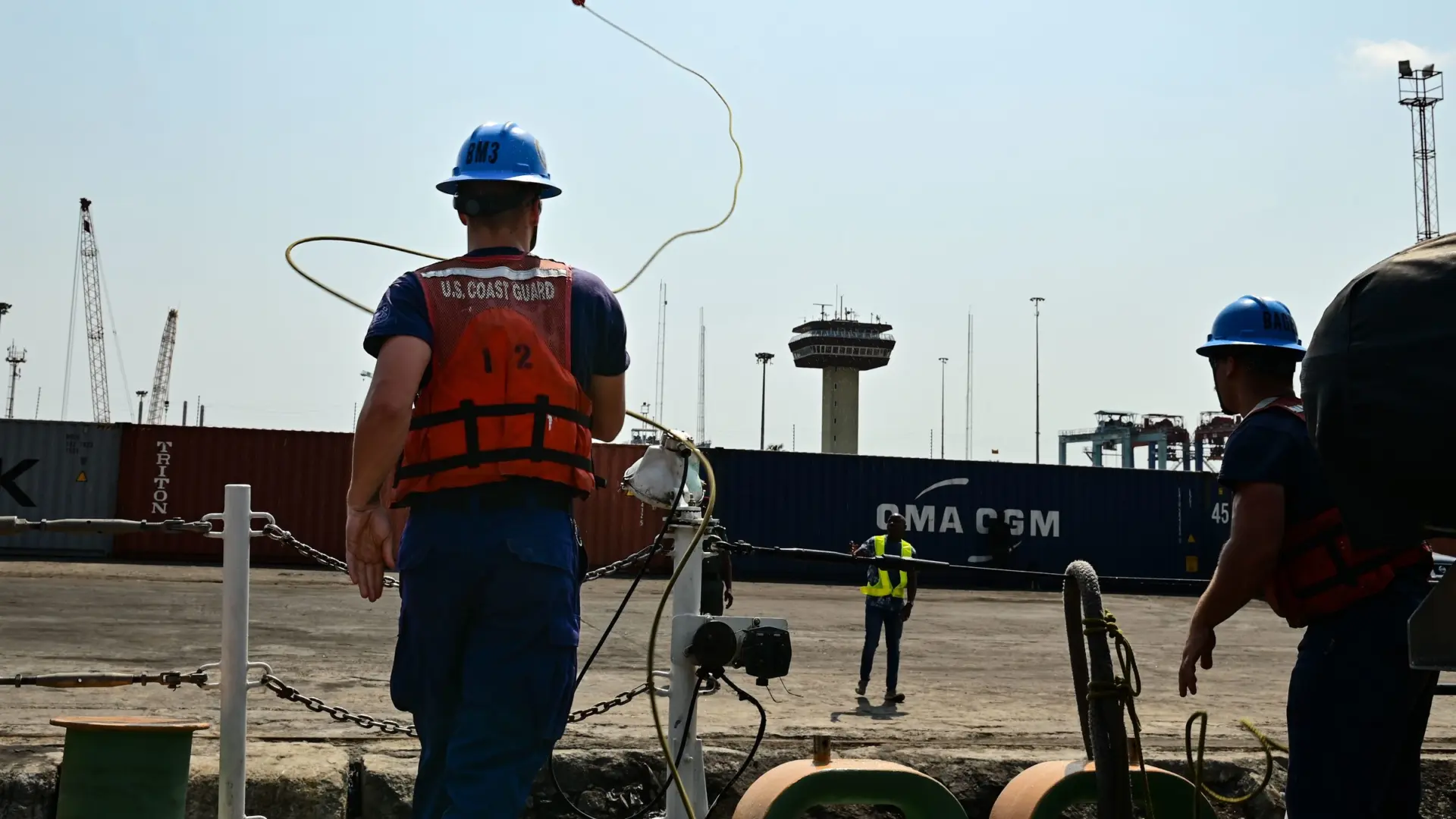
The US Coast Guard lifted its Nigeria conditions of entry on 19 August 2026, ending a twelve-year regime that imposed extra security procedures on ships arriving in American ports after calling in Nigeria. The decision rewards administrative compliance work, not naval success. The restriction was imposed over failings in port governance, and it was removed when inspectors judged those failings fixed.
What the Federal Register notice says
The Coast Guard’s notice, Federal Register document 2026-16868 (docket USCG-2026-0110), was published and took effect on 19 August 2026, alongside Port Security Advisory 4-26. Its operative sentence is short: “Based on recent assessments, the U.S. Coast Guard has determined that Nigeria is maintaining effective antiterrorism measures in its ports, and is, accordingly removing the conditions of entry announced in previously published notices.” The removal covers every Nigerian port. It does not certify every aspect of Nigerian maritime security, and it does not mention freight or insurance costs.
Why the Nigeria conditions of entry were imposed in 2014
The grounds for the original restriction were specific and unflattering. In a notice published on 12 June 2014 and effective from 26 June, the Coast Guard found “that Nigeria’s legal regime, designated authority oversight, access control and cargo control are all deficient.” That is not a complaint about piracy in the Gulf of Guinea, which is how the measure is often remembered. It is a finding about the administrative machinery of port governance, and it explains why the remedy took twelve years of paperwork and inspection rather than a naval deployment.
The 2014 regime was not a blanket ban. It exempted 22 Nigerian port facilities and offshore terminals that the Coast Guard judged to have effective antiterrorism measures, among them the AP Moller terminal at Apapa, the PTML terminal at Tin Can Island, terminals at Onne and Calabar, and the Bonny, Escravos and Forcados offshore terminals. A vessel that had called at any other Nigerian facility within its previous five port calls had to apply heightened security measures, post guards at gangways and on the waterside, and could be required to hire armed guards while in a US port. The 2026 notice removes those conditions for all Nigerian ports.
The four inspections behind the decision
The Federal Register notice does not list the assessments it relies on. Nigeria’s account fills that gap. In statements issued on 18 and 19 August 2026, Minister of Marine and Blue Economy Adegboyega Oyetola and the Nigerian Maritime Administration and Safety Agency (NIMASA) said the decision followed four Coast Guard port-security assessments: 11 to 13 March 2024, 15 to 19 April 2024, 15 to 21 March 2025 and 13 to 17 April 2026. The dates come from Nigerian officials rather than the US notice, but they fit its reference to recent assessments. What the notice itself establishes is a change in the Coast Guard’s judgement of Nigerian port antiterrorism measures.
The documented achievement is a formal reversal against an identified security standard. That is a concrete administrative outcome. Because the notice is public, it also sets a baseline against which Nigeria’s continued compliance can be assessed in future Coast Guard visits.
The commercial case, and who is making it
The commercial claims come from interested parties. Oyetola and NIMASA say the conditions added inspections, documentation, delay, freight cost and insurance cost, and that their removal will improve vessel turnaround, schedule reliability and the appeal of Nigerian ports to international lines. Those are reasonable expectations. They are also forecasts made by the party that benefits. The Coast Guard records that the security deficiencies have been addressed. It does not certify a saving, and no independent assessment of the freight-cost effect has yet been published.
What can be said without a forecast is that a structural penalty has gone. For twelve years a shipping line choosing a West African gateway had a concrete reason to prefer a competitor, because a call at a non-exempt Nigerian facility attached extra procedure to the onward American leg. Lomé in Togo and Tema in Ghana were never on the Coast Guard’s list in that period. Abidjan was: Côte d’Ivoire was under conditions of entry from 2011 until they were removed in August 2022. For the last four years, then, Nigeria was the only one of these four gateways carrying a surcharge that had nothing to do with cargo volumes or crane productivity. Whether traffic now follows depends on berth availability, terminal efficiency, customs processing and inland connections, none of which the Coast Guard assessed, and on the concession terms that govern port investment.
Maritime security as administration
The wider point lies in the nature of the achievement rather than its size. Maritime security in West Africa is usually discussed as a matter of force, in patrol vessels, naval cooperation and armed escorts, and coverage of the region is dominated by attacks, interdictions and arguments over private maritime security in the Gulf of Guinea. The restriction that cost Nigerian ports money for more than a decade was administrative, and it was removed by administrative work. Legal regimes, oversight by the designated authority, access control and cargo control are not the subject of communiqués. They turned out to be the subject of the notice that ended a twelve-year penalty.
The notice addresses only the entry conditions it removes, not every maritime risk in Nigeria or the Gulf of Guinea. Its commercial effect can be measured over the coming year through ship calls, procedures and costs. The administrative lesson is narrower and useful. Sustained compliance work, verified across four inspections in two years, produced a formal change in how an external regulator treats Nigerian ports.



