Farm violence in South Africa is real, and it is rooted in rural isolation, slow police response and the unresolved history of land dispossession. Donald Trump’s account of it as a genocide against white farmers is a different matter. During 2025 that account moved from social media into US policy: an executive order halted aid, Afrikaners were given priority for refugee resettlement, an ambassador was expelled and South African exports faced a 30 per cent tariff. South Africa’s own police data do not support the claim on which those measures rest.
How the genocide claim entered US policy
Trump first amplified the narrative on 22 and 23 August 2018. After a Fox News segment, he wrote that he had asked Secretary of State Mike Pompeo to study South African “land and farm seizures and expropriations and the large scale killing of farmers”. Elon Musk, the South African-born owner of X, repeated versions of the claim on his platform from 2023 onwards. In May 2025 Grok, the chatbot built by his company xAI, inserted unprompted claims about “white genocide” in South Africa into answers to unrelated questions.
On 7 February 2025 Trump signed Executive Order 14204, which cited “government-sponsored race-based discrimination, including racially discriminatory property confiscation”. It halted US aid to South Africa and directed the State Department and the Department of Homeland Security to prioritise Afrikaners for refugee resettlement, the only group carved out of a wider suspension of the US refugee programme. On 14 March 2025 Secretary of State Marco Rubio declared Ambassador Ebrahim Rasool persona non grata, calling him a “race-baiting politician” after remarks Rasool made about the MAGA movement in a webinar, and gave him until 21 March to leave.
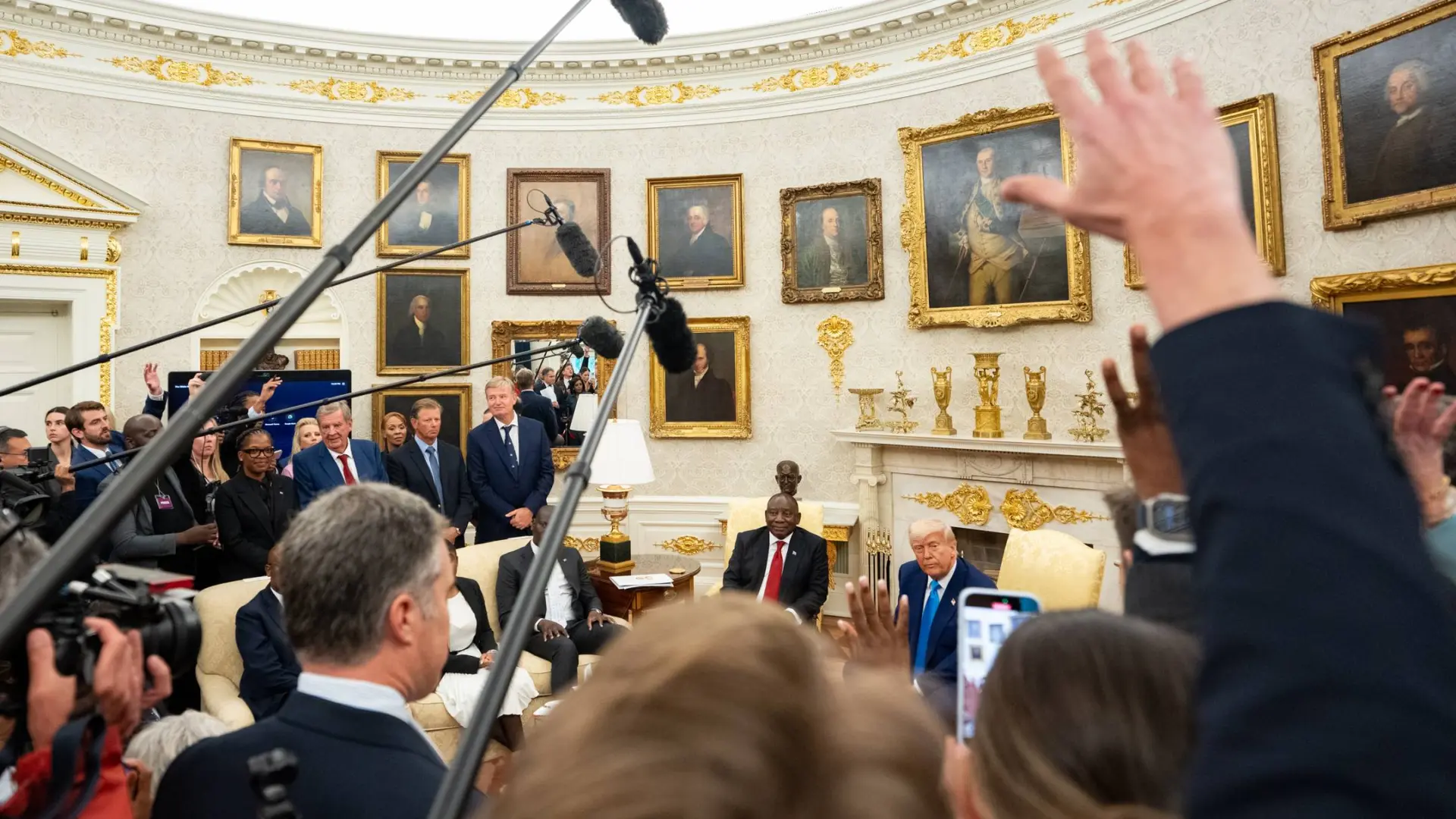
On 21 May 2025, in a televised Oval Office meeting, Trump confronted President Cyril Ramaphosa with video clips and articles alleging a genocide against white farmers. Ramaphosa rejected the claim, saying that violent crime mostly affects Black South Africans and that no land had been seized under the new expropriation law. In August 2025 the State Department’s annual human rights report cited “447 farm murders” and said the Expropriation Act enabled “land seizure without compensation from Afrikaners”. The administration also imposed a 30 per cent tariff on South African exports, double the 15 per cent rate applied to several regional peers.
What police data show about farm violence in South Africa
South Africa’s murder rate is exceptionally high by any international standard. The South African Police Service (SAPS) recorded 25,423 murders in the 2024/25 financial year, which runs from April 2024 to March 2025. Its quarterly releases for calendar year 2024 give 26,232 murders, roughly 42 per 100,000 people. The UNODC data portal puts the country’s intentional homicide rate at 39.7 per 100,000 in 2024, among the highest national rates in the world.
SAPS stopped reporting a standalone farm-murder category in 2007 and now records incidents on farms and smallholdings in quarterly rural safety breakdowns. In 2023/24 it recorded about 49 murders on farms and smallholdings, against more than 27,000 nationally, roughly 0.2 per cent of the total. The victims are not only white owners. Between October and December 2024, SAPS recorded 12 farm-related murders: one victim was a farm owner, five were farm dwellers, four were farm employees and two were others, most of them Black. For January to March 2025, Police Minister Senzo Mchunu and the Department of International Relations and Cooperation reported six murders in farming communities: two farmers, both Black, three employees and one farm dweller. The State Department’s figure of 447 is many times higher than the police count.
Farm attacks are often brutal, and their victims deserve protection. But a rising or falling total, which depends on how farms, smallholdings and reporting periods are defined, does not establish the legal elements of genocide under international law. The workers and dwellers who make up most of the victims also receive far less international attention than white landowners.
The American function of the framing
According to the Anti-Defamation League and the Southern Poverty Law Center, which documented the pattern in August 2018, American white nationalist figures have used South African farm murders as a proxy for “white genocide” propaganda. The framing casts a Black-led democratic government as a threat to a white minority, a parable about demographic change and political power aimed largely at American audiences. That function matters more to the claim’s political life than its relationship to events on South African farms. It also fits a wider pattern of transactional pressure from Trump’s second administration that African governments have had to plan for.
The Expropriation Act and Pretoria’s response
Ramaphosa assented to the Expropriation Act 13 of 2024 on 20 December 2024, and it was published in the Government Gazette on 24 January 2025, replacing a 1975 statute. Section 12(1) requires compensation to be “just and equitable”. Section 12(3) states that “it may be just and equitable for nil compensation to be paid where land is expropriated in the public interest”, and lists examples such as abandoned land or land held purely for speculation. AfriForum and the Democratic Alliance have challenged sections 12(3) and 12(4) in the Western Cape High Court under section 25 of the Constitution, and no land has been expropriated at nil compensation under the Act. Washington treated the law as confirmation of the genocide narrative. Its procedural requirements, defined categories and dispute mechanisms received far less attention than its political signal. Neighbouring states have faced similar arguments over land, as Zimbabwe’s compensation agreement shows.
Pretoria’s response has swung between outrage and patience. Outrage produced headlines without engaging the substance; patience let the narrative settle in American public debate. Ramaphosa’s answer in the Oval Office, that most victims of violent crime are Black and that no land had been taken, was the evidence-led case in brief. South Africa has been slower to make that case systematically: acknowledging rural insecurity across racial lines, publishing farm data consistently and showing, figure by figure, why the genocide claim is wrong.
Aid, health and the bilateral cost
Not every cost can be traced to the rhetoric. The suspension of US foreign assistance on 20 January 2025 was a global 90-day freeze, and State Department stop-work orders on existing PEPFAR awards followed days later in many countries. The measures aimed at Pretoria came weeks afterwards. The health effect was still real. PEPFAR contributed R7.9 billion, about 17 per cent, of South Africa’s R46.8 billion HIV response, according to UNAIDS and the Department of Health, while the government itself financed 74 per cent of the response and 90 per cent of antiretroviral drugs. A waiver kept life-saving treatment going, but most prevention work stopped, and USAID terminated about 40 South African health projects on 26 February 2025. UNAIDS reported that the terminations eliminated 8,493 PEPFAR-funded health posts and forced clinic closures.
The relationship still rests on shared interests in security cooperation, trade, public health and continental stability, and South African exporters already face uncertainty over continued AGOA access. Those interests do not disappear because an administration’s rhetoric is misleading, but they now have to be managed without the trust that once made that easier. The crosses on South African farms mark real deaths and real security failures that South African institutions must address. They do not mark a genocide. South Africa’s best response is not to match Trump’s volume but to build the evidentiary case, and to keep publishing it.



