Sub-Saharan Africa missed the Millennium Development Goal of halving the share of people without safe drinking water, with about a third of its people still lacking an improved water source when the goals expired in 2015, a 2017 study found. Yet the continent sits on vast reserves of groundwater. Its problem is not only scarcity but allocation, and this piece argues that every African country now needs a water policy that decides who gets water and how.
The gap has not closed. In March 2022 UNICEF and the World Health Organization reported that 418 million people in Africa still lacked even a basic drinking water service. The burden falls hardest on women and girls. In 2025 the two agencies’ joint monitoring programme found that, in most countries with data, women and girls are still mainly responsible for collecting water, and that many in sub-Saharan Africa spend more than 30 minutes a day doing it, the WHO said.
Africa’s hidden water
A 2012 study led by the British Geological Survey estimated that the continent’s groundwater amounts to more than 100 times its annual renewable freshwater resources and 20 times the freshwater stored in its lakes. The paradox is that the largest reserves lie in the driest places, in the great sedimentary aquifers of Libya, Algeria, Sudan, Egypt and Chad. Much of this water fell as rain thousands of years ago and is not being replaced, so this fossil groundwater must not be over-drawn, however valuable it is.
How much an aquifer can give determines what it can be used for. Scientists sort aquifers into three broad bands:
- In many areas there is enough groundwater to supply villages through hand pumps, which need a borehole yielding only 0.1 to 0.3 litres per second.
- Boreholes yielding more than 5 litres per second, the kind commercial users want, are far less common, and should not be drilled without a thorough knowledge of the local groundwater.
- The most productive boreholes, above 20 litres per second, are found only in limited areas of thick sedimentary aquifers.
Africa’s future water supply, economic growth and food security depend on developing this groundwater well and sustainably. That cannot be done without a sound understanding of the rocks that hold it, which is why commercial pumping should wait until the local resource is properly known.
Two ways to move water
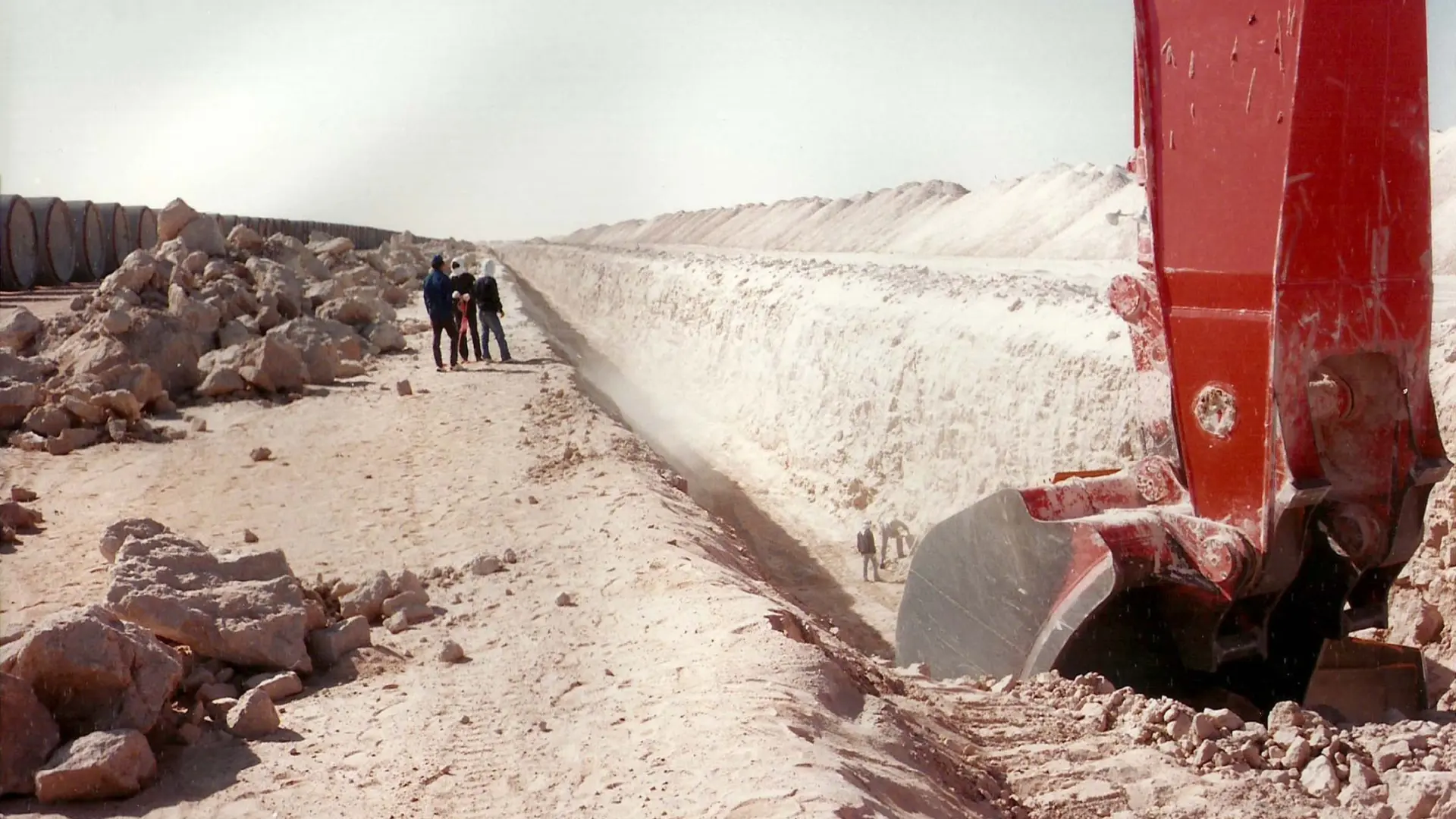
Libya’s Great Man-Made River, built under Muammar Gaddafi, shows what large-scale allocation of aquifer water can do. Work began in 1984 and the first phase opened in 1991. A network of pipes carries water from the Nubian Sandstone Aquifer System, a fossil aquifer beneath the Sahara, to Libya’s towns and farms. It has been described as the world’s largest irrigation project, built on the world’s largest underground network of pipes and aqueducts.
Ethiopia, for its part, has built the Grand Ethiopian Renaissance Dam on the Blue Nile, in the northern highlands where 85% of the Nile’s waters rise. Construction began in 2011. Egypt fears the dam allows Ethiopia to control the flow of Africa’s longest river and leaves Egyptians at risk of water scarcity. Ethiopia inaugurated the dam, the largest in Africa, on 9 September 2025, and Egypt protested to the UN Security Council on the same day that it “rejects all unilateral Ethiopian measures on the Nile”, The National reported.
A policy for every country
The importance of water should push every African country, region by region, to define a water policy at last and make it a priority. The dispute over the Nile shows what is at stake when countries allocate a shared resource without agreement.



