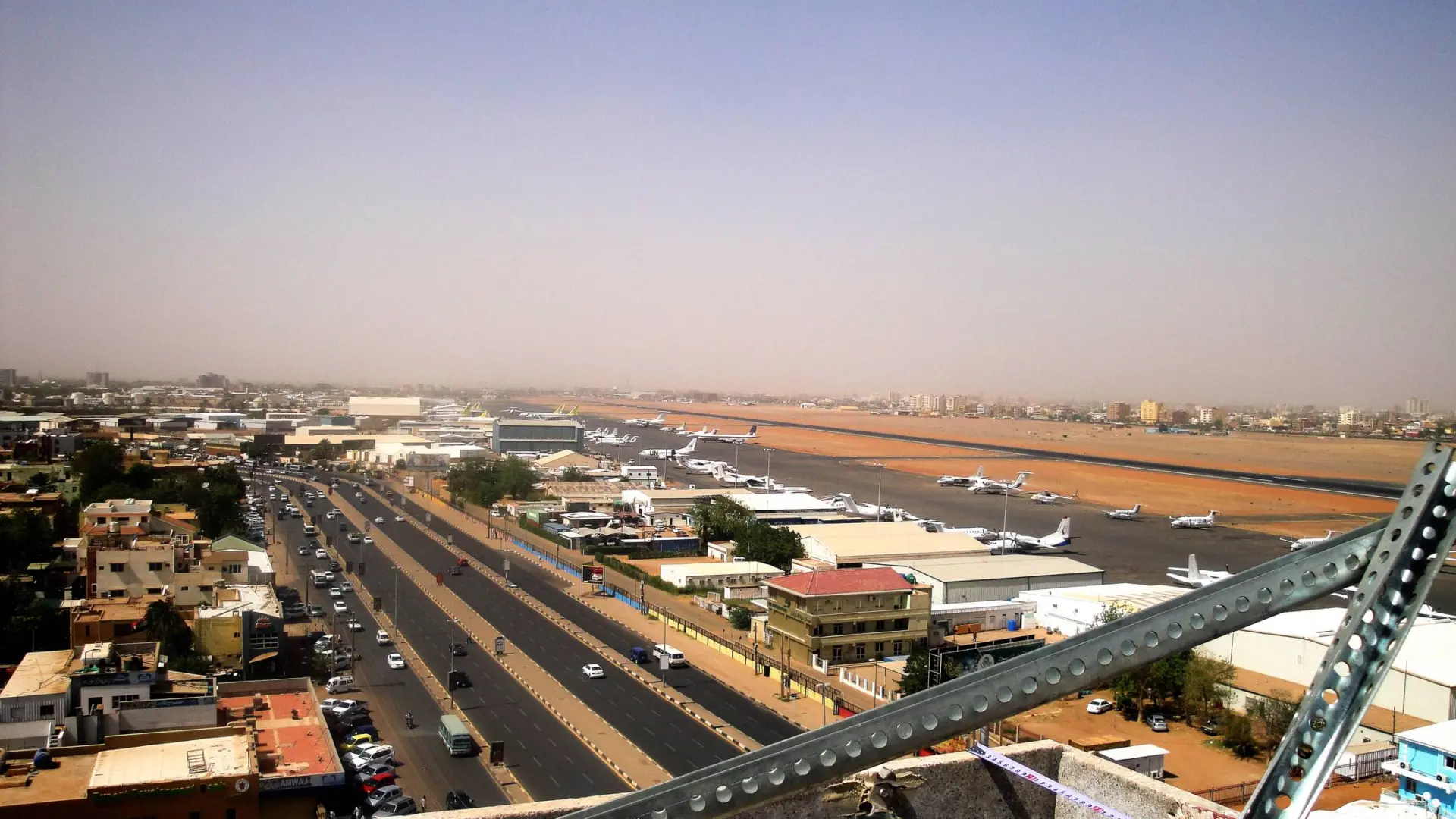
Khartoum’s airport was struck again, shattering months of cautious calm in Sudan’s capital and exposing how fragile the idea of state continuity has become in one of Africa’s most devastating wars. What first appeared as another escalation between Sudan’s armed forces and the RSF quickly became something larger: accusations of foreign facilitation, renewed anxiety over regional spillover and a sharpening question about whether any major Sudanese infrastructure can still be considered secure.
Airports in wartime are more than transport hubs. They represent sovereign access, diplomatic continuity, evacuation capacity, logistics and humanitarian corridor management. When a capital’s airspace becomes unstable again, the conflict affects not only military calculations but the perception of whether the state can function reliably enough to sustain the systems that populations and external actors depend on. The fragility of Sudan’s infrastructure is no longer a background condition. It has become the front line of what the war is about.
That shift deserves to be named precisely, because it changes what victory means. Where territorial control remains contested, the contest stops being about seizing the apparatus of the state and becomes about denying it to the other. The target is not the city but the systems that make the city governable: the runway, the transformer, the fuel depot, the fibre line, the aid corridor. A combatant who cannot rule Khartoum can still ensure that no one else rules it. This is war as subtraction rather than conquest, and its logic rewards destruction over capture, because a hollowed institution is cheaper to produce than a captured one and harder for an opponent to convert into legitimacy.
The erosion is cumulative and slow, but in a conflict now measured in years, the cumulative effect is substantial. A state is not undone in a single strike. It is dismantled one unrepaired runway, one severed line and one abandoned ministry at a time, until the institutions that once defined it survive only on paper.
Sudan’s military accused external actors, including the United Arab Emirates and Ethiopia, of helping facilitate the strike, allegations both countries denied. The accusations deepened fears that the conflict is moving beyond a domestic power struggle into a wider regional contest shaped by proxy influence, strategic access and positioning across northeastern Africa and the Red Sea corridor. That the accusations were made publicly, whatever their accuracy, is itself a signal. The domestic conflict is being narrated in regional terms, and those terms are beginning to define the political environment around it.
The regional dimension carries structural weight. Sudan sits at the intersection of multiple external interests: Gulf powers, neighbouring African states, migration routes, trade corridors and security competition that extends from the Horn of Africa to the Red Sea littoral. The more the conflict expands into infrastructure disruption and airspace instability, the harder it becomes to contain its consequences within national borders. External powers accused of shaping the conflict’s funding, armament and alignment are now more visibly entangled with its trajectory. A fragmented Sudan is less able to set its own terms over the Red Sea coast that gives the country its strategic value, and that weakness may suit some outside interests.
For civilians, the implications are immediate and compounding. Sudan’s humanitarian crisis is already among the world’s most severe, with millions displaced internally and across borders into Chad, Egypt, South Sudan and Ethiopia. Infrastructure insecurity deepens those pressures by threatening the fragile networks relied upon for humanitarian delivery, medical access, commercial movement and civilian evacuation. Each disruption narrows the margin available to a system already operating near its limits, and repeated damage makes essential services harder to restore.
The symbolism of resumed strikes near the capital matters beyond logistics. Earlier periods of relative calm in Khartoum had created cautious expectations that parts of the city might slowly regain a functional normality. Those expectations have now been disrupted, a reminder that stability built on unresolved military and political conditions can collapse rapidly. The forces that produced the conflict have not changed. They were only temporarily obscured.
In Sudan, the war is no longer simply a contest over who controls territory. It is a contest over whether the remaining structures of governance, logistics and national continuity can survive systematic fragmentation. That is a fundamentally different kind of conflict, one that cannot be resolved through territorial settlements alone, and one that demands a different quality of regional and international response than the crisis has so far received.



