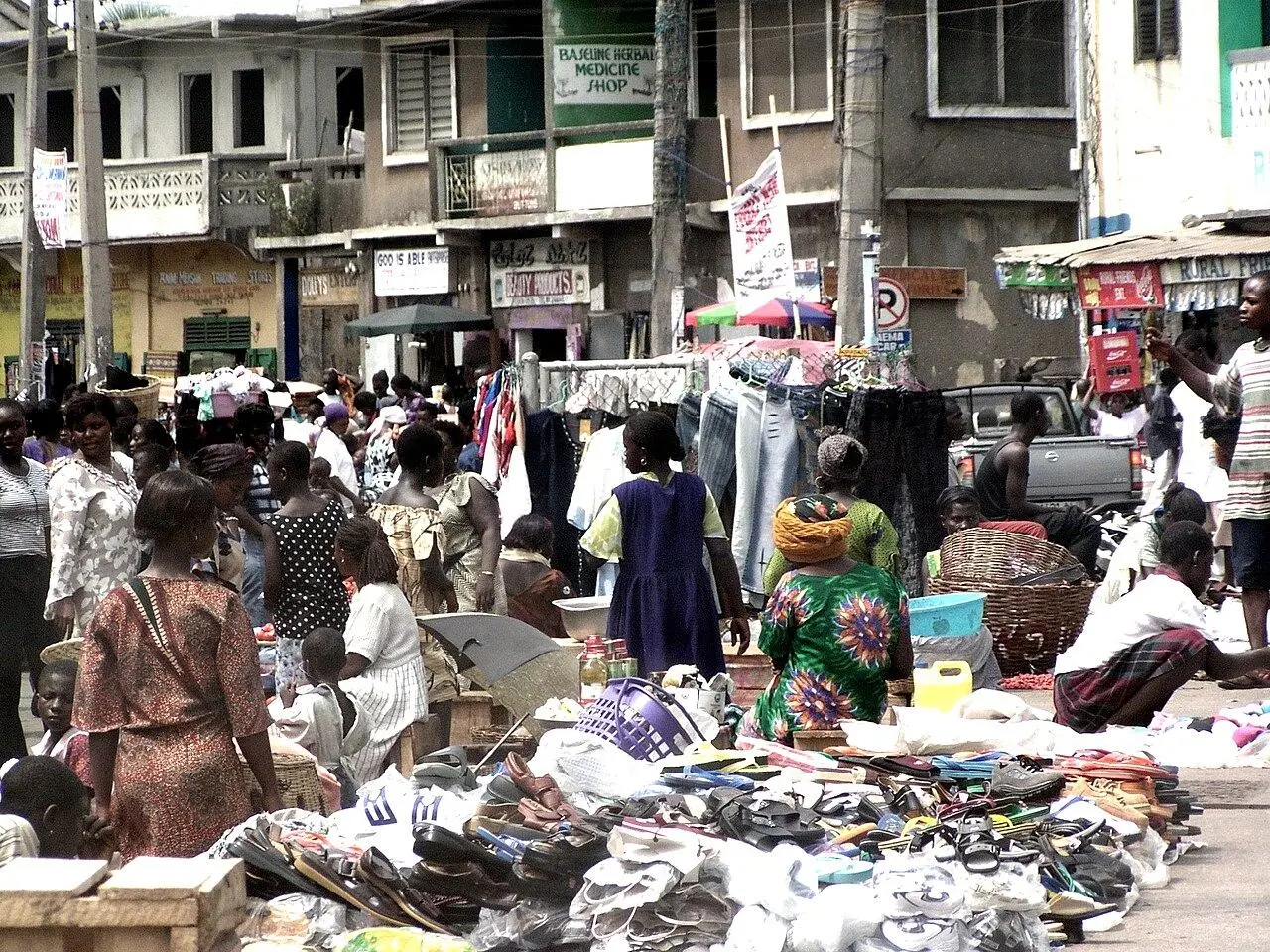
A trader in a Nairobi market opens a bale of used clothing imported from Europe, not knowing exactly what is inside, and sells its contents to customers who could not otherwise afford to dress their families. The same bale, in the argument of textile-revival advocates, is a coffin nail in the African garment industry. Cheap castoffs flood the market and smother the domestic production that might have clothed those families with goods made at home. Both descriptions are true. The habit of choosing between them (framing the secondhand trade as either a lifeline to defend or a dumping ground to ban) is what keeps the debate stuck. The clothes are a bargain and a trap at the same time, and the useful questions are who captures the trade and how a transition can be sequenced.
The trade is large and deeply embedded. Known as mitumba in East Africa and okrika in West Africa, the import of used clothing from wealthy countries clothes a large share of the population across much of the continent and supports an economy of importers, sorters, transporters and market traders. It is a livelihood for a large number of people, many of them women operating in the informal sector. To treat this as a simple evil to be legislated away is to ignore the consumers who depend on affordable clothing and the workers who depend on the trade for income. To treat it as an unalloyed good is to ignore that it is built on the discarded surplus of foreign consumption and that it occupies the market space a domestic industry would need to grow into.
This is a value-chain fight, not a parable about waste. The questions that matter are who profits from the trade at each stage, who sets the tariffs and customs rules that govern it, and whether a transition policy can honour the consumer’s need for affordable clothing while rebuilding the productive capacity the trade currently displaces.
Affordability and livelihoods
The case for the secondhand trade rests on a hard fact that revival rhetoric tends to skip. For a large share of African consumers, used imported clothing is simply the affordable option, often of better quality than the cheap new garments that would otherwise be within reach. A ban or punitive tariff raises the cost of clothing for people with little margin to absorb it, and it does so immediately, while the domestic industry that is supposed to replace the imports does not exist yet and cannot be conjured by legislation. Any restriction therefore imposes a certain and immediate cost on consumers and traders in exchange for an uncertain and deferred benefit to a domestic industry that may or may not materialise.
The East African phaseout proposal
The East African Community learnt this directly. A coordinated regional attempt to phase out used-clothing imports in order to build domestic textile and apparel industries ran into the affordability problem, the absence of ready domestic capacity, and external trade pressure from the exporting countries whose own collection-and-resale industries depend on African markets to absorb their surplus. The episode is the cautionary tale at the centre of this debate. Banning the trade before the productive capacity exists punishes consumers and traders without delivering the industry.
Banning the bargain before building the industry punishes the consumer twice, once at the till and once in the job that the promised factory never created. Sequence is the whole policy.
Effects on industry and waste
The case against the trade is equally grounded, and it is structural rather than sentimental. A market saturated with cheap used imports offers little room for a domestic garment industry to establish itself, because a fledgling local manufacturer cannot compete on price with clothing that was already paid for once in another country and arrives after collection, sorting, transport and import costs. The trade also encodes a dependency: the continent clothes itself with the discards of richer economies. And it carries an environmental tail, since a meaningful portion of imported bales contains unsellable, low-quality garments that become waste the importing country must manage, turning the trade into a partial export of the rich world’s disposal problem.
The deeper trap is that the trade can become self-perpetuating. The less capacity the domestic industry has, the more the market must rely on imports, and that loop hardens over time into a structural feature of the economy. The affordability that makes the trade a lifeline today is also the mechanism that forecloses the industry that might offer better livelihoods tomorrow. The trade serves the present and mortgages the future, and a serious policy has to hold both truths at once.
Designing a gradual transition
The resolution is sequencing, not prohibition. A transition that works builds domestic productive capacity first, through investment, skills and the kind of industrial policy that scaled apparel manufacturing elsewhere, and only then, as local supply becomes genuinely available and affordable, gradually shifts the balance away from imports. Tariffs and customs policy become tools for managing that shift at a pace consumers can bear, rather than blunt instruments for ending the trade overnight. The transition can also build on the trade rather than against it. The importers, sorters and traders who run the secondhand economy already possess distribution networks, market knowledge and customer relationships that a domestic industry will need. Folding them into the transition, rather than destroying their livelihoods, turns potential opponents into participants.
The African Continental Free Trade Area makes this more plausible than the failed national bans suggested. A regional market large enough to support competitive domestic manufacturing changes the arithmetic that doomed earlier attempts, because it can offer a new textile industry the scale that no single country could. The choice in front of African policymakers is whether they can sequence a transition that protects the consumer and the trader through the years it takes to build the industry, so that domestic capacity arrives before the affordable imports are withdrawn. Get the sequence wrong and the trap closes on the very people the policy meant to help. Get it right and the secondhand bale that clothes Africa today becomes the distribution network that helps clothe it from its own factories tomorrow.



