China is the world’s leading mining nation, yet its own mineral resources are being depleted fast. To sustain rapid economic growth, an expanding and increasingly affluent middle class and an ambitious development strategy, it needs huge quantities of minerals, from metals and non-metallic minerals to energy minerals. That need has brought it to Africa.
Africa is rich in mineral resources, and many world-class deposits have been discovered in recent years. That has made the continent attractive to investors, above all to Chinese firms looking to replenish dwindling supplies at home. This piece argues that in Nigeria the price of foreign mining interest, much of it Chinese, is paid by farmers, villagers and workers.
Africa’s mineral wealth
South Africa holds most of the world’s platinum group metal (PGM) reserves. According to the US Geological Survey’s 2025 figures, it has 63,000 tonnes of a world total of more than 81,000 tonnes. It mined about 21 million of the world’s 47 million tonnes of chromite in 2024, the USGS estimates, and it was the third-largest producer of both ilmenite, after China and Mozambique, and vanadium, after China and Russia.
The Democratic Republic of Congo, one of the richest places on earth, mined about 220,000 of the world’s 290,000 tonnes of cobalt in 2024 and holds 6 of the world’s 11 million tonnes of cobalt reserves, according to the USGS. It produced about 880 of the world’s 2,100 tonnes of tantalum, the metal refined from coltan. It is also one of the top producers of copper and diamonds.
Guinea was the world’s largest producer of bauxite in 2024, at about 130 million tonnes, and has the largest reserves, 7.4 of the world’s 29 billion tonnes.
Ghana is one of the top producers of gold and is also rich in bauxite, industrial diamonds, manganese and timber.
These countries have seen an influx of Chinese miners over the years, along with other nationalities keen to tap their mineral riches.
Many of these resources are untapped, which offers potential for greenfield development.
Nigeria, an oil-rich country, has also drawn Chinese mining firms, and some have broken the law. Several Chinese nationals have been convicted of mining without lawful authority. In March 2025, for example, the Federal High Court in Ilorin convicted two Chinese nationals and their company of dealing in minerals without lawful authority, a year after the same court jailed two others for illegal mining. In the author’s view, the record of Chinese-run operations on mining practice and environmental sustainability is poor.
The environmental cost of mining
Mining damages the environment whoever the operator is, and where operators ignore environmental rules it leaves the land in ruins. Vegetation, whether natural forest or plantation, is always the first casualty.
Farmland can also be lost to Chinese-backed projects that are not mines at all. In May 2019, community leaders and landowners in Igbesa and Ejila, in the Ado-Odo/Ota local government area of Ogun State, told the News Agency of Nigeria that more than 485 hectares of their farmland had been destroyed by the Chinese operators of the Ogun-Guangdong Free Trade Zone. They said the community had given only 250 hectares for the zone. Adebayo Akinola, a food technologist, said he had lost 21 acres of land, including 10 acres of cassava, worth more than 10 million naira. A poultry farmer known as Brother Seun said his fence had been demolished, and a retired headmistress, Kudirat Awoleye, said the coconut, kola nut, palm and cocoa plantations she inherited from her parents had been destroyed. The free trade zone denies encroaching on the communities’ land.
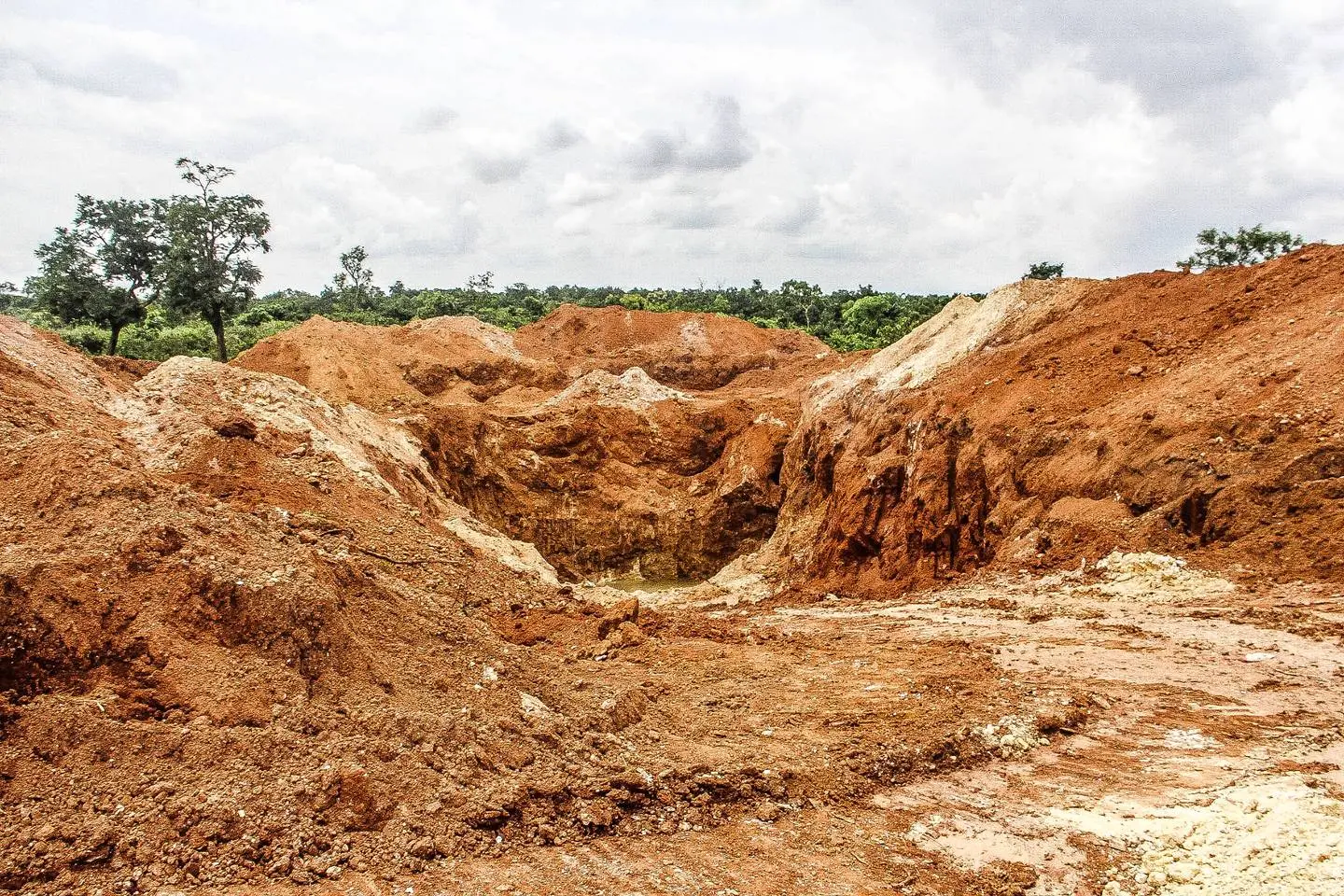
Mining itself turns farmland into pits and costs small farmers their livelihoods. Uncontrolled digging destroys the natural landscape. Operators excavate sand and cut pits and trenches haphazardly, leaving a kind of artificial badland that can no longer be farmed, along with heaps of waste rock that are hard to dispose of. The altered land erodes, and most open-cast pits fill with water. The natural landscape gives way to badland pocked with irregular holes.
Miners work a site until its resources run out, then move on, leaving patches of broken land useless for agriculture. Not all of this damage is Chinese. In the south-west, residents of Akinbo village beside the limestone quarry of the Ewekoro cement plant complained in 2018 of breaches of environmental rules at the site, and the federal government said it was investigating. In Plateau State, a century of tin mining has left trenches and ponds across Barkin Ladi, Bukuru, Bossa and Riyom districts. Dozens of people have drowned in these deep, unguarded ponds, the ICIR reported in 2015, and the state’s environment commissioner, Sylvanus Dangtoe, warned that their radioactive elements could even cause cancer.
Beyond degrading the land, mining brings varying degrees of air, water and soil pollution.
It also upsets the balance of the geological environment and can trigger hazards such as landslides, flooding, erosion and tremors. Blasting rock at quarry sites causes minor earth tremors. Villages near quarries feel the ground move with each blast, and some buildings crack from the constant vibration.
Dust, blasting and health
The Abeokuta area of Ogun State shows what this means for people living beside quarries. A July 2019 investigation by Gbenga Ogundare for the International Centre for Investigative Reporting (ICIR) found that villages in Itokuland, among them Elejigun, live with blasting from several quarries, most of them Chinese-owned, by its account. Residents breathe granite dust daily, which harms their health in both the short and the long term. By law, a quarry owner must resettle any community within a one-kilometre radius of the quarry, but that rarely happens in Nigeria. An official of the Ogun State mining ministry told the ICIR that Elejigun lay within the blast zone and was unsafe.
Environmental health experts say some conditions linked to mining, especially those caused by air pollution, have a long latency period. Dust-related conditions such as asbestosis can take 10 years or more to show any symptoms.
Villagers blame the dust for the death of one resident, Rasaki Soyoye. “He coughed to death,” Alimi Ariibi, the Baale of Elejigun, a man in his eighties, told the ICIR.
Dust from mines is among the pollutants the World Health Organization counts as ambient air pollution. In Nigeria, air pollution kills 150 out of every 100,000 people, according to the 2016 State of Global Air report cited by the ICIR. Odeda local government area in Ogun State has about 25 communities and no fewer than 10 quarries, and residents there complain of coughing, asthma, rashes, eye problems and body aches. They link these illnesses to breathing quarry dust, to the vibrations and to drinking water polluted by mining. Around the Ewekoro cement factory, a study of residents found that those living within a few kilometres were affected by the dust and that nearly a fifth suffered from asthma, as a later review of cement-dust research summarises. Ogun State is rich in rock and limestone, and most of Nigeria’s cement factories are there.
The dust hurts farming too. Particles settle on leaves and on the soil that supports the plants, which hinders photosynthesis and reduces output.
No welfare gain for mining communities
In the communities described here, mineral wealth has been a curse. They have been left in worse shape than before, with illness, ruined farmland and lost wildlife.
In the author’s view, the mining firms that profit from these areas neglect their corporate social responsibility.
Under sections 116 and 117 of the Nigerian Minerals and Mining Act 2007, mining companies and host communities are required to sign a Community Development Agreement (CDA). In it, the host community lists the basic amenities the company will provide, and the agreement is to be reviewed every five years. In practice, the ICIR found that villagers in Itesi and Oguntolu had never heard of a CDA.
What about workers’ welfare? There is little to write home about. In a bid to hire cheap labour, some quarries break the law and use child labour, and workers are denied proper safety equipment, as an ICIR investigation of Chinese-run quarries in Ogun State later found.
The record of the Chinese-run quarries investigated in Ogun State leaves a sour taste. In the author’s view, these companies are driven by profit with little regard for the environment, host communities or their own workers. They damage the farmland of these communities, harm the health of villagers and neglect the well-being of their workers, and the country is the loser.



