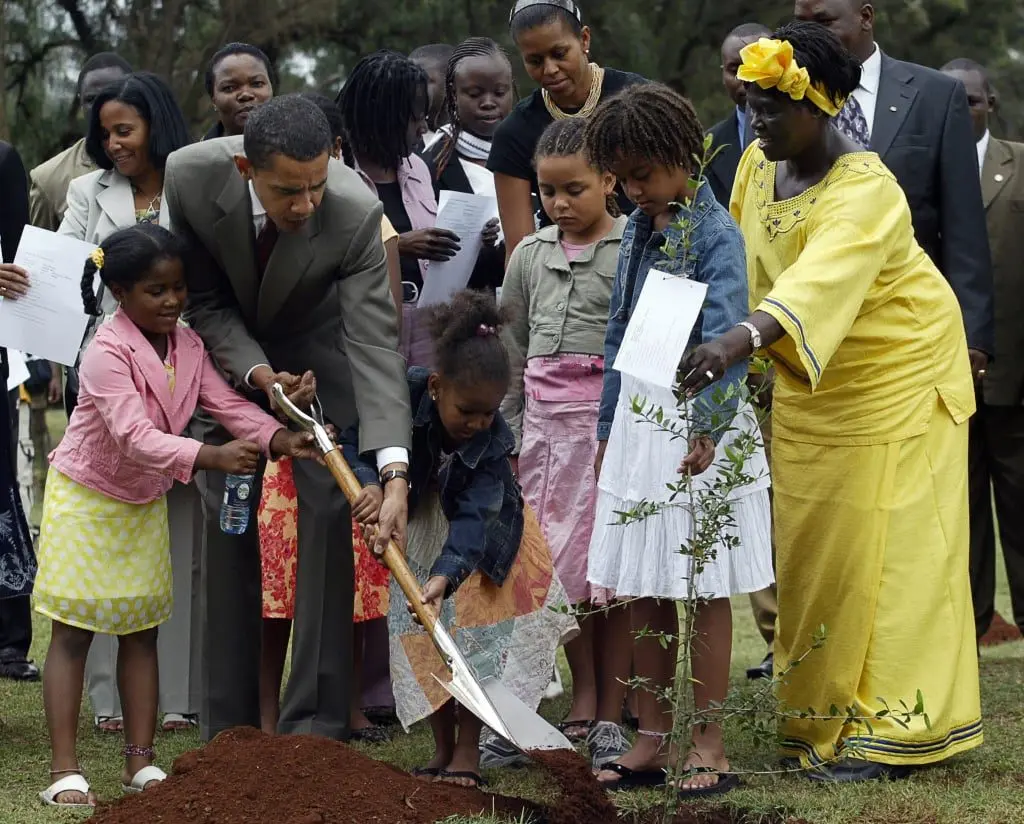
“Nothing is more beautiful than cultivating the land at dusk. At that time of day in the central highlands the air and the soil are cool, the sun is going down, the sunlight is golden against the ridges and the green of trees, and there is usually a breeze. As you remove the weeds and press the earth around the crops you feel content, and wish the light would last longer so you could cultivate more. Earth and water, air and waning fire of the sun combine to form the essential elements of life and reveal to me my kinship with the soil. When I was a child I sometimes became so absorbed working in the fields with my machete that I didn’t notice the end of the day until it got so dark that I could no longer differentiate between the weeds and crops. At that point I knew it was time to go home, on the narrow paths that criss crossed the fields and rivers and woodlots.” Wangarĩ Muta Maathai, Unbowed (a memoir), p. 47
Wangari Muta Maathai was born on 1 April 1940 in Nyeri, Kenya, into a Kikuyu family that had lived in the area for several generations. The Kikuyu are the most populous ethnic group in Kenya. A Kenyan politician and environmental activist, she was awarded the 2004 Nobel Peace Prize, becoming the first black African woman to win a Nobel Prize. She turned tree planting into a campaign for democracy and human rights, and at home her government often treated that work as unwelcome, even subversive.
Education and the Green Belt Movement
Her university education began in the United States. She took a BS in biology at Mount St Scholastica College, now Benedictine College, in 1964, and an MS at the University of Pittsburgh in 1966. The University of Nairobi awarded her a PhD in 1971, which made her the first woman in East or Central Africa to hold a doctorate. She stayed on to teach in its Department of Veterinary Anatomy and became head of the department in 1976.
The idea that shaped her life came out of her work with the National Council of Women of Kenya. Village women, she reasoned, could repair their own environment by planting trees, which would give them fuel and hold back deforestation and desertification. The Green Belt Movement, the non-governmental organisation she founded on that idea, still enlists women to plant trees against deforestation and the degradation of the land. To date, it has planted over 50 million trees.
Maathai came to see that the state of the land could not be separated from how the country was governed, from peace or from human rights. She turned her organisation into a platform for challenging abuses of power, from land-grabbing to the illegal detention of political opponents. In 1986 the movement’s leaders set up the Pan African Green Belt Network to teach world leaders about conservation and environmental improvement, and the movement’s example inspired similar schemes in other African countries, among them Tanzania, Ethiopia and Zimbabwe.
Human rights and politics
Her causes went beyond conservation. She campaigned for human rights, for AIDS prevention and for women, often taking these issues to meetings of the United Nations General Assembly, and she spoke out about poverty in Africa. She believed that purposeful political leadership could bring about real social change. “Therefore, the tree became a symbol for the democratic struggle in Kenya,” she said.
She led protests against President Daniel arap Moi, who angrily called her a “mad woman” and her activities “subversive”. In 1992, during a hunger strike at Freedom Corner in Nairobi’s Uhuru Park to demand the release of political prisoners, she was beaten unconscious by police. She remained undaunted.
Moi stepped down in 2002, and the political climate turned in her favour. She was elected to Kenya’s National Assembly in 2002 with 98 per cent of the vote, and in 2003 she was appointed assistant minister of environment, natural resources and wildlife. She was out of the government by November 2005, and she later lost her parliamentary seat in the disputed election of December 2007.
When she won the Nobel Prize in 2004, the committee praised her “holistic approach to sustainable development that embraces democracy, human rights and women’s rights in particular.”
Books and personal battles
Her first book, The Green Belt Movement: Sharing the Approach and the Experience (1988; rev. ed. 2003), told the story of the organisation. Her autobiography, Unbowed, followed in 2006. In The Challenge for Africa (2009) she attacked the continent’s leadership as ineffectual and urged Africans to solve their own problems without waiting for Western help. She wrote often for international newspapers, among them the Los Angeles Times and The Guardian.
Maathai died on 25 September 2011, aged 71. A mother of three, she gave her life to the environment and to democracy, and some of her hardest battles were personal. Her husband, Mwangi Maathai, divorced her, saying she was “too strong-minded for a woman.” She contested the divorce in court and lost, and she then called the judge “incompetent and corrupt.” For that she was sentenced to six months in jail for contempt of court, although she was released after three days.
Tributes and legacy
The tributes that followed her death were collected by the United Nations magazine Africa Renewal. UN Secretary-General Ban Ki-moon called Maathai “a pioneer in articulating the links between human rights, poverty, environmental protection and security.” Al Gore, a former US vice-president and fellow Nobel laureate, said she “devoted her service to her children, to her constituents, to the women, all people of Kenya” and “to the world.” The US Secretary of State, Hillary Clinton, said her death “has left a gaping hole among the ranks of women leaders.”
She has been honoured in several ways since her death. Wangarĩ Gardens opened in Washington, DC, in 2012, honouring the legacy of Wangarĩ Maathai and her mission for community engagement and environmental protection. Wangarĩ Gardens is a 2.7-acre community garden project for local residents, with over 55 garden allotments. It has no direct affiliation with the Green Belt Movement or the Wangarĩ Maathai Foundation, but was inspired by Maathai, her work and her passion for the environment.
On 25 September 2013 the Wangarĩ Maathai Trees and Garden was dedicated on the lawn of the University of Pittsburgh’s Cathedral of Learning. The memorial includes two red maples symbolising Maathai’s “commitment to the environment, her founding of the Green Belt Movement, and her roots in Kenya and in Pittsburgh”, and a flower garden planted in a circle representing her “global vision and dedication to the women and children of the world”, with an ornamental maple tree in the middle signifying “how one small seed can change the world”.
In 2014 her Mount St Scholastica classmates and Benedictine College unveiled a statue of the Nobel laureate at her alma mater’s campus in Atchison, Kansas. In October 2016 Forest Road in Nairobi was renamed Wangarĩ Maathai Road in recognition of her efforts, through the Green Belt Movement, to oppose attempts to degrade forests and public parks.
Even in her final days, in a Nairobi hospital as she fought ovarian cancer, she kept insisting that she must not be buried in a wooden coffin, one last stand in her long fight for trees and the environment. The Nigerian environmental activist Nnimmo Bassey wrote, “If no one applauds this great woman of Africa, the trees will clap.”



