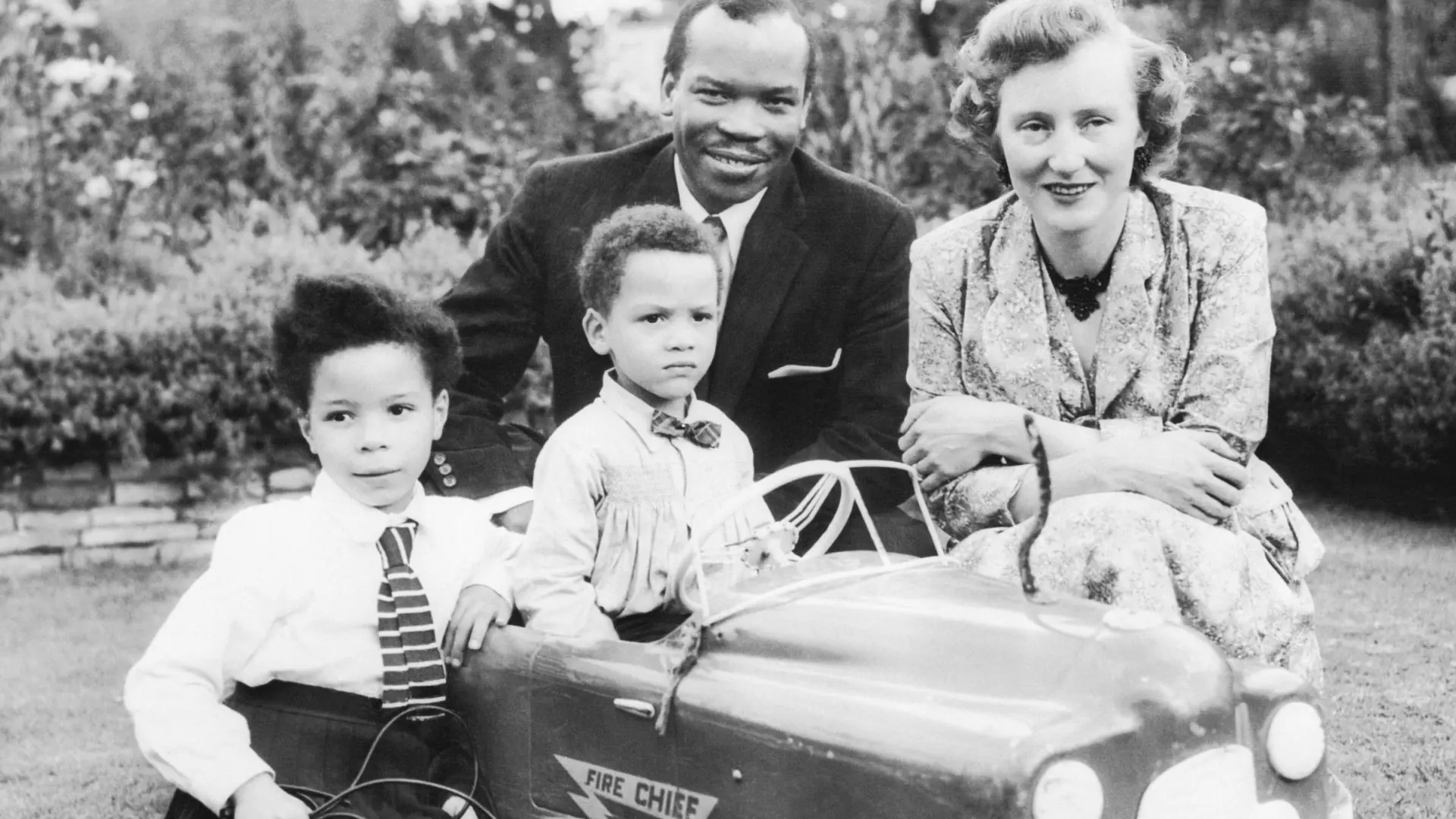
Seretse Khama’s marriage cost him six years of exile and the chieftaincy he was born to, but he turned the private citizenship forced on him into democratic leadership. The non-racial party he founded and the diamond partnership his government negotiated with De Beers built institutions that carried Botswana from poverty to middle-income status and outlasted him.
Marriage and exile
Seretse Khama was born in 1921, the grandson of Khama III, the Bamangwato king who had travelled to London in 1895 to negotiate the terms of his people’s relationship with the Crown. He inherited a royal lineage and an indigenous leadership operating inside a protectorate whose ultimate authority rested in Whitehall.
His marriage in 1948 to Ruth Williams, a British clerk he met while studying law in London, produced an international crisis. It prompted resistance within his community and diplomatic pressure on Britain from southern African governments. Bamangwato custom ultimately accepted Ruth. What the marriage threatened was the political arrangements Britain was managing with the newly institutionalised apartheid government of South Africa, which soon criminalised marriages across its racial classifications, and with the white minority government of Southern Rhodesia. The British government’s response, exile, was a calculation of diplomatic convenience presented as concern for Seretse’s own interests.
The exile lasted six years, from 1950 to 1956. Seretse was barred from returning to Bechuanaland and denied the chieftaincy that was his inheritance. He and Ruth lived in Britain, where he worked as a clerk and gave interviews that exposed a contradiction: a Labour government, committed in principle to racial equality, imposed a racial exile on behalf of the apartheid regime it officially opposed. The Conservative government that followed in October 1951 made the exile permanent in 1952. It was lifted on one condition, that Seretse return as a private citizen, having renounced the chieftaincy. He accepted.
Building a non-racial state
Returning to Bechuanaland in 1956, he entered politics not as a deposed chief seeking restoration but as an organiser of the democratic movement that would carry the country to independence. The Bechuanaland Democratic Party he founded in 1962 made non-racialism an organisational structure rather than an aspiration, with white and Asian Batswana as founding members. The country he led from independence in 1966 until his death in 1980 became a functioning democracy beside apartheid South Africa and Rhodesia, demonstrating what the region’s racial order claimed was impossible.
The choice to renounce the chieftaincy deserves more weight than it usually receives. The crown he gave up was the one office the colonial order was prepared to let him hold, provided he held it on its terms. The party he built instead answered to an electorate rather than a lineage. He traded inherited authority he could not control for democratic authority he could construct.
The diamond foundation
Diamonds were discovered at Orapa in 1967, a year after independence. Seretse’s government built state participation through the Debswana partnership with De Beers, so that the state co-owned the resource and captured a substantial share of its value rather than simply licensing its extraction. Royalty structures directed revenue into public finances rather than private hands. The country was among the poorest in the world at independence. By 2000, two decades after his death, it had achieved middle-income status on diamond revenue managed through institutions built to be durable rather than personally convenient.
The Debswana arrangement is the part of the story that travels furthest. The contrast with resource trajectories elsewhere is not a matter of luck or the quality of the stones but of the terms signed at the beginning and the institutions built to enforce them. Seretse understood that sovereignty over a resource is written in the contract, not announced at the mine.
A leader who refused the terms offered
Seretse Khama’s career shows what African leadership can look like when a leader refuses the terms that colonial and post-colonial systems offer. He refused exile’s invitation to bitterness and the chieftaincy’s invitation to rule by inheritance. He did not centralise power beyond the reach of democratic accountability. He died in office in 1980, having governed constitutionally for fourteen years, and left a country whose institutions were robust enough to survive his absence.



