Nigeria is Africa’s most populous nation, home to over 200 million people, about one in six of the continent’s people. Its road to independence ran through ancient civilisations, great kingdoms, the slave trade and more than a century of British expansion.
Officially the Federal Republic of Nigeria, it is a federal state in West Africa, bordered by Cameroon and Chad to the east, Benin to the west and Niger to the north. Its southern coast lies on the Gulf of Guinea in the Atlantic Ocean. It is made up of 36 states and the Federal Capital Territory, Abuja.
Nigeria’s history reaches back as far as 11,000 BC, when early communities lived in the land that is now Nigeria, as human remains found at Iwo Eleru in the south-west show. Before the British arrived, one of the best-known powers in the region was the Benin Empire, whose ruler was the Oba of Benin. The Nri Kingdom took root in the east, and the Songhai Empire extended into part of the country’s territory. By the eleventh century Islam had arrived through the Hausa States.
Early Nigeria, 500 BC to 1500
The Nok civilisation flourished in northern Nigeria between 500 BC and 200 AD. Its people made full-sized terracotta sculptures that are among the earliest known in sub-Saharan Africa. Further north, cities such as Katsina and Kano have histories going back to around 999 AD. In this period the Kanem-Bornu Empire and the Hausa kingdoms prospered as trading points between West and North Africa.
The Igbo Nri Kingdom came together in the tenth century and kept its power until the British ended it in 1911. Nri is believed to be the cornerstone of Igbo culture. In the southwest, the Yoruba kingdoms of Ife and Oyo rose to prominence in the twelfth and fourteenth centuries respectively. Human settlement at the site of present-day Ife goes back to the ninth century, and its culture is known for its bronze and terracotta sculpture.
Kingdoms and trade, 1500 to 1800
Oyo reached its height in the late seventeenth and early eighteenth centuries, when its influence stretched from western Nigeria to present-day Togo. The Benin Empire held sway over its region from the fifteenth to the nineteenth centuries. At the start of the nineteenth century Usman dan Fodio led a successful jihad and founded the Fulani Empire, also known as the Sokoto Caliphate. It ruled what is now central and northern Nigeria until 1903, when it was broken up among European colonies.
The peoples of the region traded heavily with North African merchants, and their cities became regional hubs on trade routes reaching West, Central and North Africa. In the sixteenth century Portuguese explorers began trading directly with local people at Calabar and at the port they named Lagos. That trade opened the way to the Atlantic slave trade. Calabar became one of the biggest slave-trading stations in West Africa, alongside Bonny Island on the Bight of Biafra and Badagry and Lagos on the Bight of Benin.
British Nigeria
By the 1600s Portugal, the Netherlands, Great Britain, private companies and a number of African states all took part in the slave trade. Great Britain abolished the transatlantic slave trade in 1807, and in 1808 it created the West Africa Squadron to suppress it at sea.
In 1851 British forces captured Lagos, intervening in a power struggle over the throne. They deposed Oba Kosoko, who favoured the slave trade, and installed Oba Akitoye in his place. A treaty between Great Britain and Lagos was signed on 1 January 1852, and in August 1861 Lagos became a Crown Colony under the Lagos Treaty of Cession.
In 1886 Britain chartered the Royal Niger Company under Sir George Taubman Goldie. In 1900 the company’s territory, which covered both banks of the Niger from the Atlantic Ocean to Lokoja as well as present-day northern Nigeria, passed to the British government, which then tightened its hold on the whole of what is now Nigeria.
On 1 January 1900 Britain set up the Southern Nigeria Protectorate, formed from the Niger Coast Protectorate (the former Oil Rivers Protectorate) and Royal Niger Company lands, and the Northern Nigeria Protectorate, alongside the Lagos Colony. The territory became part of the British Empire. In the late nineteenth and early twentieth centuries, the independent kingdoms that would later form Nigeria resisted Britain’s expansion. The British conquered Benin in 1897 and defeated other opponents in the Anglo-Aro War of 1901 to 1902.
The territories were formally united as the Colony and Protectorate of Nigeria in 1914, though Nigeria stayed divided for administration into the Southern and Northern Protectorates and the Lagos Colony. The name Nigeria itself had been coined in 1897 by the journalist Flora Shaw in an essay in The Times, after the region’s largest river. Christian missions set up Western schools in the protectorates, but were discouraged from working in the Islamic north.
Freedom at last
After the Second World War, Nigerians demanded independence. By the middle of the twentieth century a wave of demands for sovereignty was sweeping the continent. Between 1922 and 1959 Nigerian nationalism was led by figures such as Herbert Macaulay, Chief Obafemi Awolowo, Dr Nnamdi Azikiwe, Sir Ahmadu Bello and Chief Anthony Enahoro.
To give Nigerians some measure of control over their own land, and to calm popular feeling, the British introduced a succession of constitutions. They included the Clifford Constitution of 1922, the Richards Constitution of 1946, the Macpherson Constitution of 1951 and the Lyttelton Constitution of 1954. None of them stopped the demand for complete independence from colonial rule.
At last, on 27 October 1958, at the close of the constitutional conference in London, Britain agreed that Nigeria would become an independent state, and on 1 October 1960 Nigeria became an independent country.
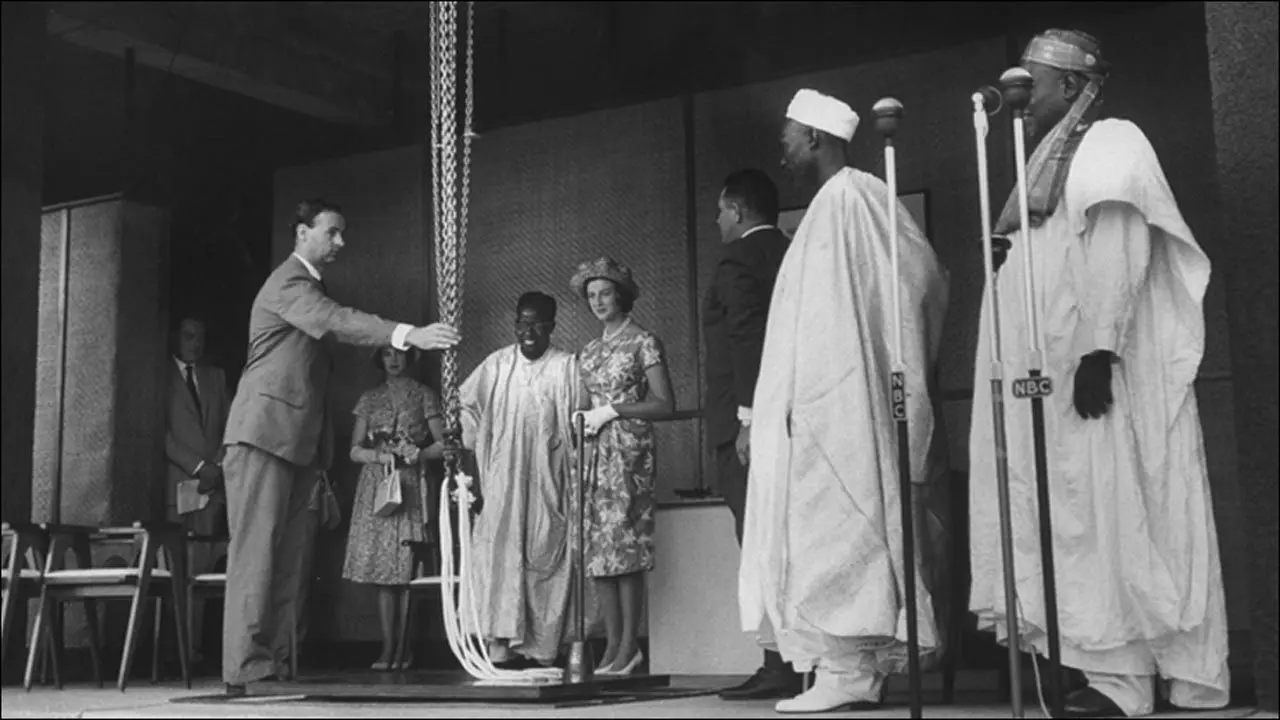
An Executive Council made up entirely of Nigerians was in place, led by Sir Abubakar Tafawa Balewa, who gave the independence speech at the ceremony at the Lagos Race Course, now Tafawa Balewa Square. Jaja Wachuku, the first indigenous Speaker of the House of Representatives, received Nigeria’s instrument of independence (also called the “Freedom Charter”) from Princess Alexandra of Kent, a member of the British royal family who represented Queen Elizabeth at the ceremony.
The Union Jack was lowered and the new Nigerian flag, designed by Taiwo Akinkunmi in 1959, was raised in its place. The national anthem changed from “God Save the Queen” to “Nigeria, We Hail Thee”, written by Lillian Jean Williams, a British expatriate then living in Nigeria.
That evening, fireworks lit the sky above the square to cries of happy independence. Dance troupes and masquerades from Nigeria’s many ethnic groups performed, thrilling the crowd with acrobatics. At a state banquet, dignitaries from Nigeria and abroad mingled, drank and danced.



