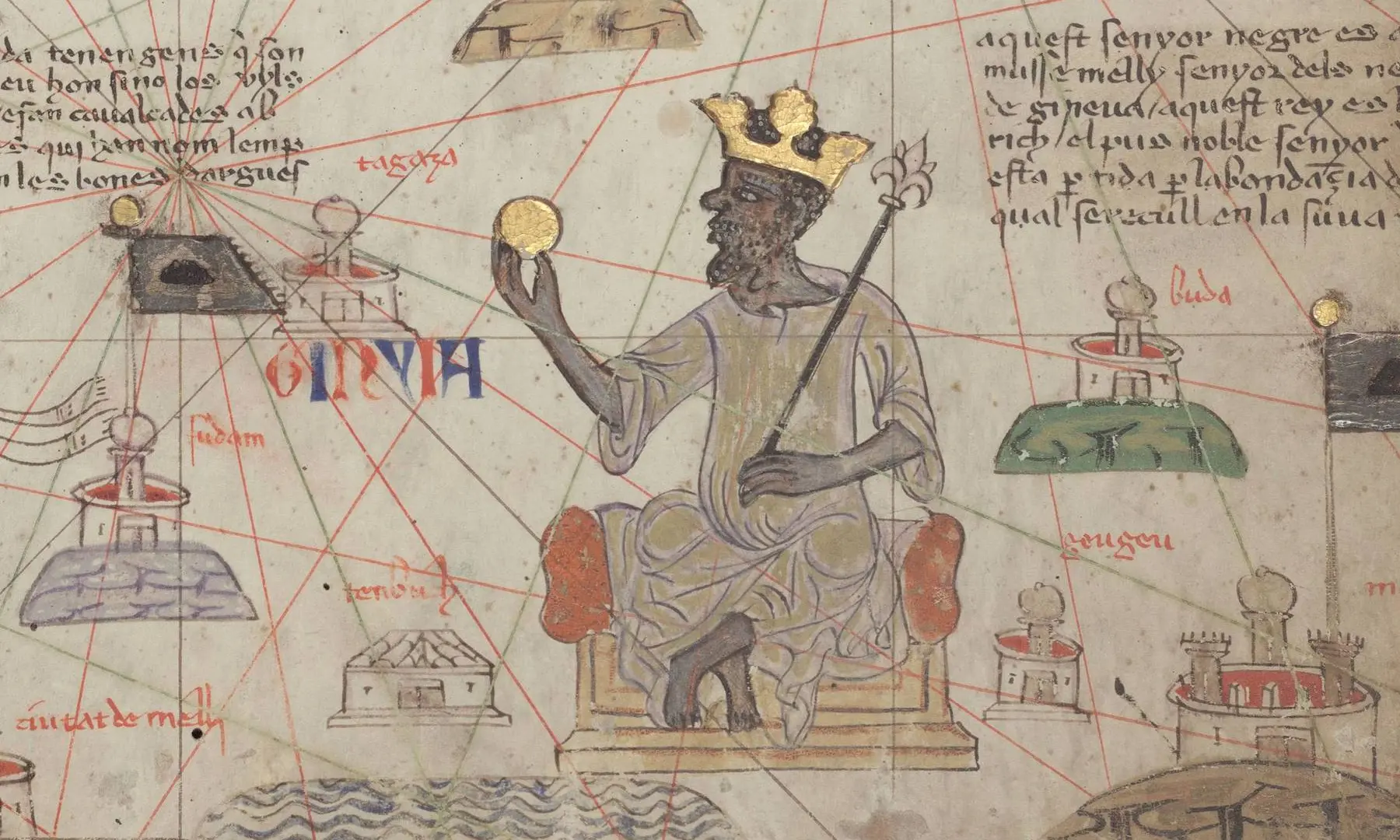
In March 2019 Forbes put the fortune of Aliko Dangote, Africa’s richest person, at US$10.9 billion. Encyclopaedia Britannica describes Mansa Musa, who ruled the Mali Empire in the 14th century, as widely considered the wealthiest person in history. Historians who study him decline to put any number on that wealth.
The figure matters less than what produced it. Musa’s fortune rested on a West African state’s control of gold-producing land and of the trans-Saharan routes that carried the metal north, and his pilgrimage to Mecca in 1324 turned that commercial power into a reputation that reached the Mamluk court in Cairo and the mapmakers of Europe. It is a history of African statecraft that Western accounts of the Middle Ages still tend to leave at the margins.
Gold, salt and the Saharan routes
Mansa was the title of Mali’s rulers, rendered in English as king or emperor. According to Britannica, the empire controlled major gold- and copper-producing regions and salt mines, as well as the trans-Saharan trade routes, and much of Musa’s wealth and the empire’s came from that trade. The BBC, citing the British Museum, reported in 2019 that Mali accounted for almost half of the Old World’s gold during his reign.
Kathleen Bickford Berzock, who curated the Block Museum of Art’s 2019 exhibition on medieval Saharan trade at Northwestern University, set out what that meant for the ruler when she spoke to the BBC. “As the ruler, Mansa Musa had almost unlimited access to the most highly valued source of wealth in the medieval world,” she said. “Major trading centres that traded in gold and other goods were also in his territory, and he garnered wealth from this trade.”
Musa widened that reach. The empire covered present-day Mali and parts of Guinea, Senegal, Mauritania and the Gambia, and in his reign it took in the trading cities of Gao and Timbuktu, according to World History Commons.
A fortune nobody can price
Modern estimates of the wealth are guesses presented as figures. In 2012 the US website Celebrity Net Worth put it at US$400bn, an estimate the BBC reported alongside the verdict of economic historians that it is impossible to pin down. “Contemporary accounts of Musa’s wealth are so breathless that it’s almost impossible to get a sense of just how wealthy and powerful he truly was,” Rudolph Butch Ware, an associate professor of history at the University of California, told the BBC. Jacob Davidson, writing for Money in 2015, reached the same conclusion: “There’s really no way to put an accurate number on his wealth.”
Cairo, where Mali presented itself
Musa came to power around 1312, the date most modern historians accept, although Britannica gives 1307, with 1312 as an alternative. In Cairo he told an emir he befriended, Ibn Amir Hajib, that his predecessor had sailed into the Atlantic with 2,000 ships and never returned, leaving him to rule. The account survives only because the Damascus scholar Shihab al-Din al-Umari wrote it down, and some historians suspect the story covered a seizure of power.
The pilgrimage of 1324 and 1325 was itself a display of what the state could do. Chroniclers of the time reported a caravan of some 60,000 people, Britannica records, among them a retinue of 12,000 enslaved people clad in brocade and Persian silk. The chroniclers wrote in superlatives, Britannica notes, and their numbers read as rhetoric rather than as a count. What they convey is a ruler able to move a court and its treasure across the Sahara.
Musa also guarded his standing. In al-Umari’s account, the emir sent to receive him on behalf of the Mamluk sultan al-Nasir Muhammad recalled that Musa resisted an audience at the Citadel, saying: “I came for the Pilgrimage and nothing else. I do not wish to mix anything else with my Pilgrimage.” The emir judged that Musa objected to having to kiss the ground and the sultan’s hand. When he did enter, Musa declared that he made obeisance to God who created him, and only then prostrated himself.
Cairo remembered the spending. Musa stayed in the city for about three months, and al-Umari, arriving later, found its people “eager to recount” what they had seen of it. The emir told al-Umari that Musa “flooded Cairo with his benefactions” and that the Cairenes “exchanged gold until they depressed its value in Egypt and caused its price to fall.” Al-Umari added his own observation. The mithqal of gold, which had not gone below 25 dirhams before the visit, did not exceed 22 dirhams about twelve years later.
How much that mattered is disputed. The US technology company SmartAsset has estimated the losses across the Middle East at about US$1.5bn (£1.1bn), the BBC reported. The historian Warren Schultz, in a 2006 reappraisal, argued that the fall stayed within the normal fluctuations of the gold price in Mamluk Egypt.
The gold ran short before the journey ended. On the way home Musa borrowed from Egyptian merchants at a high rate of interest. Al-Umari and Ibn Khaldun say the lenders were never repaid or were repaid only in part, while other sources differ on whether they were eventually repaid in full. Some accounts, the BBC reported, present the borrowing as a deliberate attempt to take gold out of circulation, others as the result of overspending.
At home the generosity is remembered less warmly. Lucy Duran of SOAS in London told the BBC that Mali’s griots, its singing historians, hold it against him. “He gave out so much Malian gold along the way that jelis [griots] don’t like to praise him in their songs because they think he wasted local resources outside the empire,” she said.
Mali on the European map
Abroad the journey bought lasting publicity. The Catalan Atlas of 1375, attributed to the Majorcan cartographer Cresques Abraham and held by the Bibliothèque nationale de France, shows Musa enthroned and holding a piece of gold. Its caption calls him the richest and noblest ruler of the region because of the gold extracted from his lands. In the 19th century Timbuktu still had a reputation in Europe as a lost city of gold, which the BBC traces largely to Musa’s pilgrimage five centuries earlier.
Scholars, builders and Timbuktu
Musa brought scholars back with him, among them Maliki jurists and Abu Ishaq al-Sahili, a poet from Granada he met on the return journey. Britannica records that al-Sahili built a domed audience hall for Musa at Niani, his capital. Al-Sahili is often credited with designing Timbuktu’s Djinguereber mosque, an attribution Britannica repeats, but the scholar Suzan B. Aradeon argued in 1989 that the historical evidence undermines the idea that he shaped West African architecture.
UNESCO, which lists Timbuktu as a World Heritage site, dates the first construction of the Djinguereber mosque to Musa’s return from Mecca. Like the Great Mosque of Djenné, it is built of earth, and UNESCO describes Timbuktu’s three great mosques as exceptional examples of earthen architecture.
Learning received royal patronage under Musa, and scholars of history, theology and law were to make Timbuktu’s Sankore mosque a teaching centre, Britannica records. The city’s peak as an intellectual capital came later, in the 15th and 16th centuries, according to UNESCO.
After Musa
Musa died in 1337, the date the historian Nehemia Levtzion judged most likely, though some evidence points to 1332. His son Maghan succeeded him. Mali’s territory was at its greatest under Musa and his brother Sulayman, who later took the throne.
That so rich a state is so rarely part of the story of the Middle Ages is, for the people who study it, a question of perspective. “The history of the medieval period is still largely seen only as a Western history,” Lisa Corrin, then director of the Block Museum of Art, said in the BBC’s report. Berzock made the same case in Northwestern University’s announcement of the exhibition: “The legacy of medieval trans-Saharan exchange has largely been omitted from Western historical narratives and art histories, and certainly from the way that Africa is presented in art museums.” That omission belongs to a longer pattern, which Africa 360° has examined in its analysis of how colonialism devalued African cultural knowledge.



