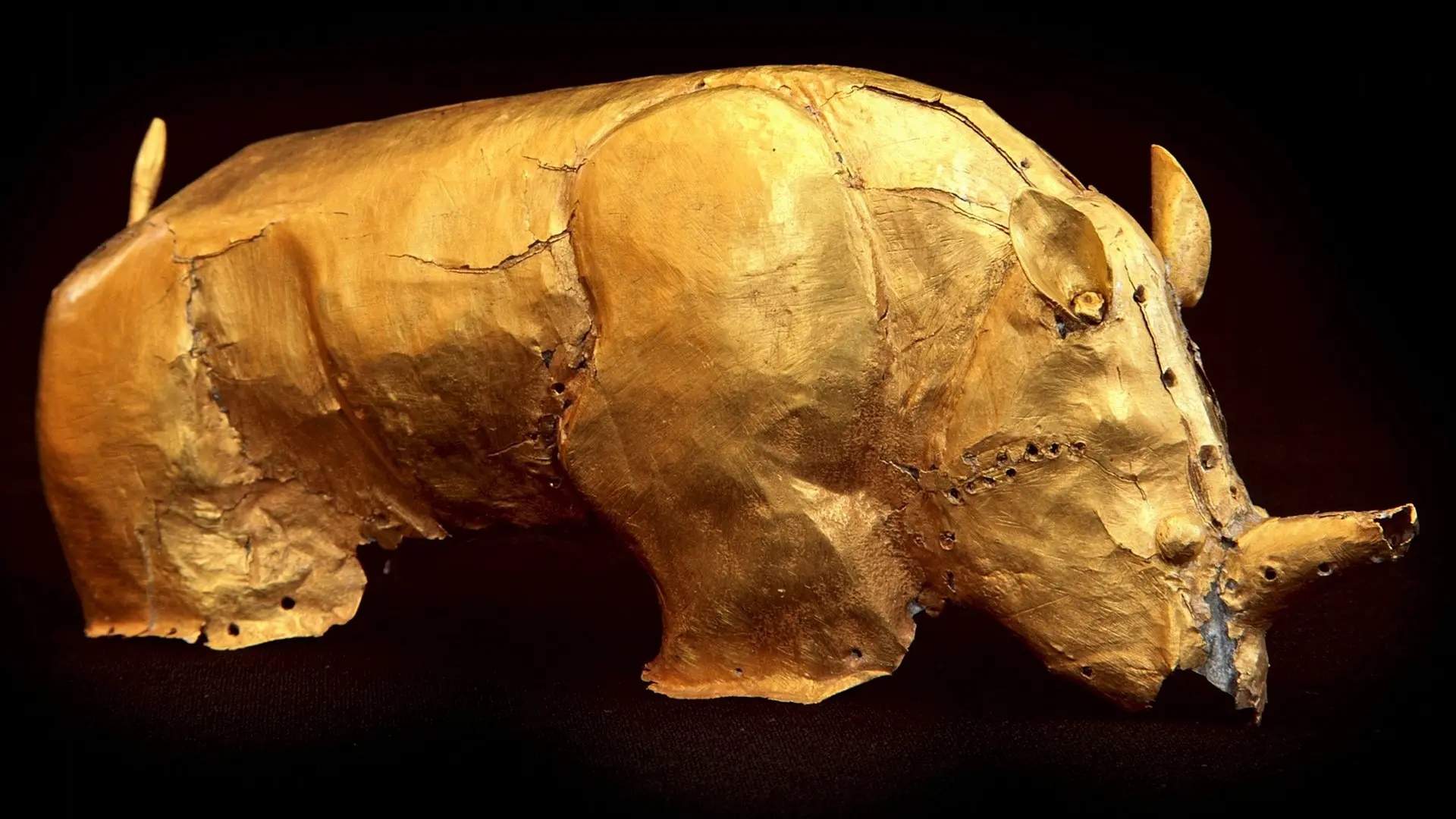
Long before colonial rule, a wealthy African state on the Limpopo River ran a class-based society, worked gold and traded with India and China. Mapungubwe is one of the clearest proofs that complex civilisations flourished in southern Africa on their own terms. That is why South Africa’s white-minority government found its discovery so uncomfortable.
The ancient city is an Iron Age archaeological site in Limpopo Province, where South Africa meets Zimbabwe and Botswana. It stands in wide, open savannah where the Limpopo and Shashe rivers meet. In July 2003 it was declared a World Heritage Site in recognition of what it tells us about the human past.
Cattle, copper and ivory
The name Mapungubwe is variously explained, as “stone monuments”, after the large stone houses and walls of the site, or as “hill of the jackals”. The kingdom’s prosperity rested on its land. The savannah suited cattle herding, and access to copper and ivory opened long-distance trade that brought gold and other exotic goods to the ruling elite.
Archaeologists divide the area they have studied into 3 parts. These are K2, also called Bambandyanalo, Mapungubwe Hill (MK) and the Southern Terrace (MST).
The earliest settlers were Early Iron Age farmers, whose presence is confirmed by a few potsherds archaeologists have identified as Early Iron Age pottery. These people made their own pottery and metal tools. The Mapungubwe community itself lived there from about 1000 to 1300.
Its people were Bantu speakers and herders, like the people of Thulamela, and they were among the ancestors of the Shona of southern Africa.
A society divided by class
As at Thulamela and Great Zimbabwe, Mapungubwe society was organised by class, and the layout of its homes shows it. The elite lived on top of Mapungubwe Hill, while their followers lived at its foot and in the land around it.
Death, too, was divided. The rich had their own cemetery on the hilltop, looking out over the region. They were buried with gold and copper ornaments and glass beads, which shows how skilled the people of Mapungubwe were at working gold.
The people were wealthy farmers. They kept cattle, sheep and goats, as well as dogs, and their harvests were large enough to trade and to store. Archaeologists have found traces of millet, sorghum and cotton in the remains of storage huts. At its peak in the mid-thirteenth century CE, Mapungubwe had a population of around 5,000.
A trading power
Wealth also came from ivory, from gold and from the fertile floodplain the rivers left behind. Herds supplied meat and hides, and the people also hunted, set snares and gathered food. From about 1220 to 1300, Mapungubwe was an advanced trading centre whose people dealt with Arabia, China and India through the harbours of the East African coast.
Its closeness to the Limpopo, which linked it to the coast, made that trade possible. Salt, cattle, fish, gold and iron, ivory, wood, and the shells of freshwater snails and mussels were exchanged, while chert and ostrich-eggshell beads were traded for glass beads and cloth.
Mapungubwe was a major state in southern Africa and a part of international trade. Glass beads almost certainly made in India and fragments of Chinese celadon show that it traded with coastal states, which in turn traded with merchants who came by sea from India and Arabia.
A discovery kept quiet
Mapungubwe is one of the earliest known sites in southern Africa with evidence of a class-based society, with leaders set apart from commoners. That is evidence of an African civilisation that flourished long before colonisation. When the site was discovered in 1932, it contradicted the white-supremacist belief in black inferiority held by South Africa’s rulers. The government of the day took control of the site, and the digs were kept fairly secret, made public only after 1994. The University of Pretoria has excavated the site since then and has recovered a large collection of artefacts, as well as human remains.
The most spectacular find is a small golden rhinoceros, made of gold foil over a wooden core. Mapungubwe Hill and K2 were declared national monuments in the 1980s.
Why Mapungubwe was abandoned
No single explanation accounts for the abandonment of Mapungubwe around 1300. Some archaeologists have argued that the climate changed, becoming colder and drier, which shrank the grazing land and made cattle farming difficult. Others think overpopulation put too much strain on local resources, a strain that droughts and a shift in trade routes may have brought to crisis point. Mapungubwe depended on trade, and any blow to it would have forced people to move away. Together these pressures drove migration further north, towards Zimbabwe.
Myth and evidence
When Europeans came upon the ruins of Great Zimbabwe in the 19th century CE, many refused to believe that black Africans had built such impressive structures, and the same disbelief met Mapungubwe after 1932. Theories multiplied to explain the ruins away and to confirm racist European beliefs, crediting them to the ancient Egyptians or the Phoenicians. Archaeology has since shown that both sites were built by indigenous Africans in the medieval period.
Many of the artefacts from Mapungubwe are on display today at the University of Pretoria Museums. The site itself is protected within Mapungubwe National Park, part of the Greater Mapungubwe Transfrontier Conservation Area.



