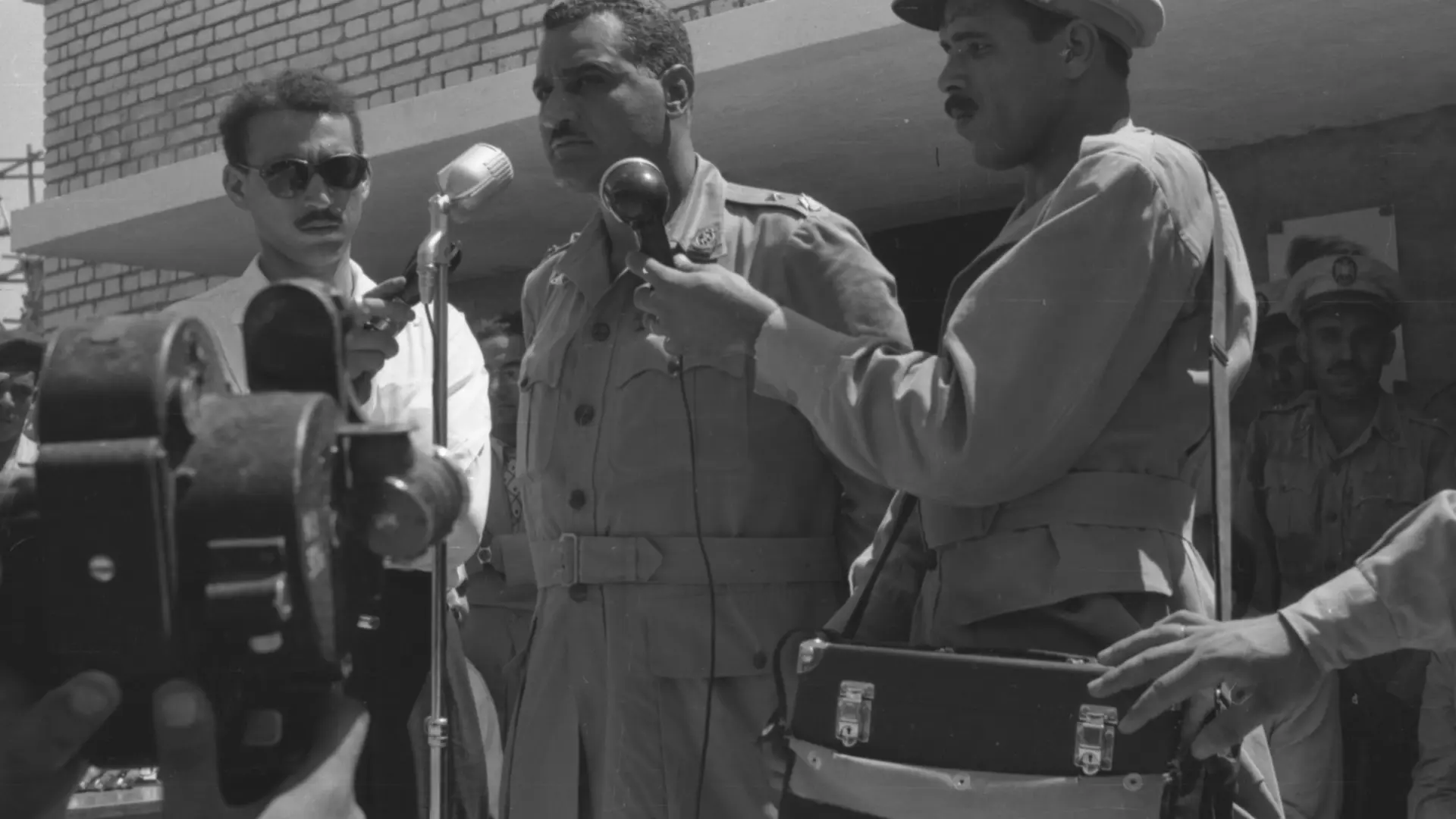
No Arab leader of modern times has held the loyalty of ordinary people across the Middle East as Gamal Abdel Nasser did in the last 15 years of his life. He led Egypt for 18 years, through reform at home, defeat abroad and the rise of a police state, and his popularity survived even two lost wars. His story begins far from power, in the family of a postal clerk.
Nasser was born in Bakos, Alexandria, on 15 January 1918. His father, Abdel Nasser Hussein, was a postal worker born in Beni Mur in Upper Egypt and raised in Alexandria. His mother, Fahima, came from Mallawi in el-Minya. The couple married in 1917. Nasser had two brothers named Izz al-Arab and al-Leithi. Izz al-Arab means “Glory of the Arabs”, a name that reflected the family’s strong attachment to the “Arab notion of glory”.
Early life
His father’s postings kept the family on the move. They went to Asyut in 1921 and in 1923 to Khatatba, a poor village in the Nile Delta, where Nasser started school at a primary school for the children of railway workers. In 1924 he was sent to live in Cairo with his paternal uncle, who had just been released from a British prison. He wrote to his mother regularly and visited her in the holidays. At the end of April 1926 her letters stopped. When he went back to Khatatba, he found that she had died giving birth to his third brother, Shawki, and that the family had kept the news from him. He said later that “losing her this way was a shock so deep that time failed to remedy”. He had adored his mother, and the loss hurt him more when his father remarried.
He moved to Alexandria to live with his maternal grandfather and in 1928 attended the city’s Attarin elementary school. In 1929 he left for a private boarding school in Helwan, but he later went back to Alexandria to enrol at Ras el-Tin secondary school and to live with his father, who was working for the city’s postal service.
Alexandria made him a political activist. In Manshia Square he came upon a clash between protesters and police and joined in without knowing what the demonstration was about. It had been organised by the ultranationalist Young Egypt Society, which demanded an end to colonial rule after Prime Minister Isma’il Sidqi annulled the 1923 constitution. Nasser was arrested and held for a night until his father bailed him out. In 1934 he briefly joined the society’s paramilitary wing, the Green Shirts. He took part in many anti-British street protests, and in one of them a blow to the forehead left him with a scar for life. After secondary school he spent a few months at a law college, then entered the Royal Military Academy and graduated as a second lieutenant.
In 1944 he married Tahia Kazem, the 22-year-old daughter of a wealthy Iranian father and an Egyptian mother. She had lost both parents young. They had met in 1943 through her brother, Abdel Hamid Kazim, a merchant and a friend of Nasser’s. After the wedding they moved into a house in Manshiyat al-Bakri, a suburb of Cairo, and lived there for the rest of their lives.
The army and the Free Officers
While serving with the Egyptian army in Sudan, Nasser met three fellow officers who would shape Egypt’s future. Zakaria Mohieddin later became vice-president of the United Arab Republic. Abdel Hakim Amer later became a field marshal. Anwar el-Sadat would succeed Nasser as president. Together they planned a secret revolutionary organisation, the Free Officers, whose full membership only Nasser knew. Its main aim was to drive out the British and the Egyptian royal family.
Into power
On 23 July 1952, Nasser and 89 other Free Officers overthrew the monarchy in an almost bloodless coup. Sadat wanted King Farouk I and some leading figures of the old order executed in public at once. Nasser overruled him and let Farouk and others go into exile. Power passed to a Revolutionary Command Council of 11 officers under Nasser’s control, with Major General Muhammad Naguib as a figurehead head of state.
For more than a year Nasser kept his real role so well hidden that foreign correspondents did not know he existed. In the spring of 1954, after a tangled power struggle, he emerged from the shadows as prime minister. In October that year a man tried to shoot him at a mass rally in Alexandria. The gunman said the Muslim Brotherhood had given him the task, and Nasser cracked down hard on the movement. In November Naguib was forced out and placed under house arrest.
In January 1956 Nasser announced a new constitution. It made Egypt a socialist Arab state with a single party and Islam as the state religion. Of the five million Egyptians who voted, more than 98 per cent chose Nasser, the only candidate, as president, and 99.8 per cent approved the constitution.
What he achieved
Nasser’s years in office changed Egypt. The Aswan High Dam, built with Soviet help, began operating in 1968. Modern 20th-century life reached many villages. Industry grew. Land reform broke up the great private estates. A campaign against corruption had some success. Women gained more rights than ever before, the vote among them. A new Egyptian middle class moved into the political and economic positions once held by Italians, Greeks, French, Britons and other foreigners, whom Nasser asked to leave. His greatest feat was simply to survive for 18 years as Egypt’s leader against a formidable array of enemies, from communists, Muslim extremists and the old parties to rival army factions, dispossessed landowners, Naguib’s supporters and what remained of the foreign community.
The cost of his rule
The darker side was a police state. Mail was opened and telephones tapped, the media were tightly censored, the main newspapers were nationalised and visitors had their rooms searched. There was no political democracy in the Western sense. Nasser and his inner circle chose the single party’s candidates for office, and political opponents were held in desert camps. The birth rate stayed so high that it undermined every effort to raise living standards.
Egypt and the world
Abroad, Nasser joined Josip Broz Tito of Yugoslavia and Jawaharlal Nehru of India as a champion of non-alignment, or “positive neutrality.” He became a world figure at the Bandung Conference of Asian and African nations in 1955. His refusal to recognise Israel, and Egypt’s defeat by Israel in 1956, led him to pour into the military vast sums that might have paid for his social revolution.
From 1962 Egyptian troops fought for the republican side in Yemen’s civil war. They were withdrawn in 1967, when war with Israel broke out again in June. Nasser had asked the United Nations to remove its peacekeepers from the Gaza Strip and Sharm al-Shaykh, and then closed the Gulf of Aqaba to Israeli shipping. The war that followed became known as the Six-Day War, or the June War. With the Egyptian air force destroyed on the ground and the army driven back across the Suez Canal, Nasser offered to resign. Huge street demonstrations and a vote of confidence in the National Assembly persuaded him to stay. The Soviet Union at once began replacing the lost equipment and installed surface-to-air missiles along the canal to shield Egypt’s artillery. Nasser had tentatively accepted an American plan for peace talks with Israel when he died of a heart attack in 1970.
The man and his health
For all the turmoil of his public life, Nasser was conservative and easy-going in private. His standing with the Arab public remained intact even after two wars that ended in disaster for Egypt. Yet he failed in his aim of a united Arab world, and before he died he had traded away some of Egypt’s political independence for Soviet military support.
He was a chain smoker who kept to 18-hour working days and seldom took a holiday, and his health suffered for it. He was found to have diabetes in the early 1960s, and by his death in 1970 he also had arteriosclerosis, heart disease and high blood pressure. He had two major heart attacks, in 1966 and 1969, and after the second he spent six weeks in bed. State media put his absence from public view at the time down to illness.



