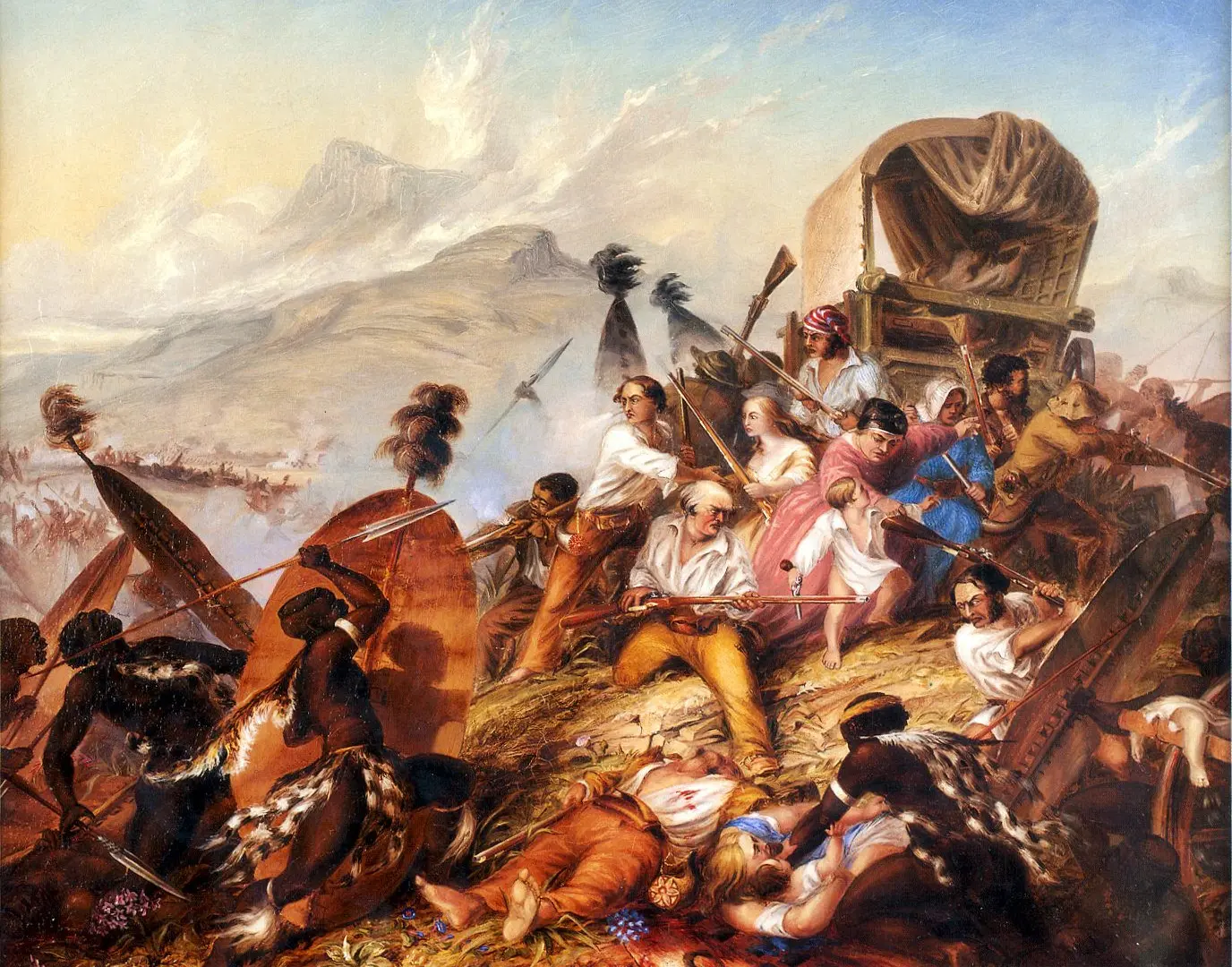
South Africans have a public holiday on 16 December. Since 1995 it has been the Day of Reconciliation, chosen because the date carries weight for both Afrikaners and black South Africans. For Afrikaners it recalls the Battle of Blood River in 1838. For the liberation movement it marks the founding of Umkhonto we Sizwe, the armed wing of the ANC, on 16 December 1961. The day was first known as Dingane’s Day (Afrikaans: Dingaansdag) and became a national holiday in 1910. It was renamed the Day of the Covenant in 1952 and the Day of the Vow in 1980.
The Afrikaner commemoration goes back to 16 December 1838. That morning 463 Voortrekkers led by Andries Pretorius, whose name lives on in Pretoria, South Africa’s administrative capital, fought a Zulu army of an estimated 10,000 to 20,000 men on the bank of the Ncome River, in today’s KwaZulu-Natal. The battle grew out of a dispute over land in Natal and the killing of Voortrekkers on the orders of the Zulu king, Dingane.
Prelude
Britain took control of the Cape in the early 1800s. Boer farmers who wanted no part of British rule moved inland in search of land beyond its reach. They became known as Voortrekkers (Afrikaans for “early migrants”). At first they met little resistance, and the trek carried them into Natal, land held largely by the Zulu.
The conflict began at the negotiating table. In November 1837 the Voortrekker leader Piet Retief met Dingane to discuss buying land in Natal. Dingane reportedly agreed to grant the territory between the Tugela and Mzimvubu rivers, on condition that Retief recovered cattle stolen by a rebel chief, Sekonyela. Retief did so. His men also took horses, cattle and guns from Sekonyela’s people to add to their own supplies.
Dingane demanded that this extra booty be handed to him. Retief replied with a letter that recalled an earlier Voortrekker victory over the Ndebele. Dingane took the letter as a barely hidden threat and as evidence that the Voortrekkers were plotting against him. When Retief’s party returned with the recovered cattle and horses, the king received them warmly. He is said to have signed a treaty for the land while planning to kill the Boers before they could settle it.
Dingane invited Retief and his men to a farewell celebration the following day and asked them to come unarmed as a mark of respect. Fellow Voortrekkers suspected treachery and warned him, but Retief ignored them and arrived with about 69 followers.
As Dingane’s warriors danced for their guests, the king suddenly accused the party of witchcraft and gave the order “Bulalani abathakathi” (Kill the sorcerers). His soldiers killed all of Retief’s men, and then Retief himself.
Dingane then moved against the rest of the Voortrekkers, who had pushed into Zulu territory. With about 15,000 men he marched to the foot of the Drakensberg, where the settlers had formed their laagers (wagon encampments). His regiments destroyed the camps and killed an estimated 500 men, women, children and servants, most of them at Bloukrans.
Help came from farmers in the Cape Colony. The settlers in Natal also asked Andries Pretorius, a supporter of Boer independence, to leave the Cape and come to their defence.
Before he arrived, the Voortrekkers struck back with a march on the Zulu capital, uMgungundlovu, under the commandants Piet Uys and Hendrik Potgieter. The Zulu attacked them on the way at Italeni, killing Uys and many of his men. The exhausted survivors expected defeat. When the Zulu attacked again on 12 August 1838, however, the Voortrekkers held their ground. The fighting lasted three days and ended in a Zulu defeat, and Voortrekker morale recovered.
On 26 November 1838 Pretorius was appointed general of a wagon commando against Dingane at uMgungundlovu. He took command of the Voortrekker forces and led them into Zululand on the offensive.
The battle
Knowing they were outnumbered, the Voortrekkers dropped their plan to attack the Zulu capital directly. With the odds against them, they made a vow to the Christian God. If they won the coming battle, they would build a church and keep the day as a holiday. According to Boer tradition, they repeated the vow every night until they reached the Zulu.
When word came that the Zulu army was approaching, the Voortrekkers took up a position near the Ncome River, a site protected by a ravine to the south. On the night of 15 December, six Zulu regiments led by Dambuza (Nzobo) tried to cross the river. Only about half of them got across, possibly because of mist. The elite regiments of the senior general, Ndlela, stayed on the far bank, and the army was split in two. By custom the seasoned warriors went in first while the younger men waited. Because the Voortrekkers were so few, the younger regiments argued that they should be allowed to attack first, and they were given permission.
On 16 December dawn broke at 4:30am under heavy mist. The Voortrekkers could not see the Zulu army, but they could hear it.
The battle began at 5 am, when the mist suddenly lifted and cannon fired from each gate of the laager. The Zulu attacked even though half their force was still on the other side of the river. Guns and cannon checked each charge. After two hours and four waves of attack, the lulls between them giving the Voortrekkers time to reload and rest, Pretorius sent a group of horsemen out of the laager to break up the Zulu formations. The Zulu stood against the charge for some time, but their losses mounted quickly. They scattered and then retreated, and the Voortrekkers hunted them down for three hours. More than 3,000 of Dingane’s soldiers were killed, among them two Zulu princes who were rivals of Prince Mpande for the throne.
Aftermath
Pretorius and the Voortrekkers reached uMgungundlovu on 20 December 1838 and found it destroyed. Near the capital, on kwaMatiwane hill, they found the remains of Retief and his men. Retief was said to have been found with the land treaty still intact in his leather pouch, though historians now question the story.
Dingane’s hold on the kingdom was weakening. Fearing that the king meant to have him killed, Prince Mpande fled across the Tugela with about 17,000 followers. Pretorius chose to back Mpande as Dingane’s replacement and to aim at Dingane alone, leaving Mpande to remove the king by force of arms.
The final clash came in January 1840 at Maqongqe. Mpande’s forces did not wait for Pretorius’s horsemen before attacking the last of Dingane’s regiments, commanded by General Ndlela. Ndlela departed from the usual Zulu tactics and sent his regiments in one at a time instead of together in the horned formation. Dingane had to flee. Before he did, he had Ndlela slowly strangled with cowhide for high treason, on the grounds that the general had fought for Mpande and had protected him until then. Pretorius then approved and attended Mpande’s installation as Zulu king in Pietermaritzburg, and the two agreed that the Tugela River would be the border between Zululand and the Republic of Natalia.
The Battle of Blood River, which was to shape the lives of everyone who lives in South Africa, was over.
Memorial
In 1841 the Voortrekkers kept their vow and built a church, the Church of the Vow, in Pietermaritzburg, the town named after their two fallen leaders, Piet Retief and Gerrit Maritz.
In 1947 a granite ox wagon by the sculptor Coert Steynberg was erected on the battlefield. In 1971 a laager of 64 ox wagons cast in bronze by the Unifront Foundry in Edenvale (Fanie de Klerk and Jack Cowlard) was put up on the site, and it was unveiled on 16 December 1972.



