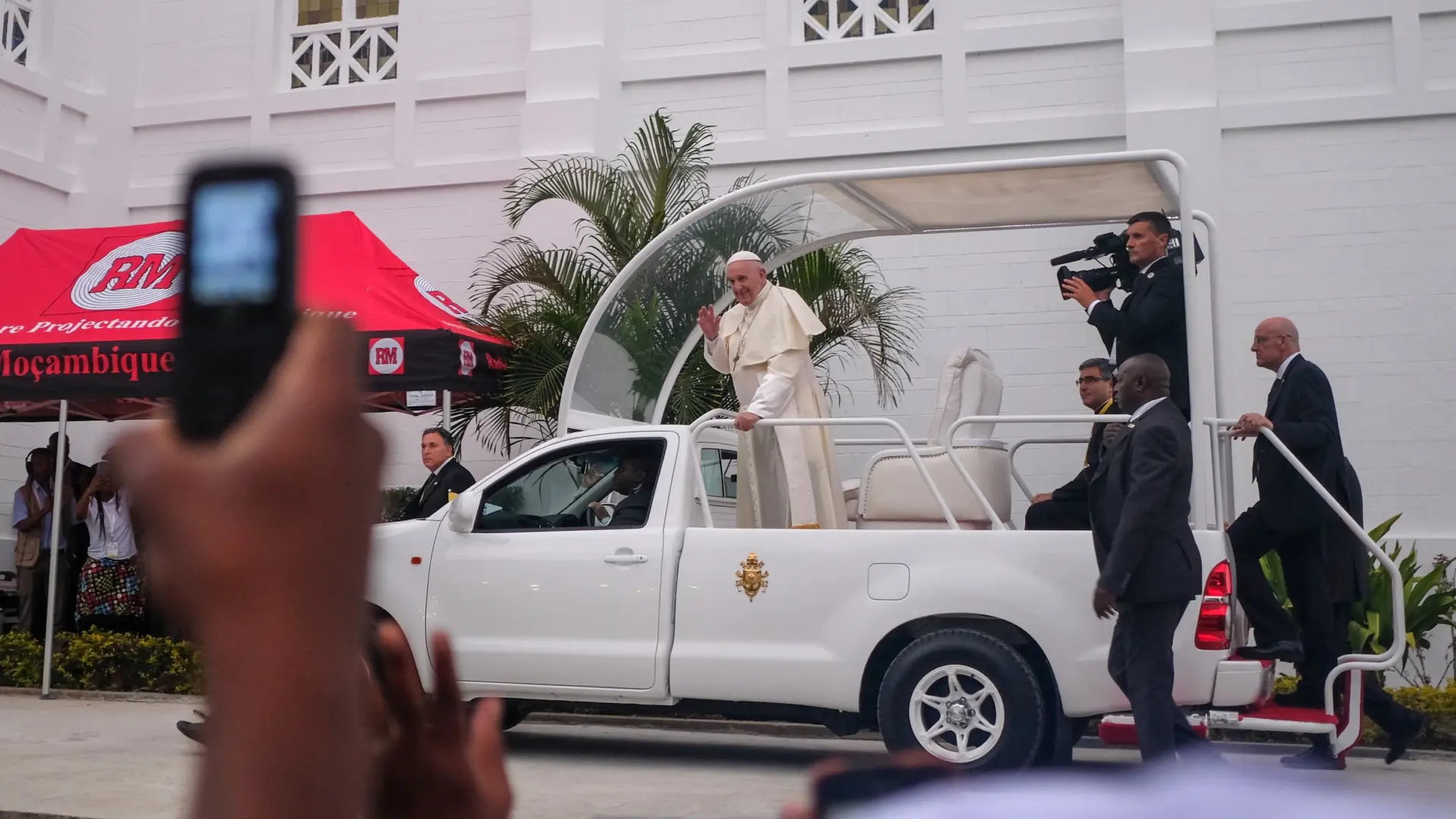
Pope Francis died on 21 April 2025 at the age of 88. Francis’s African legacy is best measured by institutional decisions rather than by the continent’s growing share of the world’s Catholics. He gave African churchmen senior roles, endorsed an African form of the Roman rite and spoke in Kinshasa about extraction in terms that African bishops took up. The African response to Fiducia Supplicans, the 2023 declaration on blessings, showed the limits of that legacy: numbers give the continent weight in the Church, but they do not transfer authority over doctrine automatically.
Senior African churchmen under Pope Francis
Representation in the Church runs through cardinal appointments, Vatican responsibilities and participation in consultations. Francis created Archbishop Fridolin Ambongo of Kinshasa a cardinal on 5 October 2019 and later named him to his Council of Cardinals, the small group that advised him on Church governance. Ghana’s Cardinal Peter Turkson had received his red hat from John Paul II in 2003. Francis made him the first prefect of the new Dicastery for Promoting Integral Human Development, a post he held from 1 January 2017 until December 2021. Both men became prominent voices on governance and social justice. The significance of such appointments lies in the responsibilities that come with them.
Cardinal appointments also shape the body that elects popes. Of the 135 cardinal electors eligible when Francis died, 18 were African, and Francis had created 15 of them. When 133 electors entered the Sistine Chapel on 7 May 2025, 17 Africans were among them; Kenya’s Cardinal John Njue did not attend for health reasons. A group of that size carries weight in a conclave, though African cardinals do not hold a single position on doctrine or governance.
African traditions in Catholic worship
On 1 December 2020 Francis recorded a video message for the launch of a Vatican Publishing House volume on the Roman Missal for the Dioceses of Zaire, praising the Congolese adaptation as a promising model of inculturation. The form was not new. It had been authorised on an experimental basis in 1974, and the Congregation for Divine Worship approved the Missal on 30 April 1988, under John Paul II. Francis’s contribution was to endorse and publicise a long process of liturgical adaptation led by Congolese clergy, not to begin it.
His language on economic justice found an audience among African church leaders. Arriving in Kinshasa on 31 January 2023, he told the authorities of the Democratic Republic of the Congo:
“Hands off the Democratic Republic of the Congo! Hands off Africa! Stop choking Africa: it is not a mine to be stripped or a terrain to be plundered.”
The words come from the Vatican text of the address. In February 2025 the Symposium of Episcopal Conferences of Africa and Madagascar (SECAM), with AMECEA and Caritas Africa, launched a Jubilee 2025 campaign for debt cancellation in Africa. The campaign condemned debt burdens that it said consume more than half of public revenue in several African states, applying Francis’s vocabulary to a specific fiscal argument.
Fiducia Supplicans and the limits of local authority
On 18 December 2023 the Dicastery for the Doctrine of the Faith issued Fiducia Supplicans, approved by Francis. It permitted spontaneous, non-liturgical blessings for couples in irregular situations and for same-sex couples, while reaffirming Catholic teaching on marriage and ruling out any ritual that could appear to validate such unions. Blessings of this kind are distinct from marriage ceremonies. After objections from bishops in several regions, the Dicastery issued a clarification on 4 January 2024 stressing that such blessings should last only a few seconds, avoid any liturgical form and allow room for prudent local discernment.
On 11 January 2024 Cardinal Ambongo, as president of SECAM, issued a statement on behalf of Africa’s episcopal conferences concluding that extra-liturgical blessings for same-sex couples “cannot be carried out in Africa without exposing themselves to scandals”. The statement was prepared with the agreement of Francis and of the Dicastery’s prefect, Cardinal Víctor Manuel Fernández. That detail matters. African bishops did not overrule Rome. They secured a continental exception within its framework, and Rome accepted it. Positions on sexuality, economic justice and institutional authority also do not sit on a single liberal and conservative scale: SECAM, the body that declined the blessings, also led the 2025 debt campaign built on Francis’s economic language.
Population and representation
Population trends affect the distribution of clergy, resources and attention within the Church. But the relationship between numbers, representation and doctrine passes through Church institutions. It is not an automatic demographic transfer of authority, a question this site has examined in asking whether Rome will give Africa’s Catholics greater authority.
The question after Francis
On 8 May 2025, on the fourth ballot, the conclave elected Cardinal Robert Francis Prevost, a Chicago-born former missionary bishop in Peru, who took the name Leo XIV. His pontificate will show whether Francis’s African appointments become lasting influence over Rome’s governance, and how far the Zaire rite and SECAM’s January 2024 exception serve as models for local discretion. The useful test, as the debate over Church authority after Francis suggests, is who takes part in decisions, what responsibilities they hold and how those decisions reach congregations, rather than treating Africa as a uniform successor to Europe.



