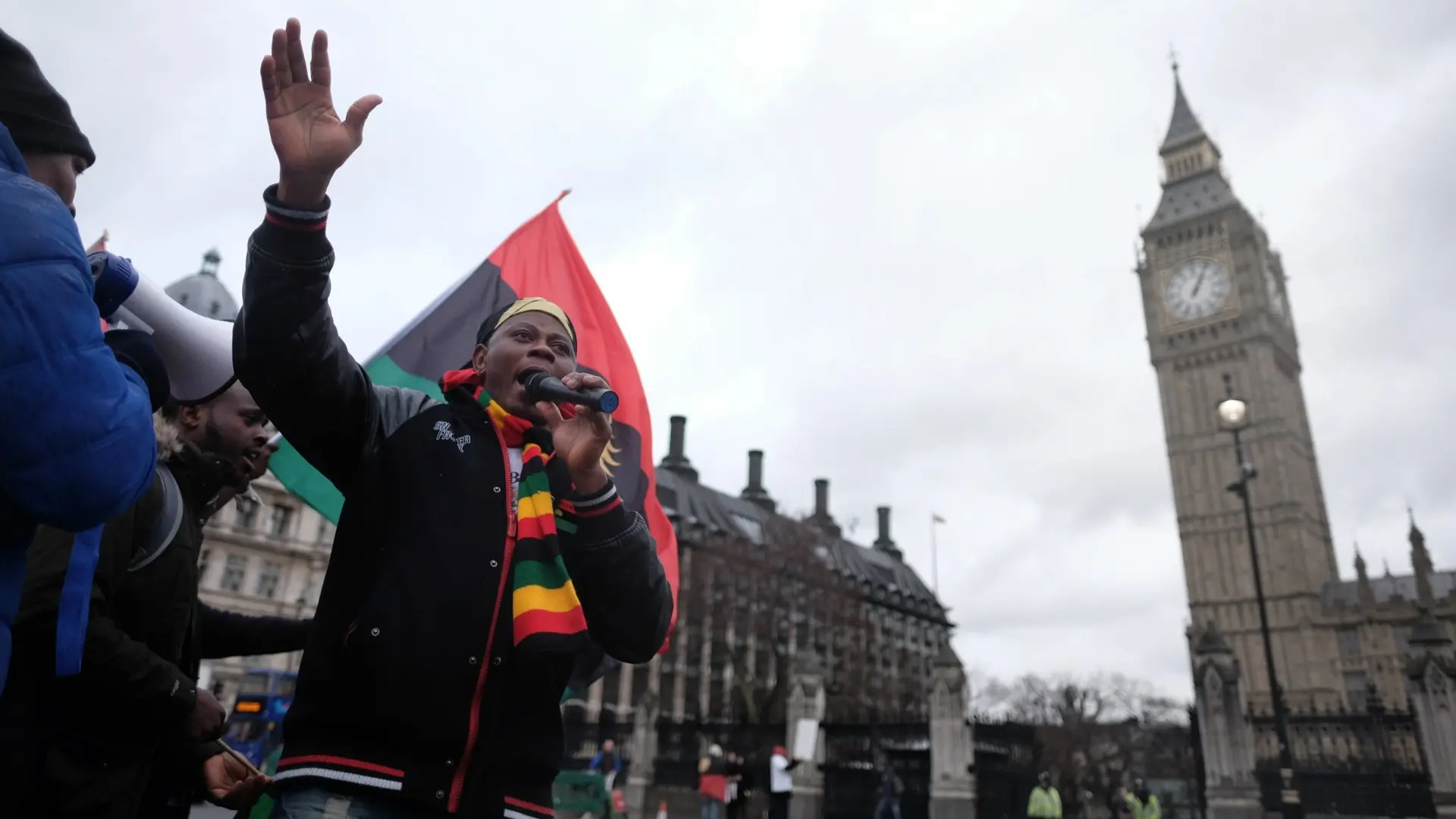
The war ended in 1970. The question it asked has never been answered. Fifty-four years after Nigeria’s federal forces declared victory over the secessionist Republic of Biafra, the state has never built a framework of transitional justice for what was done in the war and after it. That unaddressed wound, deepened by post-war policy, now feeds a grievance the federal government treats only as a security problem.
Between one and three million people died. The precise figure has never been established, and estimates depend on incomplete records and differing methods. Children starved to death on camera. The images circled the world, and Biafra became an international symbol of humanitarian catastrophe. Then, on the official record, it became a matter considered closed.
The post-war settlement
Nigeria’s post-war reintegration policy, framed under Gowon’s famous slogan “No Victor, No Vanquished”, operated on a logic that was structurally convenient for the federal side. Move forward, build Nigeria, do not litigate the past. Properties were seized under the Abandoned Property edict. Twenty pounds was what the federal government offered Biafrans for any amount they had held in their pre-war accounts. Twenty pounds. The symbolic cruelty of that figure has never been formally acknowledged.
Civilian testimony is essential to understanding the war and its aftermath. Teachers, traders, displaced families and children experienced events differently from the political and military leaders whose accounts have often shaped public debate.
The cost of silence
What persists now is not simply the IPOB movement, the annual sit-at-home orders, or the security operations in Imo and Anambra states. Those are symptoms. The underlying failure is that the Nigerian state has never built a genuine framework for post-war transitional justice: one that acknowledges that something happened, identifies what it was, creates space for the testimony of those who lived through it, and produces an accounting solid enough to anchor reconciliation on something more than time and official silence.
The cost of that refusal is visible in everything the federal government misidentifies as a security problem in the southeast. The IPOB movement, whatever its methods and however contested its tactics, draws its emotional fuel from an unresolved historical wound. The young men in Imo and Enugu and Abia who respond to the sit-at-home call (sometimes out of genuine conviction, sometimes out of fear) are responding to something that the Nigerian state has never given them language to process through any other channel. Force applied repeatedly to an unresolved wound does not heal the wound. It deepens it.
Britain’s role
There is another dimension that rarely enters the conversation, because it requires Nigeria to look at itself from the outside. The Biafra war was not a purely domestic event. Britain supplied arms and diplomatic cover to the federal side. The oil calculus was never far from the surface. The international community (with a handful of exceptions, most notably France and several African states) chose the territorial integrity of Nigeria over the protection of a civilian population that was, by multiple documented accounts, being starved as a deliberate military strategy. Those external actors have also never been held to account. The forgotten voices of Biafra are not only forgotten in Abuja. They are forgotten in London.
What a reckoning would require
Rwanda’s Gacaca courts, South Africa’s Truth and Reconciliation Commission and Germany’s remembrance institutions offer different examples of how states address mass violence. None provides a simple template, but each shows that public reckoning requires institutions as well as time. A fuller reckoning in Nigeria would create space for survivor testimony, scrutiny of post-war restitution policies and debate about the violence’s legal and historical classification. Recognition of suffering need not imply support for secession.
Nigeria cannot afford to carry this wound into its next phase. Not because the Igbo vote will swing an election (though it might) and not because international pressure requires it, though it should. But because a state that cannot account for its own history of mass violence against its own citizens remains, in that unresolved wound, incomplete. It has declared victory without yet earning peace.
The voices of Biafra have not gone quiet. They have simply been denied a room in which to speak. Building that room (not as a concession to separatism, but as the basic civic obligation of a state serious about its own coherence) is the work that remains.



