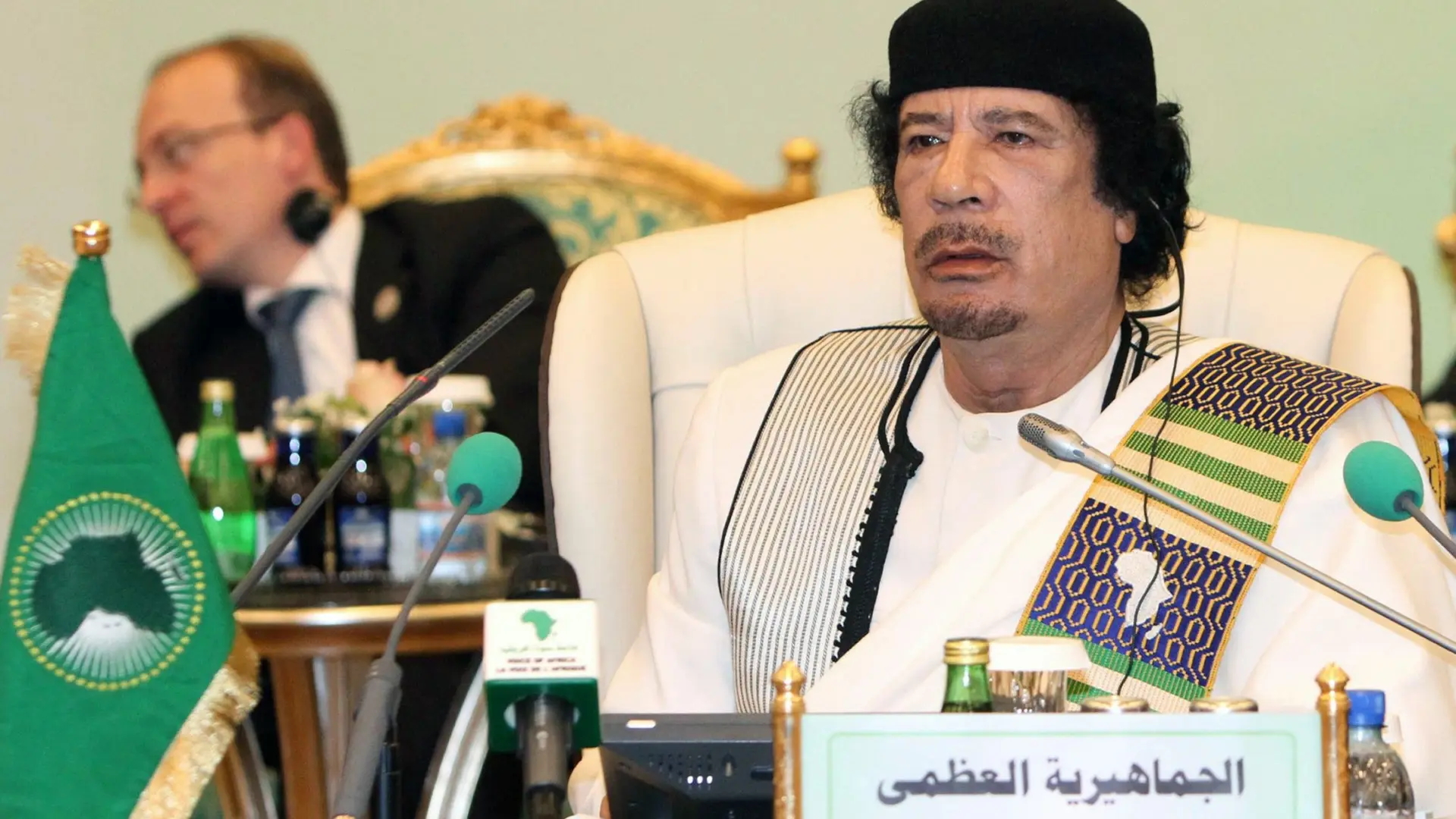
More than a decade after his death, Libya cannot decide whether it mourns Muammar Gaddafi at all. That irresolution is the shape of the problem he left behind. Gaddafi built Libya’s continental relevance around his own ideology and ran the state through personal authority, patronage and competing institutions that answered to him. When the NATO-backed uprising removed him in 2011, nothing structural replaced him, either inside Libya or in the continental role he had paid for.
Gaddafi’s relationship with the African Union was strategy, not philanthropy. He funded the AU’s operations at moments when Western donors were slow or conditional, positioned Tripoli as the gateway between sub-Saharan Africa and the Mediterranean, and used Pan-Africanism as the frame for a foreign policy that gave Libya continental influence out of proportion to its population or economic weight. The continent needed a financier. He needed an audience. The arrangement held until 2011.
A state without independent institutions
What collapsed in 2011 was not only a regime but a theory of how one North African state could act as a continental power broker. The vacuum has not been filled by successive Tripoli-based administrations, by the Libyan National Army in the east, or by the international community, which spent its intervention energy on regime change and found no appetite for the reconstruction that followed.
Inside Libya, the fracture is structural. Two governments, multiple armed factions and a coastline that has become a primary embarkation point for irregular migration towards Europe are not temporary features of a transition. Formal institutions existed under Gaddafi, but their subordination to his personal authority left them too weak to manage what followed. That legacy complicated the transition alongside decisions by domestic factions and external backers. Support from Turkish, Gulf, Russian and Egyptian actors, each with its own interests, has prolonged the fragmentation.
Regional spillover
The consequences reached far beyond Libya’s borders. The weapons depots that fell open after Gaddafi’s death, stocked over four decades of unaccountable military procurement, became supply lines for conflicts across the Sahel. Arms from those stockpiles have been traced to Mali, Niger and Sudan. The destabilisation moved with the weapons, along routes Gaddafi’s security apparatus had once controlled and that no successor government has been able to monitor.
The AU’s limits
The AU could not play the role Gaddafi had once paid for it to occupy. The organisation he championed financially became diplomatically irrelevant to his own country’s fate the moment the Western military operation began. Its call for a ceasefire was ignored by NATO and by the rebel factions NATO supported. External powers will set the trajectory of African states that have not built institutions able to resist outside pressure. An AU funded by one member’s largesse was never going to constrain the powers that removed him.
Libya now sits at the intersection of three crises: a governance deadlock its own political actors cannot resolve, a migration crisis that European states will fund border enforcement to manage but not address at its roots, and a security vacuum that has become a structural factor in Sahel instability. Each is connected to what was destroyed in 2011 and what was never built in its place.
Gaddafi was not a model of governance. His record of political repression, arbitrary detention and the systematic elimination of opposition requires no rehabilitation. But the question Libya forces onto the table is different. It is what happens to a continental order when one of its financing pillars is removed by external military force, without a plan for what replaces it. Africa is still living inside the answer, and the answer is written in the arms that crossed the Sahara and the institutions that were never built to replace a man.



