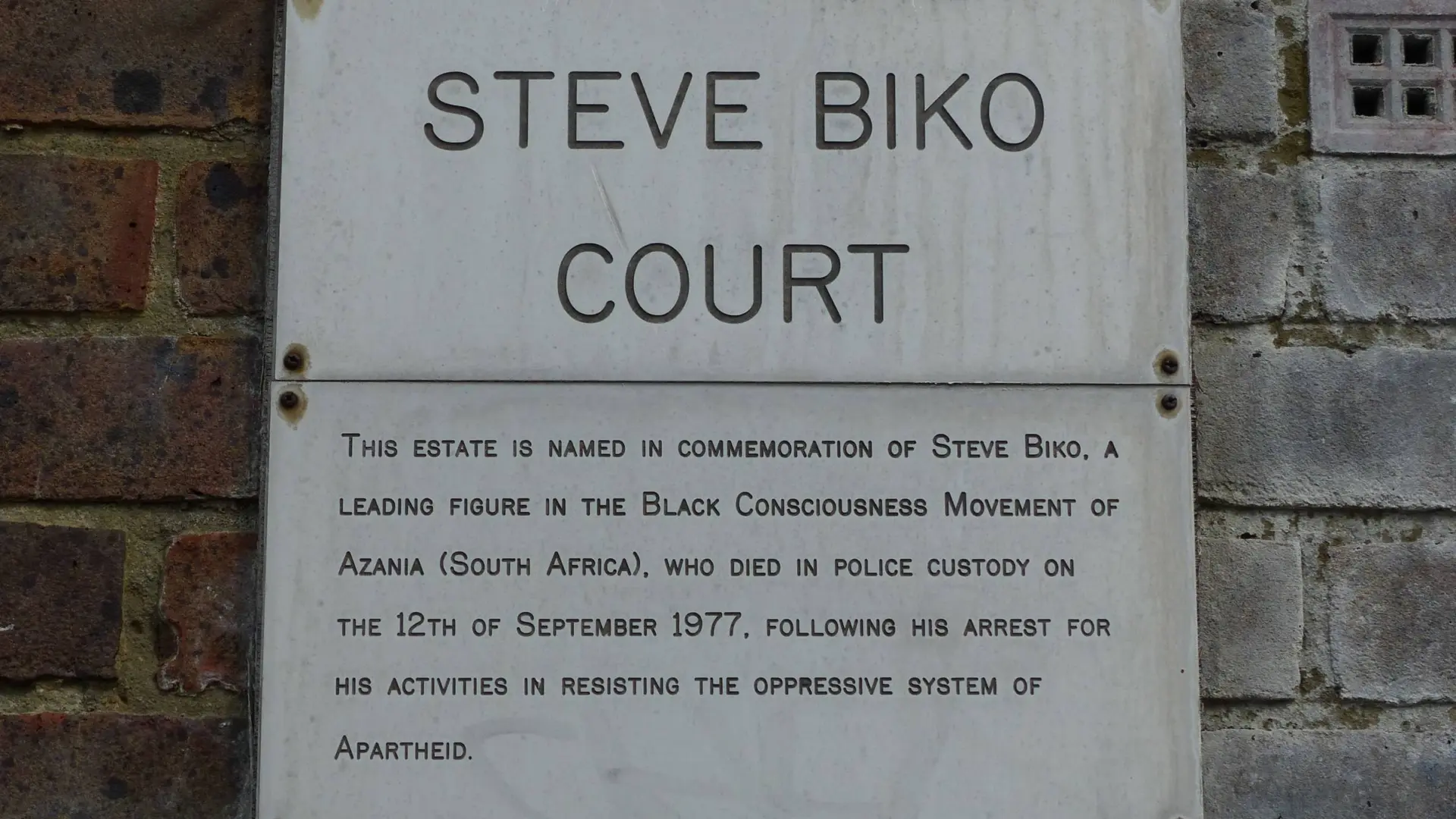
Steve Biko died in security police custody on 12 September 1977, from brain damage sustained during interrogation in Port Elizabeth. He was thirty years old, and no officer was ever charged. His death exposed what apartheid was beneath its administrative language, intensified the international pressure that produced the first mandatory UN arms embargo, and failed to silence the Black Consciousness ideas he had shaped.
Arrest and death
On 18 August 1977, Steve Bantu Biko (the man who had diagnosed apartheid’s deepest instrument as the colonised mind) was arrested at a roadblock in the Eastern Cape while travelling with Peter Jones, a fellow activist.
The context of his arrest was a state under pressure. The Soweto Uprising of June 1976 had shattered the pretence of managed apartheid, and the international isolation of South Africa was intensifying. Since 1973 Biko had been restricted to the King William’s Town district by banning orders that prohibited him from speaking publicly, writing for publication, or entering any premises where more than one person gathered. He had spent those years quietly building the Black Community Programmes, including literacy projects, health clinics and home industries. He was constructing, under the state’s nose, the infrastructure of a liberated Black South African life.
After sustaining serious head injuries during interrogation in Room 619 of the Sanlam Building, Biko was driven naked on the floor of a Land Rover for about 1,200 kilometres from Port Elizabeth to Pretoria, shackled, comatose, without medical intervention. He died in a Pretoria prison cell. Minister of Justice Jimmy Kruger, informed of his death at a Transvaal National Party congress, told the delegates that it “left him cold.” The crowd reportedly laughed.
An accountability gap
The state’s account of what happened changed several times. It settled eventually on the claim that Biko had injured himself in a scuffle. The inquest magistrate ruled that no one could be held criminally responsible. What had been done to Biko in Room 619 remained officially obscure for years, until officers who had been present gave testimony before the Truth and Reconciliation Commission. That testimony added to the public record of his detention and death, but it did not produce a criminal trial of those responsible.
The ideas that outlived him
What died on 12 September 1977 was a body. What did not die was more consequential. The writings Biko produced under his pen name Frank Talk (collected and published posthumously as I Write What I Like, edited by Aelred Stubbs) became one of the defining texts of African liberation thought. His argument was precise. The oppressor’s most durable weapon is the psychological submission of the oppressed. Freedom begins when that submission ends. The Soweto generation had already demonstrated, through its defiance under fire on 16 June 1976, that the submission was breaking. Biko’s killing, rather than closing that rupture, deepened it.
The international response was significant and, in one key dimension, precedent-setting. His death intensified international scrutiny of apartheid, alongside broader pressure for sanctions, and on 4 November 1977 the United Nations Security Council passed Resolution 418, imposing a mandatory arms embargo against South Africa, the first such embargo in UN history.
Within South Africa, the effect was not immediate revolution but a moral repositioning. The young people who had marched in 1976, many of them by then in exile, in prison or underground, carried the Black Consciousness framework with them into the next decades of struggle. Organisations like the Azanian People’s Organisation kept the tradition alive through the 1980s even as the United Democratic Front and, eventually, the unbanned ANC moved the liberation movement’s centre of gravity. The ideas did not belong to any organisation. They belonged to a generation.
Steve Biko’s death is often narrated as a martyrdom, and in the classical sense it was. But the more precise word is a revelation. His killing revealed, without ambiguity, what apartheid was beneath its administrative language and legal pretence: a system maintained by violence that tolerated no challenge to its authority over African minds. He had challenged that authority at its root. The flame he carried (the insistence that Black people did not need permission to regard themselves as fully human) could not be extinguished by the people who killed him. It is still burning.



